
General News
When Dead SIMs Died: How the NCC clean-up made Nigerian telecoms more honest

There are moments in the life of an industry when progress does not look like growth. It looks like a subtraction. It looks like pain. It looks like a sudden fall in numbers that once gave comfort to executives, investors, regulators, advertisers and the public.
That is what happened to Nigeria’s telecommunications sector after the Nigerian Communications Commission’s customer data clean-up and the implementation of the NIN-SIM linkage exercise.
Millions of mobile subscriptions disappeared from the industry’s active subscriber records. The headline was dramatic. The reactions were predictable. Some saw it as a collapse. Some saw it as punishment. Some interpreted it as weakness by affected operators. And because Globacom was the most visibly affected of the major mobile network operators, Glo became the easiest company to discuss.
But the bigger story is not only about Glo.
It is about the Nigerian telecoms industry finally moving from inflated comfort to cleaner truth. It is about MTN, Airtel, Glo and 9mobile all being forced to confront the same hard question: who exactly is an active telecom customer? Is it a SIM card printed, registered, distributed and sitting somewhere in a drawer? Is it a line that once made calls but has since gone silent? Is it a number in a database with no recent revenue-generating activity? Or is it a real, verified, reachable and commercially active customer?
This distinction matters because telecoms is no longer just about calls and SMS. Telecom identity now sits at the centre of banking alerts, digital payments, fraud investigation, social media accounts, emergency communication, mobile money, national security, customer verification, credit scoring and government planning (p. 1). In that kind of economy, a telecom subscriber database cannot be treated like a trophy cabinet (p. 1). It is national infrastructure.
That is why the clean-up was necessary.
Every maturing industry eventually goes through this type of correction. Banks clean up dormant accounts. Fintechs separate registered wallets from funded and transacting wallets. Media platforms distinguish between sign-ups, monthly active users and paying subscribers. E-commerce companies learn that app downloads are not the same as orders. Telecoms could not remain permanently immune from that discipline.
For many years, subscriber count was the loudest bragging right in Nigerian telecoms. The operator with the biggest number could claim scale, relevance and market strength. Subscriber leadership shaped headlines. It influenced public perception. It entered boardroom conversations. But the clean-up reminded the industry that not every number is equal. A verified and active customer is worth more than a dormant SIM. A smaller clean base may be more valuable than a larger contaminated one.
This was good for the entire industry.
For MTN, the clean-up reinforced the strength of a base that was already highly active and commercially deep. Its decline during the major correction was comparatively modest, which suggested that a large portion of its customer base was already aligned with the regulator’s active-subscriber definition. For MTN, the exercise was not painless, but it was validating. It confirmed the resilience of its core subscriber base and strengthened the credibility of its market leadership.
For Airtel, the correction was also useful. Airtel experienced a more visible reduction than MTN, but not a collapse. That tells a different story. It suggests that Airtel, like every mass-market operator, had to absorb the consequences of NIN-SIM enforcement and active-line validation. But it also emerged with a cleaner base and a stronger platform for data-led growth. In a market where data consumption, digital services, mobile money and enterprise connectivity are becoming more important than simple SIM distribution, a cleaner base gives Airtel more reliable intelligence for pricing, segmentation and product design.
For 9mobile, the story was more painful. Its reduction was severe, and it came on top of years of commercial and operational pressure. But even for 9mobile, the clean-up may be better understood as a forced reset rather than only a decline. A struggling operator does not benefit from carrying illusions. If the base is weak, the numbers should say so. If customers are inactive, the market should know. If the business needs recapitalisation, network renewal, repositioning or strategic rescue, clean data makes that diagnosis more honest. Painful truth is better than comforting fiction.
Then there is Globacom.
Glo’s reported reduction was the most dramatic, and because of that, it deserves the most careful interpretation. The temptation is to say that Glo “lost” tens of millions of customers. But that language may be misleading. If a line has no revenue-generating activity within the regulatory window, removing it from the active subscriber count is not the same as losing a paying customer. It is closer to removing inactive stock from a warehouse. The warehouse looks smaller after the clean-up, but the useful inventory may remain largely intact.
A telecom operator does not make money from a SIM that is not used. It does not fund network expansion from a line that generates no activity. It does not improve customer experience by pretending that dormant records are active citizens. It does not build a digital future on numbers that cannot be commercially engaged. Therefore, Glo’s headline reduction may have been more of a statistical shock than a revenue shock.
This is an important distinction.
Losing active customers is a business problem. Losing inactive records is a data correction. Losing market trust is dangerous. But gaining a clearer view of your true customer base can become a strategic advantage if handled intelligently.
For Glo, the clean-up may have provided exactly that: a clearer map. Before the correction, the company’s large subscriber number told one story. After the correction, the remaining base tells a more useful story. It shows the customers who are still active, still reachable, still capable of being served, upgraded, retained and monetised. That is the base on which a serious future can be built.
It allows the operator to ask sharper questions. Who are our real customers? Where are they? What do they use? What do they value? What can we sell to them? What service gaps are causing churn? Which customers are voice-first? Which are data-ready? Which are students? Which are traders? Which are rural? Which are urban? Which are low-income but loyal? Which are high-value but underserved?
This is how a painful regulatory exercise can become strategic clarity.
Globacom’s history makes this even more interesting. Glo has never been just another telecom operator (p. 3). It entered the Nigerian market with a disruptive spirit. It helped democratise telecom pricing. It gave Nigerians a stronger sense that access to communication did not have to be reserved for the privileged. Its early challenge to established pricing structures shaped public expectations. Later, with investments such as Glo-1, the company demonstrated that a Nigerian-owned telecom operator could participate in deep digital infrastructure, not merely retail SIM sales.
That history matters because it suggests that Glo’s value cannot be measured only by a subscriber ranking table. Glo has always represented something larger: affordability, competition, indigenous ambition and mass-market access.
This is why the post-clean-up conversation should be more generous. Being the most affected by a data correction is not necessarily the same as being the most damaged by it. Sometimes the operator with the widest mass-market footprint carries the greatest exposure to irregular usage, multi-SIM behaviour, dormant lines and incomplete identity journeys. Sometimes the company that served the broadest base must absorb the sharpest statistical correction when definitions become stricter. That is not a reason to celebrate the fall. But it is a reason to interpret it carefully.
The clean-up also created benefits that cut across all operators.
First, it improved regulatory credibility. Nigeria now has a more realistic view of active telecom participation. That matters for policy, investment, national broadband planning, infrastructure deployment, emergency response, digital identity and financial inclusion.
Second, it improved commercial discipline. Operators can no longer hide behind inflated totals. MTN, Airtel, Glo and 9mobile must now compete around active usage, data quality, service experience, customer retention, infrastructure strength and innovation. That is better for consumers.
Third, it strengthened national security and digital trust. SIM cards linked to unverifiable or inactive identities create risks. Cleaner subscriber records help reduce fraud, improve traceability and support lawful investigations. In a country battling identity fraud, cybercrime and financial scams, this is not a minor benefit.
This is why the clean-up should not be seen as a punishment of the industry. It should be seen as preparation for the next phase of the industry.
For MTN, it confirms the depth of its active base and strengthens the credibility of its leadership. For Airtel, it provides a cleaner foundation for continued data and digital-service expansion. For 9mobile, painful as it is, it reveals the scale of the turnaround required and removes the comfort of unclear numbers. For Glo, it creates perhaps the most dramatic opportunity of all: to move from the old battle for subscriber-count prestige to a new battle for verified value.
The question now is what Glo does with this moment.
If Glo merely tries to recover old numbers for the sake of optics, it may miss the opportunity. But if it uses the clean-up to rebuild around real users, improve network quality, deepen data adoption, simplify reactivation, strengthen youth and mass-market engagement, and reposition itself as the operator of inclusive digital value, the exercise may one day be seen as a strategic reset.
A smaller honest base can be powerful. It is easier to understand. Easier to serve. Easier to upgrade. Easier to monetise. Easier to protect. Easier to build around. In an industry moving into 5G, fibre, cloud connectivity, streaming, digital financial services, artificial intelligence and enterprise solutions, truth is more useful than exaggeration.
Nigeria should welcome that.
The NCC clean-up did not mean Nigerians stopped needing telecoms. It meant the industry had to stop counting uncertainty as activity. It did not mean every affected operator had failed. It meant the market was being forced into a cleaner era. It did not mean Glo had lost its future. It may mean Glo now has a clearer view of where its real future lies.
The public may remember the dramatic fall in numbers. But the industry should remember the deeper lesson: clean data is not an enemy of growth. It is the foundation of sustainable growth.
In the end, the NCC exercise was not merely a clean-up of SIM cards. It was a clean-up of assumptions.
And for MTN, Airtel, Glo, 9mobile, the regulator, the government, investors and consumers, that is a good thing.
For Globacom especially, the story may be even more profound. The company may have lost a headline position, but it may also have gained a strategic mirror. What it sees in that mirror — and what it chooses to build next — may determine whether this moment is remembered as a fall or as the beginning of a smarter, cleaner and more valuable Glo.



General News
Benue Bishop Shuts Schs, Hospital, Parish In Alia’s Community Says “Church Cannot … Expose Priests, Students To Danger”

By Felix Umande
The Catholic Bishop of Gboko, Most Rev. William Avenya, has ordered the indefinite closure of four Catholic institutions in Ihugh, Benue State, and withdrawn pastoral agents following repeated attacks, arson and insecurity.
The decision, contained in a letter and decree dated October 12, takes immediate effect and affects St. Winifred Secondary School, St. Winifred Nursery and Primary School, St. Thomas Hospital, Salus Mind Care Center and St. Winifred Parish, Ihugh.
In the pastoral letter, Avenya described the withdrawal as painful but necessary to protect lives, stressing it was not motivated by anger or retaliation.
“The Church cannot, in conscience, continue to expose her Priests, Consecrated Persons, Teachers, Medical personnel, Students and Patients to danger,” he said.
The bishop cited repeated disturbances including the burning of student hostels at St. Winifred Secondary School on October 28, 2025, May 10 and 15, 2026, and October 11, 2026, recurrent burglaries at St. Winifred Parish and criminal incidents at St. Thomas Hospital. He recalled that during the reopening of the hospital on June 21, 2024, some persons displayed placards and chanted slogans demanding that Reverend Sisters leave Ihugh.
Avenya said the Diocese had engaged the host community, traditional rulers, elders and security authorities to find lasting peace, but without security guarantees.
The decree directs the withdrawal of priests, consecrated persons, catechists, pastoral workers and lay mission partners, while teaching and non-teaching staff, medical personnel and administrators are to be redeployed through appropriate diocesan offices.
It also orders safeguarding of diocesan property, transfer of parish registers and archives to the diocesan archives, and reverent removal of the Blessed Sacrament, sacred vessels and other sacred objects under supervision.
The bishop said arrangements would be made to minimise impact on students, patients and staff. Students are to be assisted to continue education in other Catholic schools in the Diocese, while patients at St. Thomas Hospital will be referred to other facilities, especially those needing urgent care. Affected staff, he said, would be treated with justice and charity.
Addressing Catholics in Ihugh, he declared:
“To our Catholic faithful in Ihugh: do not lose heart. Your Baptism is not lost with a building, nor is your faith diminished by the closing of a door.”
He appealed to community leaders, traditional rulers, youth leaders, government and security agencies to restore peace and ensure perpetrators are brought to justice, adding that return is conditional on genuine repentance, restitution and credible assurances of safety.
“This decision is a painful one, but it is not a final farewell,” he said.
Avenya called for intensified prayers for peace and designated Friday, October 23 as a day of prayer and fasting for peace and reconciliation.
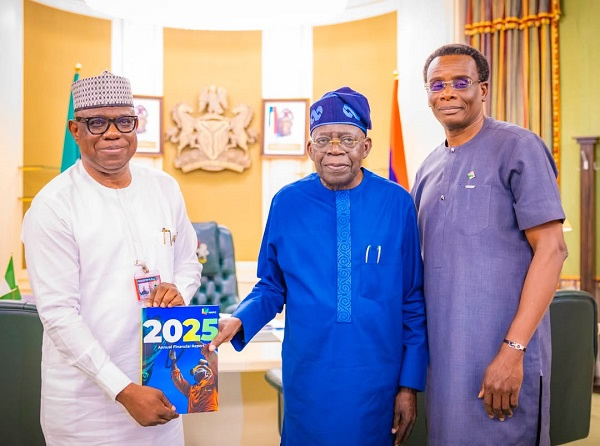
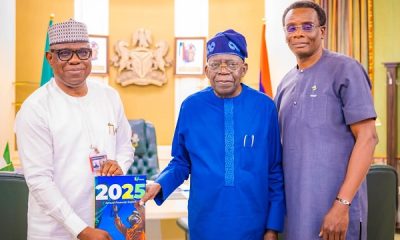
Group Chief Executive Officer, NNPC Limited, Engr. Bashir Bayo Ojulari, today at the Presidential Villa in Abuja, presented the Company’s 2025 Audited Financial Statement (AFS) to President Bola Ahmed Tinubu, GCFR.
Ojulari, who was accompanied by the Company’s Group Chief Finance Officer (CFO), Dapo Segun, presented the statement, which delivered impressive results that include ₦7.2 Trillion Profit After Tax (a 33% rise compared to ₦5.4 Trillion in 2024), ₦5.8 Trillion dividend and ₦34.5 Trillion revenue.
On 29th September, 2026, NNPC Ltd announced its audited results for the year ended 31 December 2025, following its Annual General Meeting and second Earnings Call with financial and business analysts.
The results highlight the Company’s growing earnings strength and improved operational performance, laying the foundation for future growth.

The National Chairman of the Nigerian Institution of Marine Engineers and Naval Architects (NIMENA), Dr. Eferebo Sylvanus has been honoured with the Maritime Innovation and Technology Leadership Award at the 15th Democracy Heroes Award Africa.
Eferebo received the honour at the ceremony held at the weekend at the Transcorp Hilton, Abuja, in recognition of his professional leadership and contributions to marine engineering, naval architecture and maritime technology.
The award comes amid growing calls for Nigeria to harness its maritime resources through indigenous expertise, technological advancement and research-driven industrial development.
The Democracy Heroes Award Africa, now in its 15th edition, recognises individuals making contributions across different sectors.
Eferebo’s recognition places a spotlight on a specialised but strategically important profession whose impact extends beyond engineering into industrial development and the wider blue economy.
As Nigeria continues to explore new opportunities in maritime trade, offshore energy and shipbuilding, the challenge will be ensuring that professional recognition is matched by sustained investment in research, infrastructure, training and the practical application of homegrown technology.
With more than two decades of experience in engineering consultancy and technical leadership, Eferebo leads NIMENA, a professional body committed to advancing marine engineering through research, education, technical standards and industry collaboration.
His academic background includes a Bachelor of Technology in Marine Engineering, a master’s degree in Naval Architecture and Ship Construction, and a doctorate in Naval Architecture and Shipbuilding from Rivers State University, Port Harcourt.
He is also a Fellow of the Nigerian Society of Engineers and a registered engineer with the Council for the Regulation of Engineering in Nigeria (COREN).
Beyond his professional credentials, Eferebo has built a career around developing technical solutions for Nigeria’s maritime and offshore industries.
He is the founder and chief executive officer of Somatrix Marine Limited, an engineering consultancy involved in marine consulting, ship design, marine surveys, construction management and research and development.
His leadership extends to engineering regulation and policy development, including work on maritime engineering standards and local content development.



Benue Bishop Shuts Schs, Hospital, Parish In Alia’s Community Says “Church Cannot … Expose Priests, Students To Danger”
Spread the loveBy Felix Umande The Catholic Bishop of Gboko, Most Rev. William Avenya, has ordered the indefinite closure of...

President Tinubu Receives NNPC’s 2025 Audited Financial StatementBy Aliyu Musa
Spread the loveGroup Chief Executive Officer, NNPC Limited, Engr. Bashir Bayo Ojulari, today at the Presidential Villa in Abuja, presented...


NIMENA chair, Sylvanus receives tech leadership awardBy Philip NyamAbuja
Spread the loveThe National Chairman of the Nigerian Institution of Marine Engineers and Naval Architects (NIMENA), Dr. Eferebo Sylvanus has...


SDP crises: Court strikes out criminal case against Shehu Gabam
Spread the loveBy Saint Mugaga A Magistrate Court in the Federal Capital Territory (FCT), Abuja, has struck out a criminal...


Wike Orders Removal of Illegal Structures, Stops Unauthorised Commercial operations
Spread the loveBy Isa Abdul, Abuja Wike has ordered the immediate enforcement of operations against unauthorised commercial activities and illegally...


Benue Govt Closes Two Schools in Makurdi Over Textbook Sales Violation
Spread the loveBy Vincent Tyosuugh Two academic institutions, Orenda Opal Schools have been closed by the Benue State Government over...

Only Deaf, Dumb, and Blind Can Tell Us He’s not Hearing the Truth About Nigerians’ Suffering –Cardinal Onaiyekan
Spread the loveBy Son Tertsea, Abuja Cardinal John Onaiyekan has explained why the reactions to his interview with Arise TV’s...


Nigeria Fighting Cervica Cancer: 18 Million Girls Vaccinated
Spread the loveBy Nick Ibe, Abuja In its intensified efforts to eliminate cervical cancer in Nigeria, the Federal Government said...


Bauchi Govt: Minimum Pension Now N32,000, Pays Gratuities To 2012, 2013 Retirees
Spread the loveBy Michael Lim As part of effort to reduce the huge backlog of gratuities, the Bauchi State government...


Nigeria’s Overall Best Teacher From Ogun Shows: Where You Start in Life Does Not Matter
Spread the loveBy Seyi Balogun, Lagos The emergence of Nigeria’s Overall Best Teacher for 2026 at the Federal Government’s President’s...