
General News
Nigerians’ Loss of Human Values Deeply Troubling Realities

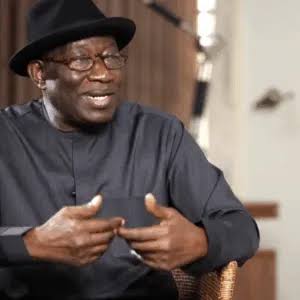
–Goodluck Jonathan
By Son Tertsea, Abuja
Former President Goodluck Jonathan has expressed deep worry that Nigeria is fast seeing killings, destruction of communities and property as normal while speaking on Saturday at the first session of the 13th Synod of the Anglican Diocese of Abuja held at St James’ Anglican Church, Asokoro, with the theme “The Priesthood of All Believers: Equipping God’s People for the Work of Ministry.”
He called for national reflection, spiritual renewal and responsible leadership amid the country’s worsening social and security challenges.
“When we look around today, particularly at the challenges confronting our country, it is easy to become discouraged. Violence, insecurity, moral decline, and the loss of human values have become deeply troubling realities.
“What is even more painful is how society sometimes appears to normalise these tragedies as though they are ordinary occurrences. In times past, such incidents would shake the conscience of the nation.
“Today, people are killed, communities are destroyed, and life seems to continue as though nothing has happened. This ought not to be so. It is a reminder that society desperately needs moral direction, spiritual guidance, and a restoration of values.”
The ex-president however stressed that the Church remains crucial in shaping society and upholding moral standards, which is why religious leaders should continue speaking the truth and defending righteousness.
He equally warned about the growing influence of negative values through technology and modern information systems.
“That is why the role of the Church remains indispensable. The Church must continue to stand as the conscience of society, speaking truth, defending righteousness, and shaping lives through faith and godly example.
“The influence of modern technology and information systems, though beneficial in many ways, has also contributed to the spread of negative values where wrong is sometimes celebrated more than good. This is not the future we should desire for our children and generations yet unborn.”
The former President emphasised the importance of integrity and courage in public service: “Permit me to also say that leadership matters greatly in moments like this. Society progresses when men and women of integrity, courage, and vision stand in the right places and speak the truth. We must continue to pray for our leaders, encourage one another, and work collectively for peace, justice, and national renewal.”
He expressed appreciation to the organisers for the invitation and prayed for God’s continued guidance upon the Church and the nation.
In his presentation at the event, the Archbishop, Metropolitan and Primate of All Nigeria, Anglican Communion, Henry Ndukuba, counseled the Chairman, Independent National Electoral Commission, INEC, Professor Joash Amupitan, and his Resident Electoral Commissioners to demonstrate neutrality in the forthcoming 2027 Presidential and general elections, while encouraging Nigerians, especially Christians, to participate actively in politics and nation-building.
Ndukuba further criticised those in leadership positions for focusing more on power struggles ahead of the 2027 elections instead of governance and citizens’ welfare. He also condemned the persistent weaponisation of ethnicity and religion as major drivers of insecurity across the country even as he took a swipe at the huge borrowing by the Federal Government, saying that the public debt profile of N159. 28 trillion is worrisome.
The bishop condemned the unstable electricity supply, and the management of crude oil resources while calling for transparency and policies that would directly benefit citizens, adding that Nigeria is bleeding following repeated cases of terrorism in the country. He also condemned Nigerians’ multidimensional poverty, as government macro gains have not reached the citizens on the streets.
He added “Crude Oil Politics: Global oil prices have spiked due to the Iran-US-Israel conflict, pushing up the costs of goods and services in Nigeria. Unlike other oil producers, Nigeria has not benefited from the windfall because of the regime of her pre-sold crude. Secondly, one considers that the politics surrounding Crude Oil sales and Dangote’s Refinery should be handled in the interest of Nigerians. Thirdly, the recent handover of the National Refineries to China must be reconsidered so that some are given to competent Nigerians who will plough back their gains into Nigeria, rather than allow China to loot our oil, as they have done in the Solid Minerals sector.”
He further condemned the continued killings, attacks, and displacement of communities in different parts of the country, especially Plateau State, Benue State, Kaduna State, and others.
But quoting from Scripture, he concluded, “Fear not, for I am with you; be not dismayed, for I am your God,” while urging citizens to continue praying and working for national peace and unity.
In his welcome address, Former Primate of the Church of Nigeria, Nicholas Okoh, called on Christians and Church leaders to remain committed to God’s purpose despite the challenges facing society, urging Christians to continue praying for leaders and to take part responsibly in national affairs, especially in elections.
On his part, former Primate of the Church of Nigeria (Anglican Communion), Peter Akinola said “It is evident that our foreign delegates departed with a far better impression of Nigeria, contrary to the negative narratives often projected by sections of the foreign media about our beloved nation.
General Yakubu Gowon, Jonathan, Ambassador Godknows Igali and other prominent Christian leaders, bishops, clergy, and delegates from different parts of the country attended the event.

By Isa Abdul
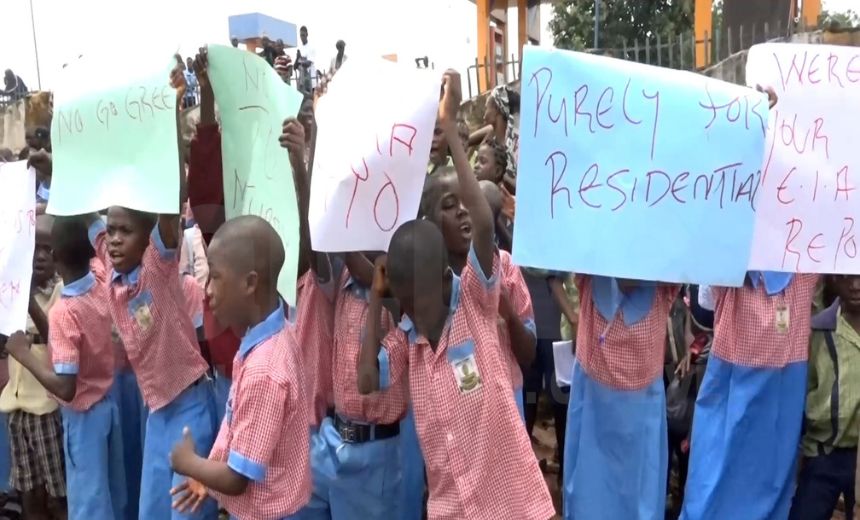
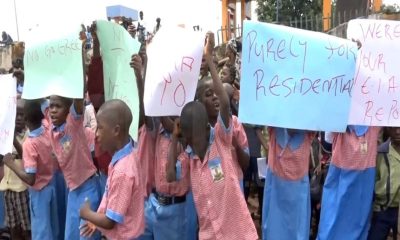
The construction of an alleged mortuary close to public school and residential buildings has been protested against by the residents of Agbeji Community in Dekina Local Government Area of Kogi State.
The protesters who carried placards on Tuesday cite health and environmental concerns, even as the landowner insists he has the right to develop the property.
One of the protesters, who spoke on camera said they are not against someone’s business but their worry is the location of the mortuary near residential buildings and a public school.
But the landowner who identified himself as Alh. Rilwan Okobomude, disagrees, insisting the property is his and that he has the right to develop it, while pledging to comply with relevant regulations.
In an interview with News Central, monitored in Abuja, the land owner talked about building the mortuary for the hospital.
But it is not clear why he’s building a mortuary before the hospital.
General News
Benue Govt Gives 2-Week Ultimatum To Owners Of Illegal Billboards, Threatens Mass Removal
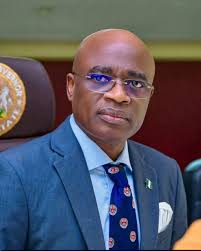
By Felix Umande
The Benue State Government has decried the arbitrary erection of billboards across the state by individuals, groups and political parties without approval, warning that all unauthorised structures will be pulled down after a two-week grace period.
In a joint statement issued on Tuesday, October 6, 2026, by the Benue State Signage and Advertisement Agency, the Benue State Internal Revenue Service, BIRS, and the Urban Development Board, the government said the billboards were erected without permit, without clearance and without payment of prescribed fees.
The agencies said the practice breaches the law, deprives the state of legitimate revenue, endangers public safety and undermines orderly urban development.
The statement, signed by the Commissioner for Information and Orientation, Hon. Chief Solomon Iorpev, however, said government was prepared to assume that many offenders acted out of ignorance rather than deliberate defiance.
Consequently, owners and operators of unauthorised billboards have been given two weeks, beginning Tuesday, October 6, 2026, to regularise their structures.
Within the window, they are required to approach the Benue State Signage and Advertisement Agency to begin the permit process, obtain clearance from the Urban Development Board, and pay all required fees.
The government warned that enforcement will commence on Tuesday, October 20, 2026, with no further notice.
“Enforcement teams are expected to begin the removal of every billboard that has not been regularised from the set date. Billboards taken down will be at the owners’ cost. Anyone who ignores this window should expect no sympathy and no exception, regardless of status, affiliation or political party,” the statement said.
It described the grace period as a sign of government’s goodwill and preference for compliance over confrontation, urging all concerned to use the window.
For further clarification, the government advised the public to contact 09034345007.
–Tells Editors: “remain primary filter against information disorder.”
By Son Tertsea, Abuja
The Independent National Electoral Commission (INEC) has set in motion a financial monitoring mechanism, in conjunction with anti-graft and financial intelligence agencies, to fish out those embarking on illegal campaign spending.
This was one of the INEC Chairman, Prof. Joash Amupitan’s, disclosures on Monday in Abuja while delivering a keynote at a strategic workshop with media executives organised by the Nigerian Guild of Editors (NGE) in collaboration with the commission.
INEC chairman also disclosed that the number of registered voters has risen to more than 103 million.
In addition, INEC said, it has acquired 57,000 new Bimodal Voter Accreditation System (BVAS) machines as part of measures to strengthen the technological infrastructure for the 2027 elections.
Its target, according to the body, was to commence voting simultaneously across all polling units nationwide during the 2027 elections.
INEC’s collaboration with the Economic and Financial Crimes Commission (EFCC), Independent Corrupt Practices and Other Related Offences Commission (ICPC) and the Nigerian Financial Intelligence Unit (NFIU), he said, was to monitor campaign financing and identify suspicious expenditure with s view to preventing money from undermining the credibility of the elections.
In Amupitan’s view, the teams will track illegal campaign spending, strengthen surveillance around polling units to detect attempts to influence voters through financial inducements.
He warned political actors that violators of the Electoral Act would attract arrest and prosecution, adding that elections must be decided by the conviction of the voter, not the depth of a candidate’s pocket.
The chairman disclosed that the three-phase National Register of Voters had produced 10,772,421 new voters, with 2,611,266 in the first phase, 4,121,835 in the second phase and 3,867,997 in the third phase, respectively. But the fugure is subject to final verification, completing eight of the 14 major statutory activities contained in its timetable for the 2027 elections.
The electoral umpire added that the final Automated Biometric Identification System (ABIS) cleanup was complete, and the preliminary register was displayed for claims and objections. In his words:
“In line with Section 10 of the Electoral Act 2026, the first phase of the CVR commenced on August 25, 2025 and ended on December 10, 2025, registering 2,611,266 voters; Phase II commenced on January 5, 2026, and ended on April 17, 2026, registering 4,121 ,835 voters; and Phase Ill commenced on May 11, 2026 and ended on July 26, 2026, registering 3,867,997 voters. The total new registration stands at 10,772,421, subject to the ABIS verification being concluded.”
Amupitan revealed that the commission had drawn lessons from recent off-cycle elections and would improve its logistics, personnel and technology ahead of the 2027 polls.
The commission further warned political parties, candidates and campaign managers against violence, intimidation and hate speech and other vices ahead of the 2027 general elections.
The commission, through the Inter-Agency Consultative Committee on Election Security (ICCES), he said, had activated an early-warning framework to monitor political violence, thuggery and dangerous campaign rhetoric.
Amupitan called editors, the “bridge in an era of information chaos”, to work with INEC to build a public space of verified information, civic responsibility and institutional trust. In his words:
“When newsrooms prioritise factual accuracy over sensational headlines, when reports contextualise field logistics rather than default to inflammatory speculation, and when information is verified before publication, you perform a sacred public service. You act as the primary filter protecting our democracy against information disorder.”
In his submission at the event, President of the Nigerian Guild of Editors (NGE), Eze Anaba, canvassed for a credible and transparent electoral process that would give voters, rather than the courts, the outcome of elections.
He said: “Elections were not merely about casting ballots but about building citizens’ confidence that their votes would count and that institutions responsible for conducting elections would act fairly and professionally.”
To Akingbulu, verification was a two-way process, arguing that newsrooms could not properly verify information that institutions failed to disclose.
Warning against deepfakes, fabricated campaign materials and other forms of manipulated content, saying such developments could undermine public confidence in the electoral process.
The Executive Director of the International Press Centre (IPI), Lanre Arogundade, stressed the importance of timely and transparent communication from INEC.


How FG’s Docility and FIFA’s Compromise on Mpasi Conspired Against Nigeria’s 2026 W’Cup Qualifier– Report
Spread the loveThe apex world soccer’s governing body, FIFA, knew that the Democratic Republic of Congo fielded an ineligible player...

Kogi Community Protests Building of Mortuary in Residential Area.
Spread the loveBy Isa Abdul The construction of an alleged mortuary close to public school and residential buildings has been...

100 Days To 2027 Polls: INEC Vows Neutrality, Says BVAS, Ballots Ready
Spread the loveBy Felix Umande The Independent National Electoral Commission, INEC, has assured Nigerians and the international community of its...


THE LAST TANGO: Tears, Tributes and A Final Goal As Messi Bows Out After 21 Years
Spread the loveBy Felix Umande Emotions ran high at the Estadio Monumental on Tuesday night as Lionel Messi signed off...

Church’s Duty to Empower Individuals, Create Opportunities and Improve Family’s Economic Well-being
Spread the loveBy Seyi Balogun, Lagos The need for the Church’s commitment to empowering its members through employment opportunities, entrepreneurship...

Taraba Explores ADR for Sustainable Peace Between Crop, Livestock Farmers
Spread the loveBy Michael Lim Conflict prevention between livestock farmers and host communities in Taraba State through the promotion of...

Financial Inclusion: Kwara Buys Dangote Refinery Shares For Female Teachers
Spread the loveBy Michael Lim Kwara State Government has announced plans to buy shares in the Dangote Refinery Initial Public...

Benue Govt Gives 2-Week Ultimatum To Owners Of Illegal Billboards, Threatens Mass Removal
Spread the loveBy Felix Umande The Benue State Government has decried the arbitrary erection of billboards across the state by...


INEC Tracking Illegal Campaign Spending
Spread the love–Tells Editors: “remain primary filter against information disorder.” By Son Tertsea, Abuja The Independent National Electoral Commission (INEC)...


Importers, Petroleum Marketers Kick Against Dangote’s Restriction of Petrol Sales
Spread the loveBy Seyi Balogun Major marketers have kicked against Dangote Petroleum Refinery’s non sale of Premium Motor Spirit (petrol)...