
General News
NDLEA Nets 67 Woman with Cocaine in Fake Plantain Peels

Nick Ibe
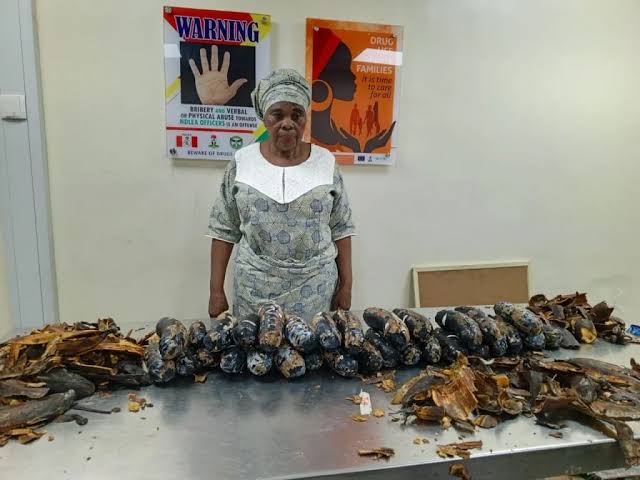
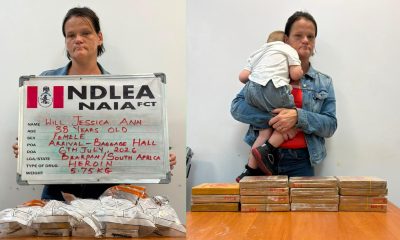
The National Drug Law Enforcement Agency, NDLEA, has arrested a 67-year-old Nigerian-British grandmother, Mrs Mary Barek, for allegedly attempting to smuggle 13 kilograms of cocaine concealed in fake plantain peels through the Murtala Muhammed International Airport, Lagos.
The agency stated that the suspect, who works as a caregiver in the United Kingdom, was arrested at the departure hall of Terminal 2 of the airport on Saturday, June 28, while attempting to board a Virgin Atlantic flight to London.
According to a statement on Sunday by the NDLEA Director of Media and Advocacy, Femi Babafemi, a thorough search of the suspect’s luggage led to the discovery of 31 large wraps of cocaine disguised as hands of plantain and packed alongside other food items.
Babafemi stated, “A thorough search of her bags resulted in the discovery of 31 big wraps of cocaine, which were packaged to appear like hands of plantain, weighing a total of 13 kilograms.
“In her statement, the elderly woman admitted full ownership of the recovered cocaine exhibits.”
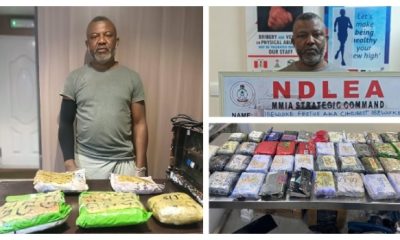
NDLEA spokesman also announced the arrest of a 45-year-old PhD student at the University of Putra Malaysia, Nwabueze Felix Onyeka, over an attempt to export cocaine concealed inside cartons of Orijin Bitters bound for Kuala Lumpur.
Babafemi said Onyeka was arrested in Ekwusigo Local Government Area of Anambra State on June 29 after investigators traced him as the alleged leader of a drug trafficking syndicate.
He disclosed that operatives had earlier intercepted 36 parcels of cocaine weighing 5.80 kilograms hidden within the walls of nine cartons of the herbal drink that formed part of a consolidated cargo destined for Malaysia.
According to him, four suspects were initially arrested in Lagos during the investigation, including the cargo agent, Alalade Taiwo Azeez; the driver who conveyed the consignment, Ndem Ogbonna Kelechi; a trader at ASPANDA Market, Trade Fair Complex, Okeke Tochukwu Chimezie; and Igwilo Chidi Henry, who allegedly supplied the cartons used to conceal the drugs.
Babafemi noted, “The efforts eventually paid off, leading to the unmasking of Nwabueze, who was hiding in his village, Aziora, Ozubulu, Anambra State, as the leader of the syndicate.”
In Taraba State, the NDLEA said its operatives arrested a 30-year-old suspect, Daniel Harrison Ugwuoke, along the Zaki-Biam Road in Wukari Local Government Area on Saturday, July 4.
The agency said 43,980 capsules of Tramadol were recovered from two vehicle fuel tanks specially modified to conceal the drugs.
Similarly, NDLEA operatives arrested Boniface Agu, 65, and Monday Nwaeze, 50, during a raid in Gwantu Local Government Area of Kaduna State on July 2, where they allegedly recovered 1.7 kilograms of methamphetamine.
In Ebonyi State, a 65-year-old suspect, Francis Ifara Eja, was arrested with 231.7 kilograms of skunk at Ikwo on July 4, while a 75-year-old suspect, Alhaji Babani, was apprehended with 15 kilograms of skunk at Kurgwi in Qua’anpan Local Government Area of Plateau State on July 3.
The agency also reported that two suspects, Dahiru Mohammed, 65, and Isiya Lawan, 36, were arrested in Gombe State on July 1 with 587 blocks of cannabis sativa weighing 556 kilograms at Kuri Village in Yamaltu-Deba Local Government Area.
Beyond enforcement operations, the NDLEA said its commands nationwide sustained the War Against Drug Abuse campaign through sensitisation programmes in schools, workplaces, worship centres, and communities.
According to Babafemi, the awareness activities were conducted at Girls Secondary School, Abagana, Anambra State; Government Technical College, Obe, Enugu State; Adeola Odutola College, Ijebu Ode, Ogun State; and the FCE Staff Demonstration School, Kabuga, Kano State, among other locations.
Commending officers involved in the recent operations, the Chairman and Chief Executive Officer of the NDLEA, Brig. Gen. Mohamed Buba Marwa (retd.), praised the commands for combining enforcement with public enlightenment.
Babafemi quoted Marwa as saying he “commended the officers and men of MMIA, Taraba, Kaduna, Ebonyi, Plateau, and Gombe Commands for the arrests and seizures,” noting that “their drug supply reduction efforts, balanced with WADA sensitisation activities,” while charging them and other officers across the country to continue to raise the operational bar.




–Mexican cartels turning Nigeria into meth hub – US
By Nick Ibe, Abuja
Mexican drug cartels now under pressure from the United States in the Western Hemisphere are turning to Africa for alternative routes for trafficking synthetic drugs, the American government has warned.
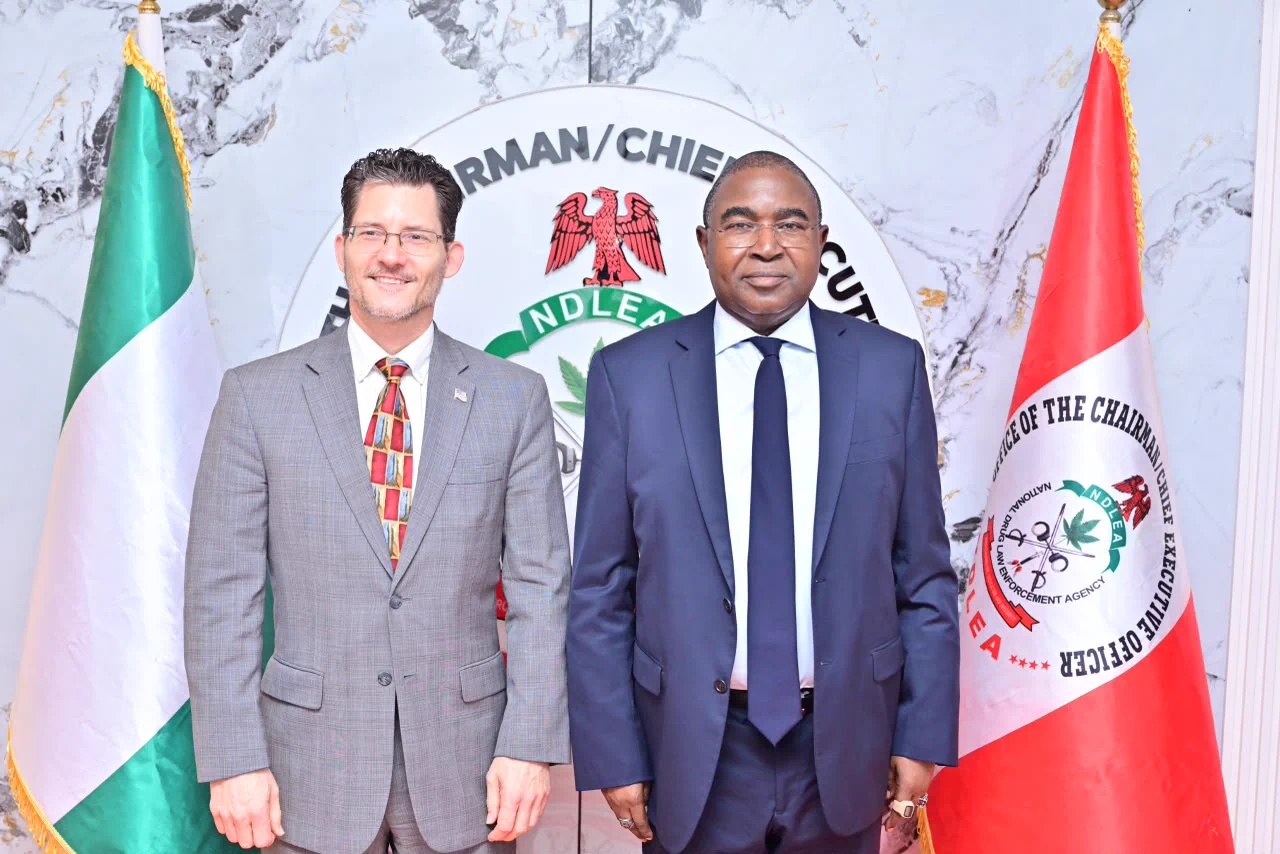
Michael Gonzales, the US Deputy Assistant Secretary of State for International Narcotics and Law Enforcement Affairs for Africa and the Middle East, has said the National Drug Law Enforcement Agency’s, NDLEA, operations with four meth labs dismantled in Nigeria this year, demonstrated the importance of Nigeria’s counter-narcotics campaign. He said this is important to both countries, as Washington intensifies pressure on cartels operating in the Western Hemisphere.
Gonzales spoke on Tuesday during a visit to the NDLEA headquarters in Abuja, where he commended the agency for its operational successes, saying he chose Nigeria as his first visit after assuming office because of the country’s strategic importance and the NDLEA’s record. In his words:
“I became the Deputy Assistant Secretary of State for International Narcotics and Law Enforcement just four months ago, covering all countries of Africa and the Middle East. And when I was thinking where it makes the most sense to visit first, Nigeria was a clear answer.
“Because as a leader, as an economic powerhouse on the continent, but also particularly NDLEA for the leadership and the impressive wins that you and your team and your interagency counterparts have delivered time and again.
“In addition to the very robust partnership between INL and NDLEA, I wanted to see firsthand where the magic happens, as we say in the United States.”
Gonzales specifically cited the four methamphetamine laboratory busts recorded by the NDLEA this year as evidence of the agency’s use of intelligence-led investigations, inter-agency cooperation, operational coordination and prosecution.
“The four meth lab busts just this year alone are a testament to the deployment of some of the best practices in our tradecraft, the intelligence-based knowledge collection, the coordination across national lines and agency lines, the operational excellence that goes into the actual bust, and then the interrogations, the investigations and prosecutions.
“They’re all so critical because ultimately counter-narcotics work, the work that each of us does day in and day out, truly delivers for the people,” he said.
The US official said the significance of the operations extended beyond Nigeria, arguing that the international nature of the narcotics trade meant that successful interdiction in Nigeria could have consequences for drug markets in other parts of the world.
“When I am talking to American audiences in the United States, I tell them there’s virtually no other issue of foreign policy that so tangibly affects the lives of every community, virtually every family across our country, than narcotics.
“And the reality of the narcotics trade is international. It knows no boundaries, very few constraints. And so, the work that INL does in the United States and globally and the work that NDLEA does fundamentally delivers for the Nigerian people, for the American people,” Gonzales said.
He added that the United States had more than four decades of experience supporting counter-narcotics operations around the world, including through training and equipment, and warned that changes in trafficking patterns required countries to work together against criminal networks.
He said intense US pressure on cartels in the Western Hemisphere was effectively “squeezing a balloon,” forcing traffickers to seek alternative routes through Africa to reach markets in Europe and beyond.
The official also pointed to the growing shift from plant-based narcotics to synthetic drugs, which he described as harder to detect and potentially deadlier, saying the response must target criminal organisations as interconnected networks, including their financial flows.
Marwa, in his response, said the NDLEA’s recent operations had uncovered what he described as a deliberate attempt by Mexican cartels to establish Nigeria as a manufacturing base for methamphetamine.
“Crime has no borders, and neither does the threat. The drugs we seize, the arms we intercept and the terrorist financing we trace are not separate problems.
“When we seize narcotics and illicit weapons in the same operations and along the same routes, we are looking at the convergence of crime. Drug money buys guns, guns sustain armed groups, and armed groups sustain terrorism.
“Terrorism has no borders. What festers in the Sahel and the Lake Chad Basin does not stay there, and what is trafficked through West Africa does not stop at our coastline,” the NDLEA chairman said.
Marwa then detailed the operations against the laboratories, beginning with the largest clandestine methamphetamine laboratory ever discovered by the agency in Nigeria.
“The Mexican cartel threat is real, and we are confronting it.
“In recent months, NDLEA operatives dismantled the largest clandestine methamphetamine laboratory ever discovered in Nigeria, in a forest in Ijebu East, Ogun State, where we arrested three Mexican meth experts and their Nigerian collaborators right in the forest where illicit substances worth over $360 million US dollars were recovered.
“Barely four weeks later, we raided another industrial-scale laboratory at Tapa Village in neighbouring Oyo State and arrested a Mexican methamphetamine expert, brought in for large-scale synthesis, together with four Nigerian collaborators.
“We have since dismantled a similar facility in Enugu State and another in Ebonyi State, South-East Nigeria, all linked to the Mexican cartels. These were not isolated incidents. They show a deliberate attempt to turn Nigeria into a manufacturing hub,” he said.
Marwa said the implications of the laboratories went beyond the Nigerian market, arguing that the cartels were seeking routes through West Africa to move methamphetamine to international markets.
“Let me be plain about why this matters to Washington. These cartels are not setting up in our forests to supply Nigerian consumers alone. They want a West African corridor to ship industrial quantities of methamphetamine to Europe, to Asia, and to American cities.
“Especially taking into consideration the President Trump hammer that is smashing cartel traffic en route to America. These cartels are now seeking alternative routes to get to the same America,” he said, adding that:
“Every meth-producing laboratory that we shut down is a supply line that never reaches an American street, and every cartel operative we arrest is one fewer in the pipeline.
“Our forensic chemists, our investigators and our tactical teams are, in effect, forward defence for communities in the United States.”
Marwa said the US partnership had strengthened the NDLEA’s capabilities in forensic and chemical analysis, professional training, investigations, financial-crime detection and equipment maintenance.
He said the support had contributed to the agency’s recent operational results, including the arrest of 96,157 drug offenders, among them 250 drug barons, and the seizure of more than 15.8 million kilogrammes of assorted illicit drugs in the last five years.
He added that 16,691 drug traffickers, including kingpins, had been convicted during the period.
Marwa, however, warned that withdrawing US support could create a gap that criminal and terrorist networks would exploit, and appealed to Gonzales to convey to Washington the need to sustain or increase its assistance.
“This great partnership has fueled our offensives that yielded the arrest of 96,157 drug offenders including 250 drug barons, the seizure of over 15.8 million kilograms of assorted illicit drugs and conviction of 16,691 drug traffickers including the kingpins, in the last five years,” he said.
He urged the US to maintain its support “as it is, if not increased,” arguing that criminal networks already operated across national boundaries.
“Traffickers, arms dealers and terrorists cooperate across borders every day, and governments confronting them must do the same,” Marwa said.
General News
STATE POLICE: Benue, Ogun, Delta, Enugu, Others Approve Constitution Amendment As Draft Bill Heads To Justice Ministry
By Felix Umande
The push for state police in Nigeria has gained fresh momentum as Benue, Ogun, Delta, Plateau, Kwara, Cross River, Enugu and Nasarawa State Houses of Assembly have approved the Constitution (Sixth Alteration) Bill, 2026, providing for the establishment of State Police Services.
They join Edo, Osun, Oyo, Rivers and Zamfara which had earlier endorsed the constitutional amendment required to institute state policing.
The proposed alteration bill amends Section 214 of the 1999 Constitution to replace the single Nigeria Police Force with a Federal Police Service and State Police Services as part of efforts to address the country’s security challenges.
The bill was transmitted to the 36 State Houses of Assembly on September 16, 2026, by the Clerk to the National Assembly, Kamoru Ogunlana, for consideration. Under Section 9 of the Constitution, an amendment requires approval of at least two-thirds of the state assemblies, representing 24 states.
In Benue, the House adopted the bill during Tuesday’s plenary presided over by Speaker Rt. Hon. Berger Alfred Emberga. The executive bill was presented by Majority Leader Hon. Peter Bemdoo Ipusu, who urged accelerated consideration.
Ipusu said state policing would improve grassroots intelligence gathering, quicker response to emergencies, address peculiar threats such as rural banditry, farmer-herder conflicts and urban crime, and allow the federal police to focus on national security. He also cited employment generation and stronger accountability.
Speaker Emberga directed the Clerk to transmit the decision to the National Assembly.
In Ogun, the Assembly passed resolution H.R. No. 194/OG/2025-2026 on Tuesday following a report by the Ad-hoc Committee on Constitutional Review chaired by former Speaker Olakunle Oluomo. Members voted in favour of all 26 clauses. Speaker Daisi Elemide described the decision as historic and said a clean copy would be transmitted to the National Assembly.
In Delta, all 23 members present at plenary on Tuesday unanimously approved the bill. Majority Leader Emeka Nwaobi said the dual policing system would guarantee security of lives and property and address insecurity at local levels.
Speaker Emomotimi Guwor, who is also Chairman of the Conference of Speakers of State Legislatures, said it was a significant step towards responsive community policing.
Meanwhile, the Presidential Working Group on the National Policing Bill said it has submitted the draft National Policing Bill, 2026, and 29 consequential amendment bills to the Ministry of Justice for legislative drafting review and validation.
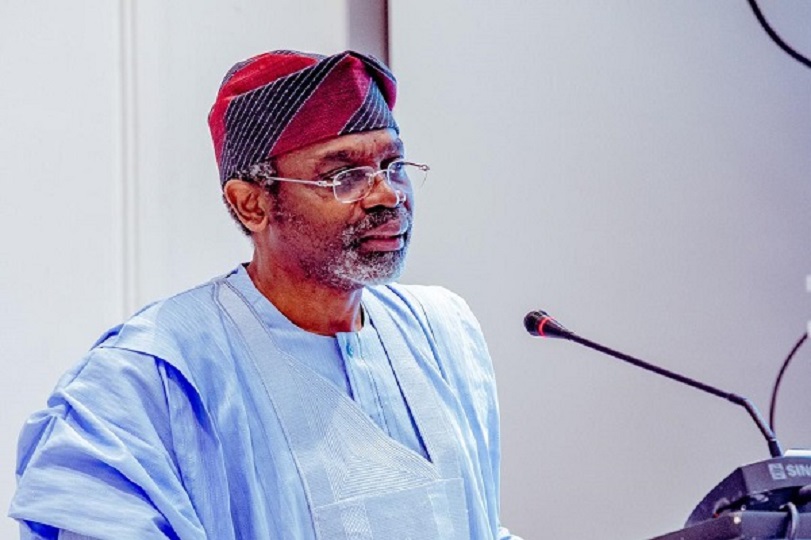
In a statement Tuesday, Chairman of the Working Group and Chief of Staff to the President, Femi Gbajabiamila, said the submission was made on October 19, 2026, to the Attorney-General of the Federation.
He said the ministry’s review will ensure conformity with legislative drafting standards and avoid conflict with existing laws, and is expected to return validated drafts on or before October 30, 2026, for final consideration before presentation to President Bola Tinubu.
Gbajabiamila said the bill seeks to establish the constitutional and legislative framework for a dual policing structure. President Tinubu had inaugurated the seven-member Working Group on July 7 to produce a technically robust, implementation-ready draft.
By Felix Umande
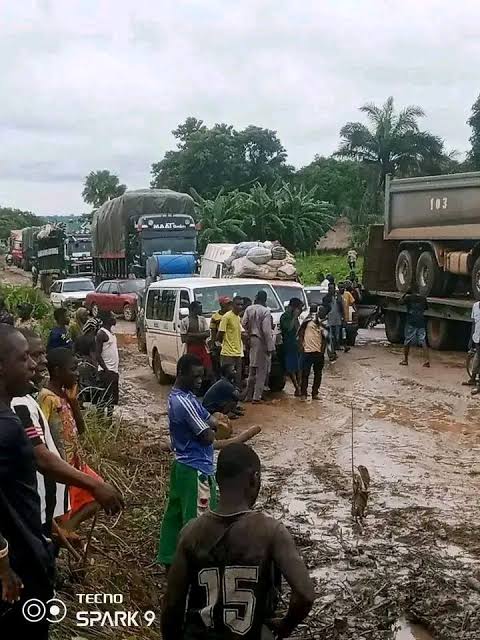
The current state of Ugbema Roundabout, a major junction in Benue State connecting many neighbouring states, has become a source of pain and anger for residents who say the situation deserves urgent attention.
Ugbema Roundabout is an important junction through which thousands of people, vehicles and goods pass daily on their way to different locations.
For travellers, commercial drivers, farmers, traders and residents, it serves as a critical passage linking different communities and routes.
However, the condition of the junction has deteriorated badly, with road users describing it as more of a death trap than a major gateway.
What worries residents the more is that even as the road lies abandoned, politicians have found it useful as a forest of campaign billboards.
Dr. Manasseh Ortoho described the road as a death trap. In his words:
“Ugbema connects communities and travellers to several states, including Taraba, Ebonyi, Cross River and Adamawa, making it a critical economic and transportation corridor. Yet, this federal road has suffered decades of neglect. From Yandev through Ipav, Tyowanye and Abwa, down to Ugbema Junction, the condition has become a serious threat to motorists, traders, commuters and residents.
“Political influence should translate into meaningful development for the people. Our roads should not become death traps while we continue to celebrate the political strength of our people. Ugbema Junction deserves attention. Yandev–Ipav–Tyowanye–Abwa–Ugbema deserves reconstruction,” Ortoho added.
Another resident, Mr. Atsu, said what should be a symbol of movement, commerce and connection has become a symbol of neglect, suffering and shame.
He said Ugbema Junction is not just another road but a major gateway linking Ugbema with Katsina-Ala, Zaki-Biam, Taraba state and beyond. It also connects Cross River, Abuja, Makurdi, Jato-Aka and several other Benue towns and villages and beyond.
“Every single day, thousands of people pass through here. Farmers transporting yams, cassava and rice to the market, students going to school, sick people being rushed to the hospital, traders, business owners, civil servants and travellers. When this junction fails, the entire economic chain of this part of Benue suffers,” he said.
According to residents, instead of a motorable roundabout, people now face massive potholes filled with dirty, stagnant water, vehicles breaking down daily, goods getting spoilt, frequent accidents and pedestrians wading through mud to cross.
Another resident, Mr. Thadeus, said the Ugbema–Adikpo Road is an important transport link for residents, farmers and traders and called on the Federal Government, through the Federal Ministry of Works and relevant road maintenance agencies, to assess and prioritise its rehabilitation.
A popular Benue activist, Mr. Ukan Kurugh, recounted a harrowing experience.
“I got stuck for almost five hours on my way to Cross River State through the Ihugh road. The experience was really frustrating and heartbreaking. How long will road users continue to suffer this much just to travel from one place to another? These roads are not just roads; they are lifelines connecting communities, businesses and families,” he said.
Residents are appealing to the Federal Government, Federal Ministry of Works, Benue State Government and relevant agencies to provide proper drainage, grading and reconstruction of the roundabout, insisting that good roads are not a luxury but essential infrastructure for development.

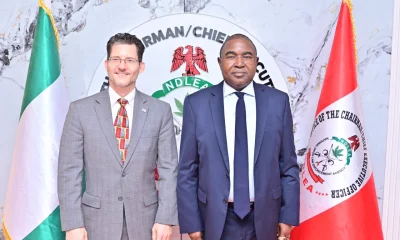

US Pressure: Drug Cartels Now Using African Routes to Reach Europe, American Markets
Spread the love–Mexican cartels turning Nigeria into meth hub – US By Nick Ibe, Abuja Mexican drug cartels now under...

STATE POLICE: Benue, Ogun, Delta, Enugu, Others Approve Constitution Amendment As Draft Bill Heads To Justice Ministry
Spread the loveBy Felix Umande The push for state police in Nigeria has gained fresh momentum as Benue, Ogun, Delta,...

Ugbema Roundabout Becoming A Death Trap For Thousands.
Spread the loveBy Felix Umande The current state of Ugbema Roundabout, a major junction in Benue State connecting many neighbouring...

Plateau Indigenous Youths Reject Petition Against DSS, Accuse Fulani Groups of Orchestrating ‘Calumny’ to Halt Security Operations
Spread the loveBy Philip Nyam A coalition of Plateau indigenous youth organisations has defended the Department of State Services (DSS),...


Hope for Patients as Reps Pass Organ, Tissue Transplantation Authority Bill
Spread the loveBy Philip Nyam The House of Representatives at plenary on Wednesday passed through second reading a bill seeking...

FG Sets Up Technical Committee To Accelerate Livestock, Wheat Production
Spread the loveBy Felix Umande The Federal Government has set up a technical committee to immediately accelerate livestock development and...


Presidency Has No Plot To Assassinate Atiku, APC Campaign Council Replies Timi Frank
Spread the loveBy Felix Umande The All Progressives Congress, APC, Presidential Campaign Council has dismissed as false an allegation by...

FG Says Ebola Patient in FCT, Traces 44 Contacts
Spread the loveBy Nick Ibe, Abuja One case of Ebola disease has been confirmed in Abuja by the Federal Capital...


Saudi Arabia executes Bangladeshi Couple Over Mosque Kiss
Spread the loveBy Isa Abdul, Abuja In Saudi Arabia, a kiss in the mosque would earn you death, as two...

Kaduna Gov Settles Land Dispute: Gives Victims Alternative Plots, Farmlands, Free Fertiliser
Spread the loveBy Michael Lim No community will be rendered homeless in Kaduna State because our administration believes in human...