
Opinion
“Islamization Agenda Started Over 200 Yeats Ago –

BY Mike Arnold
The Islamization of Nigeria Is Not a Theory. It’s a blueprint. Tinubu Isn’t Hiding It Anymore
By Mike Arnold
The Nigerian government is spending millions on lobbyists and PR firms in Washington and London. They’ve hired some of the best spin doctors money can buy. And I’ll give them this: they can muddy the waters about the terrorist massacres. They can repackage government failures as “security challenges.””” They can trot out ambassadors with talking points about “farmer-herder conflict” and “climate-driven migration.”
But there is one thing they can not hide: the historic, aggressive, and ongoing effort to fully Islamize Nigeria by any means necessary.
Not the violence. Not the body count. The structure. The laws. The Constitution. The courts. The schools. The appointments. The architecture of a 220-year conquest that is not winding down but accelerating—right now, in broad daylight, with receipts.
All the talk of a “secular democracy” is an elaborate masquerade to keep Nigeria in the good graces of the West. It is a fraud. The evidence is so overwhelming that no amount of lobbying can bury it.
I’ve made sixteen trips to Nigeria since 2010, multiple under Level 4 “Do Not Travel” warnings. I’ve spent time with children who watched their parents slaughtered for being Christian. I run three schools in displacement camps that the Nigerian government says don’t exist. I’ve sat across the table from two former Nigerian presidents. I carry protection now—even at my home in Texas—because of what I’ve uncovered.
So when I tell you the Islamization of Nigeria is not a conspiracy theory, not an exaggeration, and not Islam phobia—I’m telling you what I’ve spent fifteen years documenting with my own eyes, my own hands, and my own money. And every piece of it is on the record.
Let me show you.
This Didn’t Start Yesterday
People hear “Islamization of Nigeria” and think it’s a recent problem. It isn’t. It’s a 220-year project, and the blueprint has never changed.
In 1804, a Fulani scholar named Usman Dan Fodio launched a violent jihad across what is now Northern Nigeria. Historical records indicate as many as 250,000 died. He established the Sokoto Caliphate—an Islamic empire that swallowed dozens of ethnic groups and governed by Sharia. It was the largest state in Africa south of the Sahara.
When the British arrived, they didn’t dismantle it. They preserved it. Under “indirect rule,” they empowered the emirs, propped up the Islamic aristocracy, and suppressed the South. When they left in 1960, they handed the keys to the heirs of the caliphate.
On independence Day, the man holding those keys was Ahmadu Bello—the Sardauna of Sokoto, direct descendant of dan Fodio, Premier of Northern Nigeria. His vision was explicit. He founded Jama’atu Nasril Islam—the Society for the Victory of Islam—in 1962. He launched conversion campaigns across the North that converted more than 100,000 people in just two provinces. His stated goal: Nigeria as “an estate of our great-grandfather, Uthman dan Fodio.”
He was assassinated in the 1966 coup. But the project didn’t die with him.
When the Christian South tried to leave—when the Igbo people declared the Republic of Biafra in 1967—the Muslim-dominated North crushed them. Britain backed the North. Not for values. For oil. BP was extracting billions annually. The blockade starved one to three million people to death—mostly women and children. The message was clear: resistance will be annihilated.
After the war, the military government seized Christian missionary schools across the country. Schools that missionaries had built, funded, and operated since the 1840s—the backbone of education in Nigeria. Overnight, they were nationalized. In some Northern states, the names were changed to erase their Christian origins. St. John’s College became Rimi College. Queen of Apostles became Queen Amina College. The curricula were gutted. The moral foundations that had produced generations of Nigerian leaders were replaced with state-controlled content.
In 1986, military dictator Ibrahim Babangida secretly enrolled Nigeria as a full member of the Organisation of Islamic Cooperation—the 57-nation body that calls itself “the collective voice of the Muslim world.” He did it without consulting his cabinet. His own deputy—Commodore Ebitu Ukiwe, a Christian—said publicly that it was never discussed at the Supreme Military Council. Ukiwe was fired. In 2012, Nigeria’s Minister of State for Foreign Affairs described Nigeria at an OIC meeting in Saudi Arabia as “an Islamic state with the largest Christian population.” The backlash was fierce. The minister backpedalled. But Nigeria remains a full member of the OIC to this day.
And then there’s the constitution itself—the document that supposedly guarantees Nigeria’s “secular” character. The 1999 Constitution mentions Sharia 73 times. It mentions Islam 28 times. It mentions Muslims 10 times. It mentions Christianity zero times. The Bible? Zero. Not once. It establishes a Sharia Court of Appeal as a federal institution. It provides for Grand Khadi appointments. It embeds Islamic law into the legal architecture of a nation that calls itself secular.
Structural gerrymandering goes deeper. Nigeria’s 36 states were drawn to guarantee a permanent Muslim majority in the federal system. The North has 19 states, the South 17. Senate seats, revenue allocation, and federal appointments—all flow from a map designed to ensure that the heirs of the caliphate never lose control of the centre, regardless of what happens at the ballot box.
When Babangida built Aso Rock—the presidential villa—in 1991, he included mosques. No chapel. No church. Nothing for the Christians who make up roughly half the country. It wasn’t until President Obasanjo, a Christian, took office in 1999 and noticed the imbalance that a chapel was finally built in 2000—nine years after the villa opened. Today, under Tinubu’s Muslim-Muslim administration, reports indicate that the chapel has been shut while the mosques continue to operate.
In 1999, twelve Northern states immediately implemented full criminal Sharia law. Amputation. Flogging. Stoning. Not in some distant past. In the lifetime of every adult Nigerian alive today.
This is the through-line. 1804 to 2026. It has never stopped.
What’s Happening Right Now
After banning the teaching of Nigerian history in public schools for more than fifteen years—removed from the curriculum in 2009, with multiple failed attempts to restore it—the Tinubu administration finally mandated that Nigerian History be made compulsory from primary through junior secondary, effective 2025.
That sounds good. Until you see who Tinubu put in charge.
In December 2024, he appointed Professor Salisu Shehu as Executive Secretary of NERDC—the Nigerian Educational Research and Development Council. The man who controls what every child in Nigeria learns.
Shehu’s life’s work is something called “The Islamization of Knowledge.””” That’s not my phrase. It’s his. He wrote the book—literally. Islamization of Knowledge: Conceptual Background, Vision and Tasks, published in 1998. He served as National Coordinator of the International Institute of Islamic Thought in Nigeria. He was Deputy Secretary-General of the Nigerian Supreme Council for Islamic Affairs. In 2024, he was turbaned “Khadimul Qur’an”—Servant of the Quran—for promoting Islamic knowledge.
This is the man now designing the curriculum for 50 million Nigerian school children.
And the curriculum content? Hidden behind a paid NERDC membership wall. Nobody outside the system can read what children will be taught. Meanwhile, coordinated praise from regime-friendly influencers celebrates a curriculum they haven’t seen.
After fifteen years of erasing history from the classroom, Nigeria’s children will now learn their history—as written by the man whose career mission is the Islamization of Knowledge. Who controls the past controls the future. Who controls the curriculum controls the nation.
The Tinubu Record
Here’s what Tinubu has done since taking office in May 2023. Not speeches. Actions.
He ran on a Muslim-Muslim ticket—the first in Nigeria’s history. He appointed a Sharia advocate to redesign the national curriculum. He issued $500 million in Sukuk bonds—Islamic financial instruments that channel public funds through Sharia-compliant structures. He left Sharia courts and Hisbah morality police operating with full impunity across twelve Northern states, enforcing Islamic law on Muslims and non-Muslims alike.
His National Security Adviser, Nuhu Ribadu, armed Miyetti Allah—the Fulani herders’ association—with AK-47s under the Terrorism Prevention Act The government confirmed it. At the same time, Christian community defenders had their weapons confiscated. Hunters who protected their villages were left outgunned. In July 2025, more than 70 vigilantes were killed in a single ambush in Plateau State—because the government took their weapons while arming the other side.
He transferred Nnamdi Kanu—convicted on charges an Enugu court had already nullified—to a prison in Sokoto. The seat of the Caliphate. Eight hundred kilometres from his lawyers and family. His crime? Words. Not violence. Words.
Meanwhile, Isa Pantami—communications minister under Tinubu’s predecessor—is on tape praising Osama bin Laden, celebrating the killing of unbelievers, and Taliban victory. He kept his cabinet position. Nobody touched him.
Praise jihad and you keep your job. Advocate for your people with words, and you die in the Caliphate’s backyard.
And last month? Tinubu flew to Ankara to sign a military cooperation protocol with Erdogan. Turkish Special Forces will now train Nigerian soldiers. Turkish satellites will share intelligence. And Erdogan’s Maarif Foundation—a network of Islamic schools that scholars describe as having “a more pronounced Islamic character” – than the schools they replaced—will expand its educational footprint in Nigeria
Tinubu isn’t breaking the pattern. He’s accelerating it.
The Sultan’s Silence—and His Southern Advance
In January 2025, the Sultan of Sokoto—Sa’ad Abubakar III, 19th hereditary successor to dan Fodio—expanded Sharia arbitration panels into Southern states. Ekiti. Oyo. Yoruba Heartland. States that were never part of the caliphate. Not criminal Sharia. Not yet. Arbitration panels. Soft entry. The camel’s nose.
The Sultan presides over 108 million Muslims and 19 emirs. He could issue a fatwa against the violence tomorrow. He did it once—in 2015, and his fatwa against Boko Haram is reported to have reduced their recruitment by 40 percent. He has the authority. He has the platform. He has the reach.
He hasn’t done it. His silence is policy.
His 2025 message to the faithful: “The ummah must unite to confront challenges facing the Muslim world.” Not Nigeria. Not peace. Not coexistence. The Muslim world.
The Justice System They Built
A girl named Deborah Samuel was stoned to death and burned alive for thanking Jesus on WhatsApp. Her killers were defended by a team of 34 devout Muslim volunteer lawyers who rallied to their cause. They were acquitted—prosecution lawyers who failed to appear. In response to the arrests, Muslim mobs attacked and looted three churches.
A Christian healthcare worker named Rhoda Jatau spent 19 months in prison for condemning that murder.
A 74-year-old pastor’s wife named Bridget Agbahime was beaten to death by a mob of more than 500 for asking a man to move his ablution water from her shop door. All five suspects were discharged in five months. The magistrate’s ruling: “No case to answer. All suspects are innocent.”
A young musician named Yahaya Sharif-Aminu has been in prison more than five years for sharing song lyrics on WhatsApp. His sentence: death by hanging. The Kano state government’s lawyer said publicly: “If the Supreme Court upholds the lower court’s decision, we will execute him publicly.”
Nigeria is one of only seven countries on earth with a blasphemy law carrying the death penalty. The European Parliament, the UN Working Group on Arbitrary Detention, and the ECOWAS Court have all demanded Nigeria repeal these laws. Nigeria has not complied with any of them.
Meanwhile, captured jihadists get vocational training, cash payments, and startup equipment through Operation Safe Corridor. Nearly a thousand “repentant Boko Haram members” graduated in 2025 alone. Their victims—millions in displacement camps—have their camps bulldozed and are told to go home. To villages still controlled by the killers.
Kill a Christian for “blasphemy” and walk free. Defend a murdered Christian’s memory and go to prison. This is not a broken system. It’s working exactly as designed.
The Man Who Wants You to Look Away
After Trump’s Christmas Day strike on ISIS targets in Sokoto, a man named Sheikh Ahmad Gumi stepped to the microphone.
Gumi is the most influential Islamic cleric in Northern Nigeria. Son of the man critics called “the Ayatollah of Nigeria.” Preaches at the Sultan Bello Mosque in Kaduna. In 2021, he walked into forest camps to meet more than 600 armed bandits. He distributed Islamic books to them. He gave them medical treatment. He demanded the government give them amnesty and money. He said publicly—on the record—that “kidnapping children from school is a lesser evil.”
He’s also the man who exchanged emails with Umar Farouk Abdulmutallab before the young Nigerian tried to blow up 289 people on a Christmas Day flight to Detroit in 2009. U.S. intelligence found the correspondence. Saudi Arabia arrested Gumi and held him for more than six months. The Nigerian government lobbied for his release.
In May 2025, Saudi Arabia banned him from entering the country, immediately deporting him upon arrival. Too radical for Saudi Arabia—the same Saudi Arabia that the United States has designated a Country of Particular Concern.
And after the Christmas strike? Gumi demanded Nigeria “halt all military cooperation with the United States” and pivot to “neutral countries”—China, Turkey, and Pakistan.
Those are not neutral countries. Turkey just signed a military cooperation protocol with Tinubu. Pakistan already has fighter jets in the Nigerian Air Force—co-developed with China. Iran has built a three-million-strong proxy movement in Northern Nigeria. When Gumi says “pivot,” he’s describing what’s already underway.
The Numbers
Ninety per cent of all Christians killed for their faith on earth are killed in Nigeria. More than 10,200 were killed by armed groups in just the first two years of Tinubu’s administration, according to Amnesty International. 725 villages under bandit control in Zamfara. All 23 local government areas of Benue State attacked. Boko Haram and ISWAP recruitment videos indicate that Nigeria is “phase one” of a worldwide caliphate revival—with $40 billion a year in oil and $700 billion in strategic minerals to finance it.
Former AFRICOM Commander General Michael Langley called the region anchored by Northern Nigeria “the of global terrorism.”
The Nigerian government’s official position stated in September 2025: “There is no religious persecution in Nigeria.”
Why I’m Telling You This
The lobbyists can spin the violence. They can reframe massacres as “community disputes.” They can buy op-eds and plant friendly stories.
But they can not rewrite the constitution that mentions Sharia, Islam, and the Quran more than 100 times and Christianity zero. They can not un-seize the missionary schools. They can not un-join the OIC. They can not erase the conversion campaigns or the caliphate or the curriculum czar whose life’s work is the Islamization of Knowledge. They can not explain away a presidential villa built with mosques and no chapel. They can not make Ahmadu Bello’s vision disappear or pretend that twelve states don’t enforce criminal Sharia in a “secular democracy.”
The masquerade is over. The record is clear. And the full picture—how this 220-year conquest machine works, who built it, who feeds it, and what it will take to stop it—is coming. Soon.
EarthShaker
By H. E. Mejeh
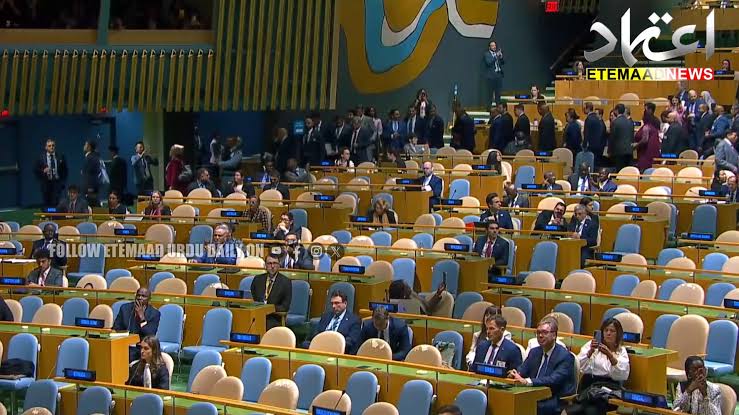
Yesterday in New York, Nigerian delegates staged a well-rehearsed walkout from the United Nations General Assembly as Israeli Prime Minister, Benjamin Netanyahu, took the podium.
Dozens of delegates left the hall in protest of Israel’s war in Gaza and Lebanon. Netanyahu, unfazed, called them “moral cowards” and continued his speech.
It was a powerful scene for international cameras. But for any Nigerian watching at home, it was a scene of profound irresponsibility and hypocrisy.
Our government is very good at performing morality abroad, while abdicating its primary duty at home.
What moral standing do we have to walk out on terrorism?
Israel says it is fighting terrorism – Hamas, Hezbollah, Iran. You may agree or disagree with its methods. But its government leaves no doubt that it will defend its citizens at all costs. Netanyahu told the UN that attacking Iran “was one of the easiest decisions I’ve ever had to make” because the security of his people was non-negotiable.
What is Nigeria’s doctrine on terrorism?
For over 15 years, Boko Haram, ISWAP, bandits, and kidnappers have turned the North-East, North-West, and North-Central into killing fields. Thousands of our citizens have been slaughtered, our schoolgirls abducted, our farmers displaced, our soldiers ambushed, killed. Yet the response of the Nigerian government has been press releases, committees, and condolence messages.
We walk out against alleged genocide in Gaza, but we have normalized genocide in Benue, in Plateau, in Southern Kaduna, in Zamfara, in Borno. A government that cannot protect its own people has no business performing outrage on the world stage.
The Lackadaisical War
1.No Clear Ideology: Israel has defined its enemy. Nigeria still calls terrorists “bandits,” “gunmen,” and “unknown gunmen,” as if naming them correctly would be too offensive.
2.No Accountability: When terrorists kill 40 citizens in a village, no security chief loses his job. When a school is attacked, no minister resigns. Failure is rewarded with tenure extension.
3.No Justice: Terror suspects are “repented” and reintegrated with stipends, while their victims rot in IDP camps without justice or compensation.
Which serious nation fights terrorism this way?
Our delegates can afford to fly Business Class to New York to walk out on Israel, but our soldiers in the trenches cannot afford basic drones, night-vision goggles, and timely air support.
The Truth
You cannot fight foreign injustice while you pamper domestic terror.
That UN walkout was not foreign policy. It was a distraction. A government that is failing to secure lives and property at home is trying to buy cheap moral credit abroad.
If our government had the same energy it used to walk out on Netanyahu to walk into Sambisa Forest, into the bandit camps of Zamfara, into the killer herdsmen hideouts in Benue, Nigeria would be safer today.
Charity begins at home. Security begins at home. Leadership begins at home.
Until we defeat the terrorists in Nigeria, we have no moral right to lecture any nation on how it defeats its own.
H. E. Mejeh Esq.
Lawyer with Conscience, Nurtured by Truth.

By Rufai Oseni
The Minister of Works is a key player in President Bola Ahmed Tinubu’s government who is not performing well to help Mr President win the hearts of many Nigerians ahead of the crucial January 2027 Election.
I have been a staunch supporter of President Tinubu even before the 2023 Presidential Election.
I strongly disapprove of the performance of Works Minister, Sen. David Umahi. His failure is causing huge embarrassment and hatred to PBAT because of the hardship brought upon Nigerians on federal roads despite the trillions of naira released for road rehabilitation projects by PBAT.
I doubt if since May 29, 1999 there has been any Nigerian President who has shown so much commitment and determination to fix federal highways than President Tinubu
Believe me, if I were the Minister of Works under a very patriotic, committed and determined leader like President Tinubu, I would have restored these critical federal highways within the last three years with such trillions of naira released for this purpose. I say this from my knowledge and experience as an Engineer who headed Delta State Government Direct Labour Agency (DLA), an Agency statutorily charged with the construction, rehabilitation and maintenance of roads and who in August 2011 was saddled with the tough task of urgently restoring hundreds of kilometers of roads in my State that had collapsed and became death traps leading to fatal accidents and deaths of our people and commuters.
In less than two years and with only about three billion naira released by the State Government, I reconstructed and rehabilitated these collapsed roads, constructed some new ones and also opened up many new roads in our rural communities to enable our farmers to commute easily to their farms and transport their produce to urban cities.
The records are there, he said, for anyone to go verify. He added that: Some of the asphalt paved roads I did over thirteen years ago are still standing firm today as if they were constructed just one week ago. I guarantee that these roads will last another ten years or more.
A patriotic and committed PBAT should not end up being daily abused by Nigerians who are rightly angry because of the hell they go through traveling on these roads; instead, Mr President should be receiving their praises and prayers if only his Minister of Works rightly utilized the funds released to him by the President to fix these roads.
I can tell Nigerians that President Tinubu is more pained and heartbroken than anyone else seeing reports of the hell Nigerians still go through traveling across our country on these federal roads.
Frankly if this disturbing situation continues on our federal highways I worry that Nigerians may express their anger against PBAT at the January 2027 Presidential Election except Mr President swiftly takes decisive action right now
The Minister’s Concrete Pavement Policy has been a disaster and a source for huge waste of public funds. It is ridiculous and makes no engineering and economic sense at all! What has Concrete Pavements got to do on Lokoja to Abuja, Abuja to Kaduna highways? I am surprised that some State Govs even adopted his Concrete Pavement Policy and wasting their States’ Funds.
It is wrong for the Minister to promise that within the next two weeks he will restore the collapsed sections of Benin-Agbor-Asaba and Benin-Sapele-Effurun Fedeal Highways. He knows that this is not possible in this peak of rainy season. Only palliative works can be done just to allow vehicles to maneuver.
It is also wrong for the NDDC to be directed to take over responsibility meant for the Ministry of Works and for which trillions of naira have been released to the Ministry. Statutory Funds approved and released to NDDC are not meant for such Federal Road Projects; they are meant to take care of very special and pressing needs of our people of the Oil and Gas Producing States of Niger Delta Region
By Philip Nyam
Last month, I was part of a delegation that participated in the Seminar on Young Leaders under the Global Development Initiative (GDI), organised by the University of International Business and Economics (UIBE), in Beijing, China. We came from diverse countries including Angola, Antigua and Barbuda, Gambia, Grenada, the Kurdish Iran, Nigeria, Sierra-Leone, Macedonia, and South Africa. Available records show that the UIBE has, since 2000, with the approval of the Chinese Ministry of Commerce, conducted more than 140 bilateral and multilateral training programmes, hosting over 350,000 participants.
The UIBE is by every standard a welcoming academic environment, a great citadel of learning renowned for building leaders for tomorrow. It is axiomatic that one of the problems plaguing developing or underdeveloped countries is poor leadership. This effort is to lay a solid foundation and bridge the gap.
The GDI, of course, is China’s ambitious proposal for worldwide development, launched by President Xi Jinping at the UN General Assembly on September 21, 2021. The idea is simple and urgent: Push the UN 2030 Agenda and the SDGs, but anchor them in what developing countries need most. Poverty reduction, food security, vaccines and health, financing for development, climate change and green development, industrialisation and the digital economy. In other words, the GDI is China’s call for a shared future, and it is a project that puts developing countries first.
So, for two weeks at UIBE, we lived inside that idea. Despite the fact that some of us were visiting China for the first time, we quickly integrated. We were taught China’s basic national conditions and achievements since reform and opening up. We studied how China is implementing the UN 2030 Agenda through poverty alleviation. We took lectures on China’s political system, the digital economy, artificial intelligence, intellectual property, Chinese history, Chinese culture, and the cultivation of young leaders under GDI. The participants were also exposed to the philosophy behind Chinese steady development: “If you want to be rich, build the roads”. The lecturers were professional and down-to-earth; the supervisors and volunteers were amazing, and the people were generally friendly and welcoming. And so, we read, digested, and assimilated what we were taught.
Between classes, China opened itself to us. We tasted our way through Beijing and Sichuan’s rich cuisine. In Chengdu, capital city of Sichuan Province, we watched Sichuan Opera face-changing until we couldn’t tell where the mask ended and the wonder began. We sat for tea and learned the quiet discipline in every pour. At the Panda Base, we met giant pandas and red pandas, black-and-white ambassadors that everyone falls for. We climbed the Great Wall and felt history under our feet. We had the rare opportunity of participating in the Fourth China International Supply Chain Expo, and we visited the Museum of Foreign Economic and Trade Relations.
It was indeed a masterclass in policy and culture. But some encounters don’t fit into a seminar schedule. They slip between lectures, between the Great Wall and a bowl of hotpot, and end up rewriting the whole trip for you. And the lesson I keep returning to came from a narrow lane lit by lanterns. It didn’t happen in a lecture hall; it happened in Kuanzhai Alley of Chengdu.
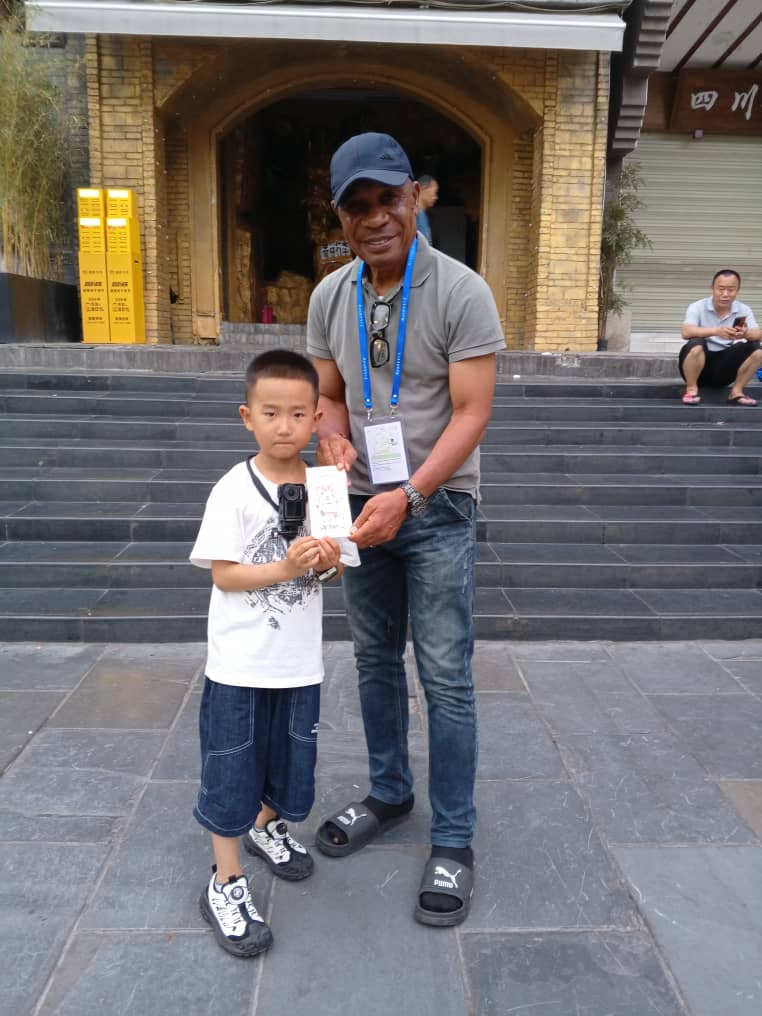
My encounter with a six-year-old boy named Eno. It was a rare encounter that has left an indelible impression on me. Kuanzhai’s Alley is Chengdu’s living room. Red lanterns, teahouse chatter, the smell of spice in the air. We were taking a walk into the Alley when a small voice stopped me. Eno was six. Bright eyes. Questions ready before his hello finished. “Where from? Your name? Do you love football?” At six, he spoke good English. He knew Cristiano Ronaldo. He asked about pandas and why only Chengdu keeps them so close. He asked about the ongoing World Cup in the USA, Canada, and Mexico. He talked like a child with maps and goals in his head, but he listened like someone older. No shyness, no demand. Just courage wrapped in courtesy.
Then came the gesture I did not expect. Eno pressed a small picture of a panda into my hand. “Wish you well,” he said, and gave it free. No blood, no prior knowing. A stranger’s hand, offering love without a sound. I felt it immediately. I had to look away for a second. Because tears rose unbidden. In that moment, Eno was not just a boy in an alley. He was the idea behind GDI made human: spreading love, uniting humanity, one small act at a time. To me, Eno is not just a little boy in an alley; he is China’s welcome, wide and deep.
That small panda picture now lives in my sitting room in Nigeria. I guard it. Some days it’s just paper and ink. Other days it’s a window back to Chengdu, to lantern light, to a boy who decided a stranger should feel welcome.
Eno taught me something the lectures circled but could not say as plainly: kindness needs no reason. It just begins. Love needs no reason to be sweet. If GDI is about building a more connected, equitable world, I saw it in miniature that afternoon. Policy, trade, and technology matter. So do pandas, football, and a child’s unguarded generosity.
I hope to reconnect with Eno someday. Until then, I’ll keep looking for that golden light in Kuanzhai’s alleys, and I’ll keep telling the story of the six-year-old who reminded a visitor from Nigeria that the soul of a city, a nation, can fit in one small hand.
…Philip Nyam participated in the just-concluded Seminar on Young Leaders under the GDI in Beijing.


Kogi Community Protests Building of Mortuary in Residential Area.
Spread the loveBy Isa Abdul The construction of an alleged mortuary close to public school and residential buildings has been...


100 Days To 2027 Polls: INEC Vows Neutrality, Says BVAS, Ballots Ready
Spread the loveBy Felix Umande The Independent National Electoral Commission, INEC, has assured Nigerians and the international community of its...

THE LAST TANGO: Tears, Tributes and A Final Goal As Messi Bows Out After 21 Years
Spread the loveBy Felix Umande Emotions ran high at the Estadio Monumental on Tuesday night as Lionel Messi signed off...

Church’s Duty to Empower Individuals, Create Opportunities and Improve Family’s Economic Well-being
Spread the loveBy Seyi Balogun, Lagos The need for the Church’s commitment to empowering its members through employment opportunities, entrepreneurship...
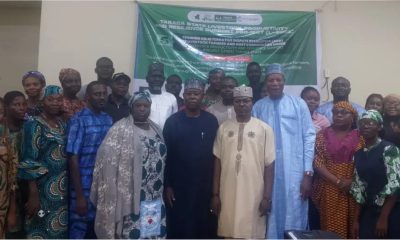

Taraba Explores ADR for Sustainable Peace Between Crop, Livestock Farmers
Spread the loveBy Michael Lim Conflict prevention between livestock farmers and host communities in Taraba State through the promotion of...
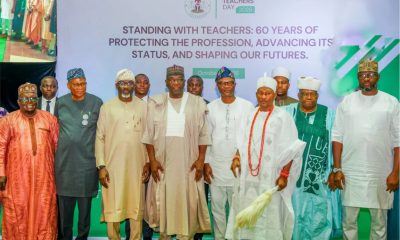

Financial Inclusion: Kwara Buys Dangote Refinery Shares For Female Teachers
Spread the loveBy Michael Lim Kwara State Government has announced plans to buy shares in the Dangote Refinery Initial Public...

Benue Govt Gives 2-Week Ultimatum To Owners Of Illegal Billboards, Threatens Mass Removal
Spread the loveBy Felix Umande The Benue State Government has decried the arbitrary erection of billboards across the state by...


INEC Tracking Illegal Campaign Spending
Spread the love–Tells Editors: “remain primary filter against information disorder.” By Son Tertsea, Abuja The Independent National Electoral Commission (INEC)...

Importers, Petroleum Marketers Kick Against Dangote’s Restriction of Petrol Sales
Spread the loveBy Seyi Balogun Major marketers have kicked against Dangote Petroleum Refinery’s non sale of Premium Motor Spirit (petrol)...

Jim Ovia Counsels: Nigeria must not Sacrifice Quality for Quantity in Tertiary Education
Spread the loveBy Seyi Balogun, Lagos Nigeria must not allow the size and the number of universities to come at...