
Opinion
How Akpabio’s Leadership Secured Nigeria’s Electoral Future

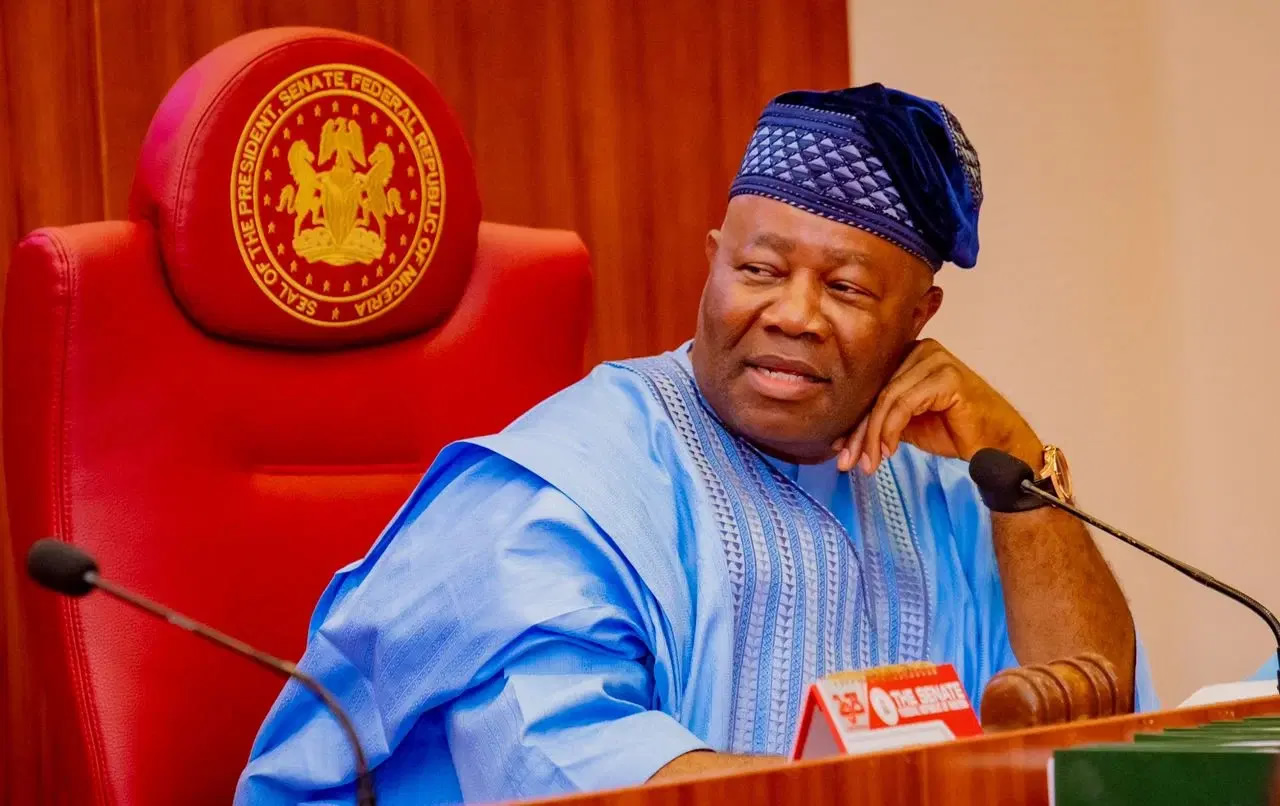
- By Rt Hon Eseme Eyiboh mnipr
In the evolving story of Nigeria’s democratic consolidation, few issues have provoked as much intensity as electoral reform. The signing into law of the Electoral Act (Repeal and Re-enactment) Bill 2026 by President Bola Ahmed Tinubu marked another chapter in this journey, drawing applause, skepticism, and fierce debate in equal measure.
At the centre of this moment stands Godswill Akpabio, President of the Senate, who has consistently articulated a position that blends institutional caution with reformist intent. His assertion that the National Assembly met “the aspirations of Nigerians, not a few people who make noise” reflects not merely rhetorical flourish, but a deeper philosophy of lawmaking anchored in constitutionalism, legislative procedure, and national peculiarities.
To understand Akpabio’s positioning, one must situate the reform within Nigeria’s broader democratic trajectory. Since the country’s return to civilian rule in 1999, electoral reforms have often oscillated between technological optimism and structural reality. The 2026 re-enactment does not discard innovation; rather, it recalibrates it. In defending the new Act, Akpabio emphasized that the National Assembly undertook a “painstaking” and “thorough” process, mindful of the country’s infrastructural limitations, judicial precedents, and the ultimate objective of preventing disenfranchisement.
A key flashpoint in the debate was the question of electronic transmission of results. For many reform advocates, real-time electronic transmission became symbolic of transparency. Yet Akpabio’s argument was not against technology; it was against rigidity detached from capacity. He consistently maintained that technology must serve democracy, not endanger it. In a country where broadband penetration is uneven, where insecurity disrupts network infrastructure across multiple states, and where power supply remains inconsistent, embedding inflexible “real-time” mandates into statute could, in his view, expose elections to avoidable litigations and invalidation.
This perspective aligns with the constitutional role of the legislature. The Senate does not conduct elections; it makes laws. The responsibility for operational modalities rests with the Independent National Electoral Commission (INEC), which applies the law within its administrative and technical capacity. By leaving room for INEC to determine timing and modalities of transmission, the Act reflects a respect for institutional boundaries. Akpabio’s defense of this approach underscores his insistence that Parliament legislate for posterity, not for transient political advantage.
At the State House signing ceremony, President Tinubu reinforced this institutional clarity. He observed that Nigeria’s elections remain “essentially manual.” Ballots are cast manually, counted manually, and declared by human beings. While electronic viewing enhances transparency, the core process remains human-centered. Tinubu’s caution about broadband readiness and cyber vulnerabilities echoes Akpabio’s reasoning. Together, their statements project a governance philosophy that privileges clarity and feasibility over performative reform.
Perhaps the most celebrated innovation in the new Act is the formal legal recognition of the Bimodal Voter Accreditation System (BVAS) result viewer, commonly referred to as IReV. This recognition represents a significant milestone. For the first time since independence in 1960, electronic viewing of polling unit results is explicitly grounded in statutory authority. Under the amended framework, results transmitted electronically—even if delayed due to connectivity issues—must ultimately reflect on the IReV portal once network is restored. This creates a verifiable digital trail that citizens, observers, and parties can scrutinize and interrogate.
Akpabio described this as a landmark safeguard against a historic problem: tampering between polling units and collation centres. By ensuring that Form EC8A—the primary polling unit result form signed by presiding officers and party agents—feeds into a publicly accessible portal, the law strengthens accountability without discarding manual collation procedures validated by courts.
The Supreme Court’s pronouncements in post-2023 election litigation had clarified that IReV, as previously configured, was not the definitive legal record of results. Rather than ignore this judicial interpretation, the legislature responded by integrating electronic viewing into statutory text while preserving the evidentiary primacy of signed result forms. This harmonization of law and jurisprudence illustrates legislative maturity.
Critics, including the opposition parties, alleged that the Act’s signing reflected partisan fear. Civil society voices such as Yiaga Africa described the reform as incremental where transformation was needed. Yet even among critics, a pragmatic thread emerged.
The Civil Society Legislative Advocacy Centre and the Transition Monitoring Group urged acceptance of the law while focusing attention on demanding credible conduct from INEC. This convergence suggests that while disagreements persist about optimal reform design, there is recognition that institutional strengthening is iterative.
Akpabio’s stance during earlier debates further illuminates his approach. On February 8, at a public presentation of Senator Effiong Bob’s book in Abuja, he cautioned against hasty conclusions about an amendment process still underway. His insistence that commentators wait until Votes and Proceedings were finalized before passing judgment reflects a proceduralist ethos.
Legislative drafting is iterative. Clauses are debated, amended, harmonized between chambers, and only then crystallized into final text. By defending this process against what he termed premature media trials, Akpabio positioned himself as a guardian of institutional integrity.
His critique of “retreat politics” is equally telling. Consultative retreats, he argued, are valuable but not binding. Final authority rests on the Senate floor, where clauses are debated and voted upon. This distinction reinforces parliamentary sovereignty within Nigeria’s constitutional framework. It also shows a deeper democratic principle: advocacy informs lawmaking, but elected representatives deliberate and decide.
Another noteworthy provision in the amended Act concerns internal party democracy. By empowering party members to vote directly for candidates during primaries, the law dilutes the dominance of small delegate blocs. In theory, this broadens participation, reduces transactional politics, and enhances legitimacy. Akpabio’s highlighting of this reform signals an understanding that electoral integrity begins within parties, not merely at polling units.
The Act also addresses scenarios where leading candidates are disqualified by courts. By mandating fresh elections in such circumstances, it prevents outcomes where significantly lower-polling candidates assume office by default. This provision closes a loophole that had generated controversy in past cycles. In doing so, the legislature strengthens the moral authority of electoral outcomes.
The reduction of statutory notice for elections from 360 days to 300 days, may appear technical but carries practical implications. It allows scheduling flexibility, including the possibility of avoiding sensitive religious periods such as Ramadan and Lent. This demonstrates legislative sensitivity to socio-cultural realities—a recurring theme in Akpabio’s rhetoric about Nigeria’s peculiarities.
Opposition criticisms deserve engagement. The PDP characterized the signing as hurried and partisan. Yet the legislative timeline reflects deliberation across chambers, conference committee harmonization, and eventual executive assent. Moreover, the principle of the legislative-executive cooperation is intrinsic to constitutional governance. The swift assent by President Tinubu can be interpreted not as haste but as responsiveness to parliamentary consensus.
Support from figures like Nyesom Wike reinforces the perception that the reform commands cross-sectional backing within the governing architecture. Wike’s description of democracy as a “work-in-progress” aligns with Akpabio’s incrementalist philosophy. Reform, in this view, is evolutionary rather than revolutionary.
Central to Akpabio’s defense is the rejection of absolutism. Mandating real-time electronic transmission in a context of infrastructural fragility could render entire states’ results vulnerable to nullification due to network outages. He invoked comparative examples, including electoral disputes in advanced democracies, to illustrate that even technologically sophisticated systems encounter anomalies. The lesson he draws is humility: laws must anticipate worst-case scenarios.
This caution is not synonymous with conservatism. By embedding IReV recognition in statute, the Act advances transparency beyond previous frameworks. It creates a hybrid model—manual voting and collation complemented by electronic visibility. Such hybridity may represent a uniquely Nigerian pathway, blending global best practices with domestic constraints.
Akpabio’s rhetorical framing—distinguishing “noise” from lawmaking—has attracted attention. While critics may interpret it as dismissive, it also speaks to a tension in contemporary democracies: the amplification of vocal minorities through media ecosystems. Legislative legitimacy, however, derives from electoral mandate and constitutional procedure. By emphasizing the “generality of Nigerians,” Akpabio situates himself within a majoritarian democratic theory tempered by rule of law.
The question of disenfranchisement further illuminates his position. If technological failure in insecure or rural areas invalidated results, marginalized communities could bear disproportionate impact. By allowing delayed electronic uploads once connectivity is restored, the Act seeks to reconcile inclusivity with transparency. This compromise reflects distributive sensitivity.
In evaluating Akpabio’s stewardship, one must also consider his broader legislative philosophy. He repeatedly asserts that laws must outlast individuals. This intergenerational perspective discourages tailoring statutes to immediate partisan contests. Whether one agrees with every clause, the emphasis on durability highlights a statesmanlike orientation.
The reactions from civil society, though critical, implicitly acknowledge the dynamic nature of reform. Calls to continue advocating improvements indicate that the 2026 Act is part of an ongoing process. Akpabio himself has stated that doors remain open. This openness suggests confidence rather than defensiveness.
Ultimately, the measure of electoral reform lies not only in statutory text but in implementation. INEC’s capacity, political party behavior, judicial adjudication, and citizen vigilance will shape outcomes. Yet legislation provides the framework within which these actors operate. By integrating electronic viewing, clarifying collation hierarchies, strengthening internal party democracy, and closing disqualification loopholes, the National Assembly has recalibrated that framework.
In positioning Akpabio in a favorable light, it is important to avoid hagiography. Democratic leadership entails contestation. However, his consistent themes—respect for process, infrastructural realism, institutional boundaries, and posterity—form a coherent narrative. Rather than capitulate to populist maximalism or resist reform altogether, he charted a middle course.
Nigeria’s democracy, like many across the globe, navigates between aspiration and capacity. Technological for determinism offers seductive simplicity; constitutional prudence demands complexity. In the crucible of electoral reform, Akpabio has presented himself as a custodian of that prudence. Whether history ultimately vindicates every provision of the 2026 Act will depend on future elections. But as of its enactment, the legislative record reflects a deliberate attempt to harmonize innovation with stability.
The broader democratic project requires precisely this balance. Transparency without feasibility breeds litigation. Feasibility without transparency breeds distrust. By embedding electronic visibility within a manual backbone, the Act seeks equilibrium. In championing this architecture, Akpabio aligns himself with a vision of reform that is incremental yet substantive, cautious yet forward-moving.
As Nigeria approaches future electoral cycles, the real test will be whether citizens experience greater confidence, fewer disputes, and clearer outcomes. Should that occur, the painstaking deliberations defended by the Senate President may be remembered not as noise, but as necessary groundwork. In that sense, Akpabio’s insistence that lawmaking differ from clamor may prove less a rebuke than a reminder: democracy flourishes not only through passion, but through patient construction of rules capable of enduring the storms of politics. Nigeria’s Electoral Future shall have Senator Godswill Akpabio positively mentioned in its repository.
Rt Hon Eseme Eyiboh mnipr, Special Adviser on Media/Publicity and official Spokesperson to the President of the Senate



By Rufai Oseni
The Minister of Works is a key player in President Bola Ahmed Tinubu’s government who is not performing well to help Mr President win the hearts of many Nigerians ahead of the crucial January 2027 Election.
I have been a staunch supporter of President Tinubu even before the 2023 Presidential Election.
I strongly disapprove of the performance of Works Minister, Sen. David Umahi. His failure is causing huge embarrassment and hatred to PBAT because of the hardship brought upon Nigerians on federal roads despite the trillions of naira released for road rehabilitation projects by PBAT.
I doubt if since May 29, 1999 there has been any Nigerian President who has shown so much commitment and determination to fix federal highways than President Tinubu
Believe me, if I were the Minister of Works under a very patriotic, committed and determined leader like President Tinubu, I would have restored these critical federal highways within the last three years with such trillions of naira released for this purpose. I say this from my knowledge and experience as an Engineer who headed Delta State Government Direct Labour Agency (DLA), an Agency statutorily charged with the construction, rehabilitation and maintenance of roads and who in August 2011 was saddled with the tough task of urgently restoring hundreds of kilometers of roads in my State that had collapsed and became death traps leading to fatal accidents and deaths of our people and commuters.
In less than two years and with only about three billion naira released by the State Government, I reconstructed and rehabilitated these collapsed roads, constructed some new ones and also opened up many new roads in our rural communities to enable our farmers to commute easily to their farms and transport their produce to urban cities.
The records are there, he said, for anyone to go verify. He added that: Some of the asphalt paved roads I did over thirteen years ago are still standing firm today as if they were constructed just one week ago. I guarantee that these roads will last another ten years or more.
A patriotic and committed PBAT should not end up being daily abused by Nigerians who are rightly angry because of the hell they go through traveling on these roads; instead, Mr President should be receiving their praises and prayers if only his Minister of Works rightly utilized the funds released to him by the President to fix these roads.
I can tell Nigerians that President Tinubu is more pained and heartbroken than anyone else seeing reports of the hell Nigerians still go through traveling across our country on these federal roads.
Frankly if this disturbing situation continues on our federal highways I worry that Nigerians may express their anger against PBAT at the January 2027 Presidential Election except Mr President swiftly takes decisive action right now
The Minister’s Concrete Pavement Policy has been a disaster and a source for huge waste of public funds. It is ridiculous and makes no engineering and economic sense at all! What has Concrete Pavements got to do on Lokoja to Abuja, Abuja to Kaduna highways? I am surprised that some State Govs even adopted his Concrete Pavement Policy and wasting their States’ Funds.
It is wrong for the Minister to promise that within the next two weeks he will restore the collapsed sections of Benin-Agbor-Asaba and Benin-Sapele-Effurun Fedeal Highways. He knows that this is not possible in this peak of rainy season. Only palliative works can be done just to allow vehicles to maneuver.
It is also wrong for the NDDC to be directed to take over responsibility meant for the Ministry of Works and for which trillions of naira have been released to the Ministry. Statutory Funds approved and released to NDDC are not meant for such Federal Road Projects; they are meant to take care of very special and pressing needs of our people of the Oil and Gas Producing States of Niger Delta Region
By Philip Nyam
Last month, I was part of a delegation that participated in the Seminar on Young Leaders under the Global Development Initiative (GDI), organised by the University of International Business and Economics (UIBE), in Beijing, China. We came from diverse countries including Angola, Antigua and Barbuda, Gambia, Grenada, the Kurdish Iran, Nigeria, Sierra-Leone, Macedonia, and South Africa. Available records show that the UIBE has, since 2000, with the approval of the Chinese Ministry of Commerce, conducted more than 140 bilateral and multilateral training programmes, hosting over 350,000 participants.
The UIBE is by every standard a welcoming academic environment, a great citadel of learning renowned for building leaders for tomorrow. It is axiomatic that one of the problems plaguing developing or underdeveloped countries is poor leadership. This effort is to lay a solid foundation and bridge the gap.
The GDI, of course, is China’s ambitious proposal for worldwide development, launched by President Xi Jinping at the UN General Assembly on September 21, 2021. The idea is simple and urgent: Push the UN 2030 Agenda and the SDGs, but anchor them in what developing countries need most. Poverty reduction, food security, vaccines and health, financing for development, climate change and green development, industrialisation and the digital economy. In other words, the GDI is China’s call for a shared future, and it is a project that puts developing countries first.
So, for two weeks at UIBE, we lived inside that idea. Despite the fact that some of us were visiting China for the first time, we quickly integrated. We were taught China’s basic national conditions and achievements since reform and opening up. We studied how China is implementing the UN 2030 Agenda through poverty alleviation. We took lectures on China’s political system, the digital economy, artificial intelligence, intellectual property, Chinese history, Chinese culture, and the cultivation of young leaders under GDI. The participants were also exposed to the philosophy behind Chinese steady development: “If you want to be rich, build the roads”. The lecturers were professional and down-to-earth; the supervisors and volunteers were amazing, and the people were generally friendly and welcoming. And so, we read, digested, and assimilated what we were taught.
Between classes, China opened itself to us. We tasted our way through Beijing and Sichuan’s rich cuisine. In Chengdu, capital city of Sichuan Province, we watched Sichuan Opera face-changing until we couldn’t tell where the mask ended and the wonder began. We sat for tea and learned the quiet discipline in every pour. At the Panda Base, we met giant pandas and red pandas, black-and-white ambassadors that everyone falls for. We climbed the Great Wall and felt history under our feet. We had the rare opportunity of participating in the Fourth China International Supply Chain Expo, and we visited the Museum of Foreign Economic and Trade Relations.
It was indeed a masterclass in policy and culture. But some encounters don’t fit into a seminar schedule. They slip between lectures, between the Great Wall and a bowl of hotpot, and end up rewriting the whole trip for you. And the lesson I keep returning to came from a narrow lane lit by lanterns. It didn’t happen in a lecture hall; it happened in Kuanzhai Alley of Chengdu.
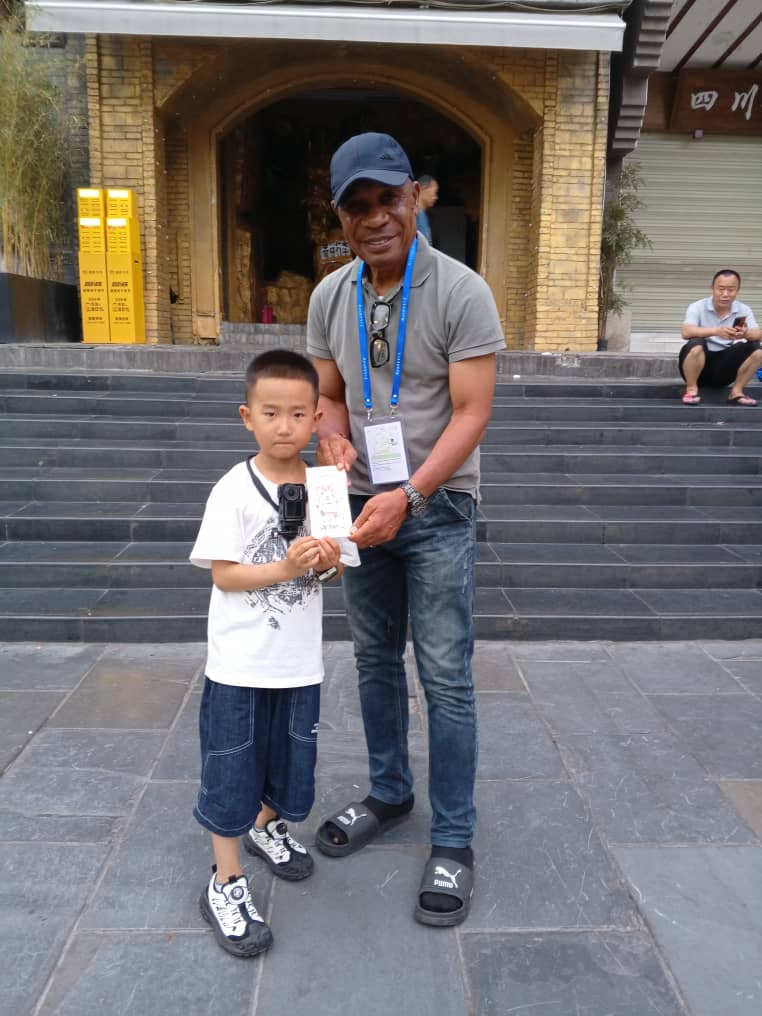
My encounter with a six-year-old boy named Eno. It was a rare encounter that has left an indelible impression on me. Kuanzhai’s Alley is Chengdu’s living room. Red lanterns, teahouse chatter, the smell of spice in the air. We were taking a walk into the Alley when a small voice stopped me. Eno was six. Bright eyes. Questions ready before his hello finished. “Where from? Your name? Do you love football?” At six, he spoke good English. He knew Cristiano Ronaldo. He asked about pandas and why only Chengdu keeps them so close. He asked about the ongoing World Cup in the USA, Canada, and Mexico. He talked like a child with maps and goals in his head, but he listened like someone older. No shyness, no demand. Just courage wrapped in courtesy.
Then came the gesture I did not expect. Eno pressed a small picture of a panda into my hand. “Wish you well,” he said, and gave it free. No blood, no prior knowing. A stranger’s hand, offering love without a sound. I felt it immediately. I had to look away for a second. Because tears rose unbidden. In that moment, Eno was not just a boy in an alley. He was the idea behind GDI made human: spreading love, uniting humanity, one small act at a time. To me, Eno is not just a little boy in an alley; he is China’s welcome, wide and deep.
That small panda picture now lives in my sitting room in Nigeria. I guard it. Some days it’s just paper and ink. Other days it’s a window back to Chengdu, to lantern light, to a boy who decided a stranger should feel welcome.
Eno taught me something the lectures circled but could not say as plainly: kindness needs no reason. It just begins. Love needs no reason to be sweet. If GDI is about building a more connected, equitable world, I saw it in miniature that afternoon. Policy, trade, and technology matter. So do pandas, football, and a child’s unguarded generosity.
I hope to reconnect with Eno someday. Until then, I’ll keep looking for that golden light in Kuanzhai’s alleys, and I’ll keep telling the story of the six-year-old who reminded a visitor from Nigeria that the soul of a city, a nation, can fit in one small hand.
…Philip Nyam participated in the just-concluded Seminar on Young Leaders under the GDI in Beijing.
By Son Tertsea, Abuja
A disturbing development in the Nigerian political space came with the judgment of a Lokoja federal court with its call on INEC to deregister the National Democratic party, NDC.
The devastating effects of this judicial pronouncement on all candidates for the 2027 general elections nominated on the platform of the Nigeria Democratic Congress (NDC) and the entire polls cannot be overemphasised.
The Lokoja Federal High Court Lokoja earlier granted the party recognition as a political party in Nigeria.
Justice Isah Dashen delivered Friday judgement in Suit No. FHC/LKJ/CS/49/2025, to set aside its December 10, 2025 judgment, which had ordered the Independent National Electoral Commission (INEC) to recognise and register the NDC.
The court upheld an application by the Peace Movement Party (PMP), which argued that it was a necessary party in the suit.
The judge further held that failure to include the PMP amounted to a denial of fair hearing and rendered the previous judgment invalid.
Justice Dashen ordered that the parties return to the position they were in before the December 10, 2025 judgment, pending the fresh determination of the substantive case.
The judge also held that some material facts were not brought before it during the earlier proceedings, a development that contributed to its decision to set aside the judgment.
The NDC and the Peter Obi Media Reach (POMR) described the court’s decision as a temporary legal hurdle.
NDC National Chairman, Sen. Moses Cleopas Zuwoghe, said the party had directed its team of lawyers to challenge the order at the Court of Appeal.
In a statement on Friday, Zuwoghe assured the public and candidates of the party in the forthcoming 2027 elections that “our party is on course,” stressing that “the NDC has not been deregistered.”
He stated that: “The public knows that by December 2025, the Nigeria Democratic Congress as an association complained of INEC’s refusal to register us as a political party, whereupon we proceeded to the Federal High Court. The Federal High Court upheld our constitutional right to freedom of association under the Constitution and compelled INEC to register us, which INEC did.
“Since then, we have started political activities, embarked on the registration of members, held congresses from ward to national levels, held conventions and concluded primaries to all offices following INEC’s timetable. We have been fully participating in all INEC activities without let or hindrance.
“NDC also fielded candidates and fully participated in the just-concluded bye-elections in Nasarawa and Enugu states.
“Candidates for the House of Assembly, House of Representatives, Senate, Governorship, Presidential, and Vice-Presidential positions have been duly nominated, and we are in the process of formally submitting them to INEC in accordance with INEC’s timetable.
“The association that filed the complaint is unknown to us. The Peace Movement Party (PMP) is not a registered political party in Nigeria. They claimed, in a motion (not even a substantive suit or appeal), that the court should set aside its earlier judgment on the purported ground that, in 2015, they had sought registration as a political party with the victory sign as their symbol and were denied.
“It is important to note that they are not an association applying for registration now under the exercise that started last year. They are also not a registered political party in Nigeria participating in the political process now, as we are.
“Furthermore, the court, having delivered a final judgment in our suit against INEC, had become functus officio. The court had also dealt with all related issues concerning associations claiming they wanted to use the same symbol and colours. The court, in its judgment, overruled INEC when those issues were raised, and there is no appeal against that judgment.
“Therefore, we are surprised that, on an application by an association claiming that it wanted to register as a political party with the victory sign in 2015, an association that is not a registered political party and is not seeking registration now to participate in the current political process, His Lordship came to the conclusion that they have locus standi, and furthermore, that he has jurisdiction to do what he did.
“Accordingly, we have been informed that His Lordship made an order setting aside the court’s earlier decision of December 2025.
“There was no order directing our deregistration. However, we are dissatisfied with the decision that has been made, and we have instructed our team of lawyers to immediately proceed to the Court of Appeal to challenge the jurisdiction and propriety of His Lordship’s order.
“We assure the general public and particularly our candidates at all levels that our party is on course. The NDC has not been deregistered, and we are challenging today’s order at the Court of Appeal as soon as possible. We have no doubt that justice will be done.”
The party condemned what it described as efforts by those who seek to shrink the democratic space and stifle opposition voices and alternatives.
“Nigerians have a right to a full range of opinions, ideas and alternatives; and political platforms and candidates should be allowed to participate in the 2027 general election process, which has already gone midway.
“It is too late for anyone to attempt to use the judiciary to derail or narrow Nigeria’s multi-party democratic space. If the said association (Peace Movement Party) were a party affected by the judgment on our initial suit, the only option open to it was to appeal the verdict, an option which it did not take. Even at that, the window open for such appeal has since closed and any such appeal by now has become statute-barred.
“To now try to upturn that verdict through the back door, via a motion, is not only unheard-of, but also illegal and an outright abuse of court process.”
The judgment is coming exactly 10 days after the Court of Appeal in Abuja ordered a stay of execution of the judgment of the Federal High Court, Abuja, ordering INEC to deregister the African Democratic Congress (ADC), Action Peoples Party (APP), Action Alliance (AA), Accord Party (AP), and Zenith Labour Party (ZLP).
The three-member panel of the appellate court led by Justice Abubakar Mohammed, accused Justice Peter Lifu of the Federal High Court in Abuja of flouting an order it made on May 22, which directed him to suspend proceedings before him.
The appellate court had held that Justice Lifu’s action amounted to an affront and judicial rascality on the hierarchy of courts.
It described the lower court’s action as “the highest form of judicial impertinence,” stressing that the Supreme Court previously held that a judge who acted in such manner “is unfit for the bench as it amounts to judicial rascality.”
Legal luminary, Femi Falana in statement entitled ‘Nigerian Judges and Lawyers Should Be Prevented From Sabotaging the 2027 Election,’ expressed concern over recent judgments delivered by judges of the Federal High Court on the powers of INEC regarding election timelines.
The senior advocate recalled that Justice Mohammed Umar of the Federal High Court invalidated INEC’s timeline for the conduct of party primaries and nomination of candidates ahead of the 2027 elections.
The court also nullified INEC’s May 10 deadline, directing political parties to submit their membership registers and databases as part of the requirements for participation in the polls.
According to him, the court held that the timeframe announced by INEC for political parties to conduct primaries and submit, withdraw, or replace candidates “is inconsistent with the provisions of the Electoral Act, 2026.”
The suit was filed by the Youth Party against INEC
He further noted that INEC had appealed the ruling and filed a motion for a stay of execution pending the Court of Appeal’s determination of the appeal.
Falana said the situation became more complicated after another judge of the Federal High Court, Justice James Omotosho, ruled in a separate suit filed by the Social Democratic Party (SDP) that INEC possesses the constitutional authority to fix timelines for political party primaries and other electoral activities ahead of the 2027 elections.
He argued that the two judgments created uncertainty within the political system.
Therefore, he urged NJC and NBA to urgently investigate the circumstances surrounding the judgments in Youth Party vs. INEC and SDP vs. INEC, warning that failure to address the issue could threaten the credibility of the 2027 elections.
He added that judges and lawyers must avoid actions capable of undermining the credibility of future elections, warning that legal disputes should not become tools for disrupting democratic processes.
He drew parallels with Nigeria’s political history, warning that failure to address the situation immediately could reopen painful memories of 1993. He warned:
“Unless the judges and lawyers involved are called to order, the 2027 election may be sabotaged by judges and lawyers.”



Mother Subjects Daughter to Abuse, Admits: “I made $300 from my 8-yr-old daughter’s pornographic video’
Spread the loveBy Nick Ibe The viral video on the social media involving an 8-year old girl whose ordeal was...

Lawyer Assaulted by Police: NBA Gboko Branch Secures N500 Million General and Exemplary Damages in Makurdi Court
Spread the loveBy Our Reporter In the pursuit of justice for a colleague, B. B. Iliamkondo, Esq., who was recently...


Alia Denounces Ayilamo Attack, Commiserated With Victims as DSS Arrests 3 Suspects
Spread the loveBy Felix Umande Governor Hyacinth Alia of Benue State has strongly condemned the deadly attack on Ayilamo Community...

Alia Condemns Ayilamo Attack, Commiserates With Victims, As DSS Arrests 3 Suspects
Spread the loveBy Felix Umande Governor Hyacinth Alia of Benue State has strongly condemned the deadly attack on Ayilamo Community...


FG, States, Be warned We Will Strike, Without Warning –ASUU
Spread the loveBy Nick Ibe, Abuja Without urgently resolving all the pending salary and welfare issues, by the Federal Government...
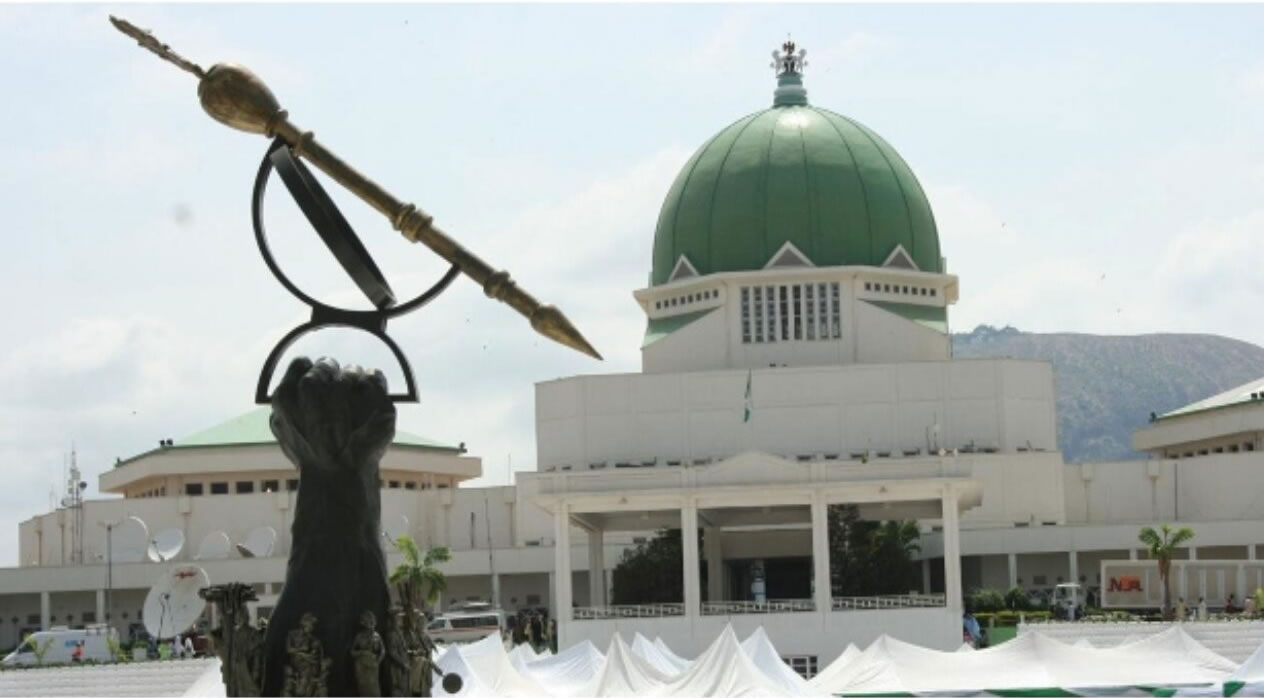
Protest Against Xenophobia: NASS Orders Boycott of South African Organised, Hosted Legislative activities
Spread the love–Calls on State Assemblies to join By Isa Abdul, Abuja In a bold move against South Africa’s xenophobic...

Why Education is Dear to Me – By Peter Obi
Spread the loveAfter returning to Abuja on 8th September 2026, following our visits to Benue and Plateau States, I travelled...

After Two Decades: FG Pays 2,700 ex-Nigeria Airways Staff N18bn
Spread the loveBy Son Tertsegha, Abuja Over two decades after the national carrier, Nigeria Airways, was liquidated, the Federal Government...

To Boost Sch Enrollment: Nasarawa Plans Mobile Courts To Arrest, Prosecute Parents Of Out Of School Children
Spread the loveBy Michael Lim, Jos As part of measures to tackle the growing number of out-of-school children in Nasarawa...

Akume to Religioud Leaders Make Peacebuilding Part OF National Security Ahead of 2027
Spread the loveBy Felix Umande The Secretary to the Government of the Federation, Senator Dr. George Akume, CON, on Wednesday...