
Food and Agriculture
FG’s Six Locations for Pilot Ranching Programme


By Isa Abdul, Abuja
Six locations in five states and the Federal Capital Territory, FCT, have been chosen by the Federal Government for the pilot implementation of its National Ranching Policy.
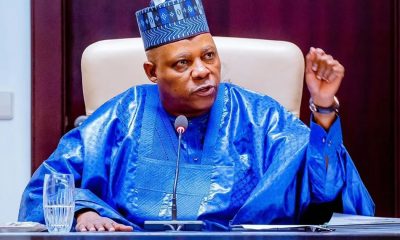
Minister of Livestock Development, Alhaji Idi Maiha, disclosed this after briefing President Bola Tinubu on the ministry’s activities at the Presidential Villa, Abuja, on Tuesday.
Maiha revealed that the pilot programme would commence at the Wase Grazing Reserve in Plateau as the model concept for the new ranching programme.
The five states identified for the pilot programme and FCT are Adamawa, Benue, Kaduna , Nasarawa and Plateau.
He said the areas were selected because they have recorded some of the highest incidences of farmer-herder conflicts in recent years. In his words:
“Our understanding is that large numbers of cattle on the move are crisis-prone because grazing routes have disappeared due to farming, urbanisation and infrastructure development.
“Nomadism, as we know it, is no longer sustainable and we need a different concept.”
The minister added that the government had engaged more than 34 pastoral organisations and would continue consultations to build support for the policy.
He said the ministry recently met pastoralist leaders under the leadership of the Sultan of Sokoto, Alhaji Muhammadu Sa’ad Abubakar III, and would hold another engagement within two weeks.
The minister said the policy would encourage pastoralists to rear animals in designated locations rather than move them over long distances in search of feed and water.
“Today, we go and fetch the grass and bring it where the animals are. Better still, grow the grass where the animals are.
“There are genetically developed grasses with all the nutritional value required to feed livestock,” he said.
Maiha said the government would provide housing, veterinary clinics, schools, primary healthcare centres, solar lighting and water infrastructure in designated ranching communities.
He added that each grazing reserve would evolve into an economic hub capable of attracting milk processors, modular abattoirs, bio-digesters and other livestock-related businesses.
“Imagine what you are going to have if you have 30,000 herds of cattle in one area. The milk collection alone will attract processors and many other investments,” he said.
The minister said the Federal Government was also implementing a nationwide livestock identification programme using radio frequency technology.
According to him, all four-legged livestock would be tagged for identification, geolocation and proof of ownership.
He said the initiative would help combat cattle rustling, recover lost animals and build a comprehensive national livestock database.
Maiha said the ministry was also promoting dairy development, commercial fodder cultivation, modern abattoirs, veterinary services and poultry production.
He disclosed that seven model veterinary clinics had been established, with plans to provide at least one model veterinary hospital in every state.
The minister added that the government was strengthening vaccine storage facilities and encouraging investments in dairy and red meat value chains.
On the ministry’s progress, Maiha said about 20 states had established similar livestock ministries or agencies, reflecting growing acceptance of the Federal Government’s livestock development agenda.
He commended Tinubu for his support and commitment to transforming the livestock sector.
He quoted the President as saying, “The value chains in the livestock sector are fantastic,” while urging Nigerians to take advantage of opportunities in the industry.
Even though five states, and the FCT have been selected for the pilot model, only Wase in plateau state has been clearly mentioned as a designated site.



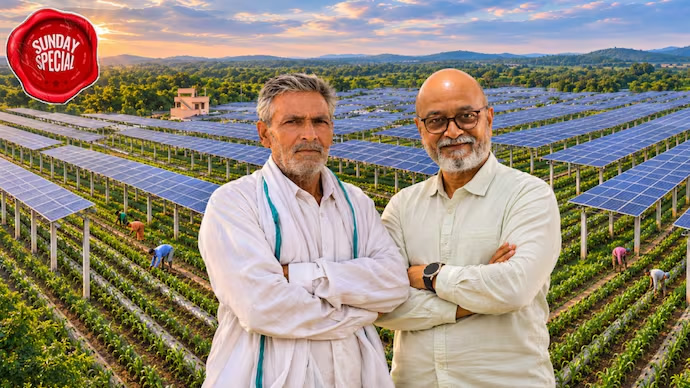
In India, a small but growing number of farmers are cultivating crops on their land while selling electricity generated by solar panels above.
The technological innovation, called agrivoltaics, is turning the same piece of land into two sources of income, with a Rajasthan farmer earning 10 times more than earlier.
Indian farmers are making this possible with crops beneath solar panels, and agrivoltaic plants on his farmland. is experimenting with crops beneath solar panels, and Anand Jain is exploring to add more agrivoltaic plants on his farmland.
A couple of years back, Kajod Mal Jat, a farmer from rural Jaipur in Rajasthan, having become an urjadata (energy provider), missed being an annadata (food provider). The solar panels he had put up on his field were generating electricity and money. But the land beneath them could no longer grow crops. Similarly, hundreds of kilometres away, in Madhya Pradesh’s Sagar district, innovator-farmer Anand Jain was determined not to let solar panels take away his joy of farming.
Today, both farmers are growing cash crops on their farms beneath and generating electricity from solar panels above, which they are selling to the government and earning big. Jat and Jain are annadatas and urjadatas at the same time. And, this has been made possible by a technology called agriphotovoltaics, or Agri-PV, or agrivoltaics, which combines farming and solar power generation on the same piece of land.
The technology, now taking its first steps on the ground in India, promises to revolutionise agriculture by boosting farmers’ incomes severalfold.
It’s already doing so.

By Lazarus Oko
By reducing farmers’ dependence on rainfall and attracting carbon credit financing for agricultural projects, the National Agricultural Land Development Authority on Tuesday revealed it is developing climate-smart farm estates powered by solar energy and electric machinery.
This was disclosed at a session on Green Industrialisation, Critical Minerals and Energy Security at the 2026 United Nations Climate Change Conference in Antalya, Türkiye, by the Executive Secretary and Chief Executive Officer of NALDA, Cornelius Adebayo, .
The CEO spoke during the session, which focused on climate-smart farming, stating that the agency was piloting a farm estate where land clearing would be done with electric bulldozers, while electric tractors were solar-powered. In his words:
“Our hope as an agency is to earn carbon credits from such farm estates and farm locations.
“We use zero-emission areas. We’re introducing electric bulldozers; we’re introducing electric tractors in that particular location. And we are introducing solar power irrigation for full irrigation of the scheme. Everything, every single thing within that facility is climate conscious. Every single thing. And that is our first location that is supposed to be a fully clean location.”
The agency’s plan comes as Nigerian farmers contend with increasingly unpredictable rainfall, which has disrupted planting seasons and exposed rain-fed agriculture to climate risks.
Adebayo said the experience of the current planting season had reinforced the need to move towards irrigation-based farming.
In his words, “The rains were not predicted in Nigeria. And the farmers- a lot of farmers that don’t do the planting yet were the lucky ones. The ones that did the planting were quite unlucky this year. So it shows that we need to move from rain-fed to climate-smart to irrigation-based farming. And this is one direction that Nigeria is going in headway.”
NALDA was working with investors to provide solar irrigation facilities to farmers, with users paying for the services based on the hectares cultivated, he disclosed. The model, he said, would make the facilities easier to extend to more farming communities.
However, the chief executive acknowledged that electric machinery and clean-energy systems cost more than conventional equipment. But the Bank of Industry and other development finance institutions were bridging the financing gap by providing capital at lower interest rates.
NALDA boss further stated that the agency is promoting an anchor-based farming arrangement designed to reduce the financial burden and production risks faced by smallholder farmers.
Under the model, farmers receive land, training, extension services, seeds, fertiliser and other inputs through an anchor investor. The investor also arranges mechanisation services and buys the produce after harvest, deducting the cost of services and inputs supplied.
Adebayo said the arrangement meant farmers would not have to raise all the capital needed to cultivate their land before planting.
“The person that is taking the risk for that expansion is the anchor, not the smallholder. So it’s just making everything easier for that smallholder farmer to scale up. If the crop fails, it’s really the anchor that takes the hit,” he said.
He added that agricultural insurance and risk-sharing institutions would provide additional protection, although the anchor investor would bear the largest share of the production risk.
The agency is also linking farm development to rural security, arguing that farmers working in organised clusters are easier to protect than those operating on scattered plots.
Adebayo said NALDA planned to use drones to monitor farm boundaries and detect threats around its estates, while security agencies could be deployed more effectively to concentrated farming communities.
He said the model was also intended to attract young people by providing housing, solar-powered electricity, clean water and recreational facilities within farm settlements.
NALDA was established in 1992 under an Act of Parliament to support agricultural land development, improve the use of rural land resources, expand food production and create employment.
The authority was reactivated in 2020 after years of inactivity, with integrated farm estates among its programmes.
In a separate technical presentation at the Nigerian Pavilion, NALDA outlined how its Green Hope Project was combining agroforestry, food production and youth participation to address environmental degradation and strengthen food security.
The CEO’s Special Adviser on Projects, Al-Mustapha Ibrahim, said the agency’s Green Hope Project had mobilised more than 400 volunteers to plant approximately 5,000 trees across five sites in Ogun, Plateau, Kwara states and the Federal Capital Territory.
The project covered 50 hectares and included mango, avocado and coconut trees intended to support both environmental restoration and future food production.
The sites include Odogbolu in Ogun State, where 1,000 trees were planted across 10 hectares with 80 volunteers; Barkin Ladi in Plateau State, with 500 trees across five hectares and 40 volunteers; and Oke Onigbin in Kwara State, where 1,500 trees were planted across 20 hectares with 120 volunteers.
The remaining locations are Iporin in Kwara State, where 1,000 trees were planted across five hectares with 80 volunteers, and the University of Abuja, where another 1,000 trees were planted across 10 hectares with 80 volunteers.
The presentation identified mango, avocado and coconut among the food-producing tree species planted under the initiative. Beyond restoring vegetation, the trees are expected to provide fruits for household consumption and commercial sale as they mature, creating additional income opportunities for farming communities.
NALDA said the initiative was designed to make environmental restoration part of agricultural production rather than treating tree planting as a stand-alone exercise. The trees are expected to improve land cover, protect soil, support biodiversity and strengthen the resilience of agricultural landscapes to climate-related pressures.
The agency further incorporated perimeter fencing to protect newly planted areas, stressing the need for site protection and post-planting management to ensure the trees survive and mature.
The project received support from the Agricultural Research and Training Institute, the National Council on Climate Change and the National Horticultural Research Institute.
The collaboration, according to the presentation, demonstrated the importance of partnerships among government agencies and technical institutions in addressing agricultural and environmental challenges.
The initiative also targets young people through practical participation in tree planting and environmental education, with more than 400 volunteers involved in the first phase, giving them opportunities to work with agricultural and environmental stakeholders and build experience in sustainable agriculture.
By Felix Umande
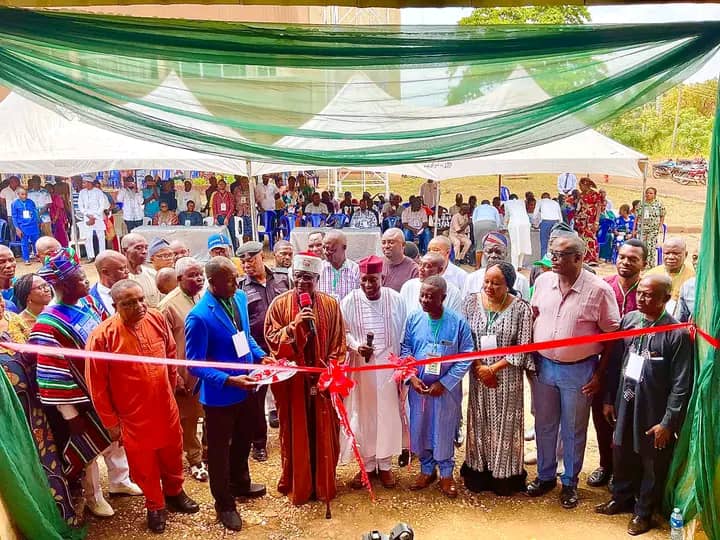
The Och’Idoma and Paramount Ruler of Idoma Kingdom, His Royal Majesty, Agabaidu John Elaigwu Odogbo, on Tuesday flagged off the office of the MATAN Food Bank Professional Association of Nigeria and its 21-Pillar Stakeholders’ initiative in Benue State.
The ceremony, which took place at the Bank of Agriculture, Makurdi on Tuesday, 3rd November 2026, was attended by government functionaries, traditional rulers, religious leaders and other stakeholders.
Speaking as both Och’Idoma and Patron of the Association, the monarch said food security must become a collective national priority, stressing that no society can attain sustainable prosperity when a significant portion of its population struggles to access adequate and nutritious food.
“Food is central to human existence, dignity, peace and national development,” he said, noting that Benue as the Food Basket of the Nation has the agricultural potential to transform its economy, but that potential must be translated into measurable productivity, income, employment and food availability.
The royal father charged the Association to move beyond meetings and ceremonial engagements to visible impact in the lives of people, measured by the number of families empowered, households supported, youths encouraged and jobs created. He also assured the leadership of his goodwill and support for initiatives that advance food security and sustainable agriculture.
He commended the Benue Chapter for adopting the 21-Pillar framework, describing it as a symbol of stability, structure and sustainability, but cautioned that the pillars must be developed into actionable programmes addressing real needs, including smallholder farmers’ empowerment, youth participation in agribusiness, women empowerment, community food banks, food processing and storage, agricultural financing, market access and skills acquisition.
The monarch further stressed the role of traditional institutions as indispensable partners in grassroots development and called for practical partnerships to encourage youths to embrace agriculture as a profitable venture.
Also speaking, the Special Adviser to the Benue State Governor on Internal Security, Chief Dr. Joseph Har, said without physical security, food security cannot be guaranteed. He noted that security challenges in the state have improved compared to the past and assured that government is determined to make the situation better.
In an interview with newsmen, the National Vice President, Contact, Mobilisation and Organisation of MATAN Food Bank Professional Association of Nigeria, Comr. Ikpe David Idah, said the event marked the official declaration of the Association’s office complex in Makurdi by its Patron, the Och’Idoma, and the kick-off of the 21 pillars in Benue as one of the pilot states in the North Central.
He listed some of the pillars to include MATAN Food Bank Foundation, MATAN Mobility, Community Food and Nutrition Resilience Initiative, Street Feeding, Pan-African and inter-regional commodity exchange, among others contained in the organisation’s profile.
According to him, the primary aim of the Association is to end hunger and ensure not just food sufficiency, but nutrition in quality, quantity and proportion, with laboratory testing and medical certification of food before distribution to the public.


Tinubu Unveils Five-year Defence Plan To End 17-year Insecurity, Recruits 78,000 Soldiers
Spread the loveBy Felix Umande President Bola Tinubu is determined to end the 17-year scourge of insecurity ravaging parts of...


As Tinubu Supporters and Saboteurs Claim Arises: Benue APC Split Deepens
Spread the loveBy Felix Umande The crisis in the Benue State chapter of the All Progressives Congress has deepened, with...


Dangote Refinery IPO Nets ₦5.85 Trillion From 3.8 Million Investors
Spread the loveBy Seyi Balogun, Lagos Following the overwhelming response to Dangote Petroleum Refinery’s initial public offering (IPO), attracting share...


Dangote Sinotruk’s First Locally Assembled Electric Trucks Out in Lagos
Spread the loveBy Seyi Balogun, Lagos A new phase in Nigeria’s automotive manufacturing industry and its transition to cleaner transportation...


52 African Countries Converge on Abuja for Asset Recovery, Corruption Discourse
Spread the loveBy Son Tertsea, Abuja The first General Assembly of the African Asset Recovery Practitioners Forum (AARPF), scheduled to...


Three Travellers Kidnapped, Driver Shot by Gunmen in Benue South
Spread the loveBy Lazarus Oko Three travellers have been kidnapped and a driver shot by gunmen during an attack on...


SCD: Before Marriage, Know Your Genotype Kwara Tells Youths– Parents Tasked
Spread the loveBy Lazarus Oko As a deliberate effort to curb the prevalence of sickle cell disease, the Kwara State...

Indian Farmers Growing Food below, Generating Power Above Earn 10 Times More
Spread the loveIn India, a small but growing number of farmers are cultivating crops on their land while selling electricity...


JAMB’s New Tech for Easier Registration, Exam Fraud Check, CBT Centres’ Monitoring –Registrar
Spread the loveBy Son Tertsea, Abuja Ahead of the 2027 Unified Tertiary Matriculation Examination, UTME, the Joint Admissions and Matriculation...


Benue APC Split Deepens As Akume Group is Tagged “Saboteurs not Supporters of Tinubu”
Spread the loveBy Felix Umande The crisis in the Benue State chapter of the All Progressives Congress has deepened, with...