
Article
Why Nigeria Should Present Amina Mohammed Africa’s Next UN Secretary-General Candidate

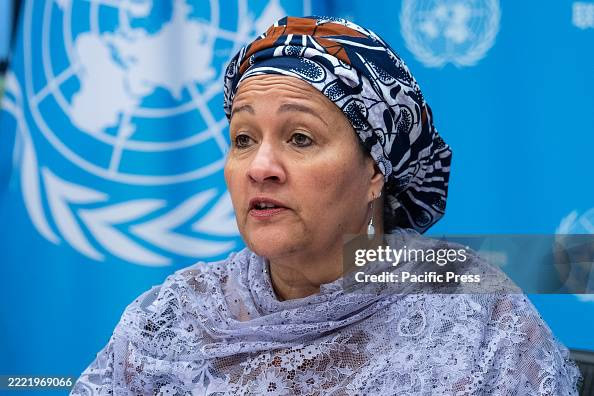
By Aisha I. Dankani
With the tenure of António Manuel de Oliveira Guterres, as the Secretary-General of the United Nations gravitates to an end in January 2027, the world’s attention is increasingly turning to what matters most to keep the global body tick: the search for credible candidates capable of leading the world through one of its most turbulent periods in modern history.
With Nigeria lucky to have many great nationals, especially Amina Mohammed, it behoves her to do the needful: present her as Africa’s next UN Secretary -General candidate.
The conflicts in Europe and the Middle East, climate change, widening poverty, humanitarian emergencies, migration, technological disruption and growing distrust among nations demand a leader of uncommon experience, diplomacy, integrity and vision.
Against this backdrop, the recent article: Overlooked by the President, published by LEADERSHIP newspapers on July 5, 2026 and reproduced on the Phoenix app, raises an important question that deserves thoughtful national debate:
Why has Nigeria not formally presented one of its most distinguished daughters, Amina J. Mohammed, for the highest office in global diplomacy?
It is a legitimate question. For if the world seeks competence, experience and credibility, few candidates can rival Amina Mohammed.
Her credentials are exceptional. Before becoming Deputy Secretary-General of the United Nations in 2017, she had already established herself as one of the foremost architects of the global development agenda. As special adviser to former Secretary-General Ban Ki-moon, she led the process that culminated in the adoption of the historic 2030 Agenda for Sustainable Development and the Sustainable Development Goals (SDGs), the blueprint that continues to guide international efforts to eradicate poverty, protect the planet and promote prosperity for all.
Today, as Deputy Secretary-General and Chair of the United Nations Sustainable Development Group, she coordinates the UN development system across the globe, helping shape responses to climate change, humanitarian crises, sustainable development and international cooperation. Few individuals possess such an intimate understanding of the workings of the United Nations.
Yet, before the world came to know Amina Mohammed, Nigeria already did. She served with distinction under successive administrations, beginning with former President Olusegun Obasanjo, where she played an important role in managing the implementation of debt-relief gains for poverty reduction and development. She later served former President Muhammadu Buhari as minister of environment, where she strengthened Nigeria’s engagement on climate policy and sustainable environmental management. Her career is remarkable for transcending partisan politics while remaining firmly anchored in national service.
International recognition naturally followed. Her work attracted the admiration of leading development partners, including Bill Gates and earned her widespread respect across the global development community.
But perhaps her greatest achievement lies beyond offices and titles. Amina Mohammed has become one of the strongest symbols of what the modern northern Nigerian woman can aspire to become.
A proud daughter of Gombe State, she has remained deeply rooted in her Islamic faith and northern identity while emerging as one of the world’s foremost advocates of sustainable development, climate justice, education, women’s inclusion and human dignity.
She has demonstrated that faith and progress are not mutually exclusive. She has shown that one can remain proudly Muslim, proudly northern and proudly Nigerian while providing leadership at the highest levels of international diplomacy.
To millions of young girls across Arewa, especially within the core Muslim North, she represents hope. She is living proof that education, character, faith and excellence can carry one from northern Nigeria to the highest councils of the international community.
She has become, in many respects, the poster figure for educated Muslim women in northern Nigeria.
Even while serving humanity globally, she has never forgotten home. Following the election of Governor Muhammadu Inuwa Yahaya of Gombe State (APC) in 2019, Amina Mohammed accepted the responsibility of chairing the transition committee that prepared the incoming administration for its exceptional service to Gombe in the past seven years. Serving alongside distinguished Nigerians of Gombe extraction, including Dr Sadiq Umar Abubakar, who was deputy chairman, she once again demonstrated that international responsibility does not diminish commitment to one’s community. This combination of global excellence and local commitment is rare. President Bola Ahmed Tinubu, therefore, has before him a rare opportunity.
However, a Nigerian nomination would not guarantee Amina Mohammed’s election. The selection of a United Nations Secretary-General is ultimately determined through consultations among member states, with the decisive role played by the United Nations Security Council before confirmation by the General Assembly. Nevertheless, Nigeria’s nomination and formal endorsement, which we expect soon, would send a powerful message. It would proclaim that Nigeria believes in merit. It would demonstrate confidence in one of its finest public servants. It would affirm Nigeria’s readiness to compete for leadership at the highest level of international diplomacy. And it would present Africa with a candidate whose credentials command respect across continents.
Such a decision would also resonate positively within northern Nigeria.
Many in Arewa increasingly seek reassurance that competence and excellence from the region continue to receive national recognition.
Supporting Amina Mohammed would not be an act of regional favouritism, it would simply acknowledge that one of Nigeria’s most accomplished daughters happens to come from the North.
Indeed, this is not about North versus South, it is not about party politics; it is not even primarily about President Tinubu, it is about Nigeria presenting its best to the world. Great nations proudly advance their finest citizens; Nigeria should not be any different.
History may yet decide who succeeds António Manuel de Oliveira Guterres. That decision ultimately belongs to the international community.
But history will also record whether Nigeria recognised excellence when it stood before us.
There is an old saying: If the cap fits, wear it. For Amina Mohammed, perhaps a more fitting expression is: If the scarf fits, Nigeria should proudly present it to the world. She has worn that scarf with dignity, distinction and honour—from Nigeria to New York, from Gombe to the global stage.
She has served humanity with uncommon devotion. She has honoured her country without seeking acclaim. She has inspired generations of young Africans, particularly girls from northern Nigeria, to dream beyond circumstance. Nigeria should now do its part.
Amina Mohammed is not merely Nigeria’s preferred candidate, she is Africa’s choice for the next United Nations Secretary-General.
Aisha I. Dankani, MFR, mni, is President and Convener of Kano LEADS (#DaRUWANA), K’asar Kano’s foremost NGO. She is a retired Director of the Federal Civil Service, a former Chief Magistrate, and an active politician and public affairs advocate from Kano State, Nigeria.






By Celphas Iyorhen
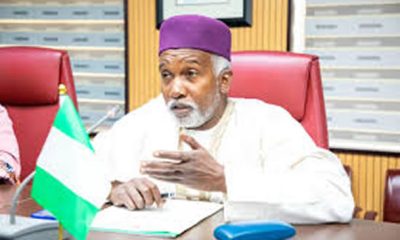
The National Human Rights Commission wants Sheikh Sani Yahaya Jingir arrested for hate speech. It sounds decisive. It sounds like justice is stirring. But when you place that call against the full and documented weight of what Christians in Nigeria have endured under this government, not just from Jingir, but from a parade of voices that have faced zero consequence, the NHRC’s intervention reads less like protection and more like performance. Nigerians deserve honesty, not acting.
Let us begin from the foundation. Before Jingir opened his mouth, the architecture of Christian marginalisation had already been constructed brick by brick. When President Bola Ahmed Tinubu chose a Muslim running mate, Sheikh Ibrahim Aliyu Kaduna had already issued a public threat: pick a Christian running mate and lose Muslim votes. Whether that threat directly shaped Tinubu’s choice is a matter for political analysts. What is not in dispute is that the then candidate, having observed the contempt, the nepotism and the imbalance that defined Buhari’s presidency, found no moral discomfort in replicating the same deviltry. The victims of that era were still counting their dead when the new government arrived in the same morally objectionable appearance.
Then came Professor Ishaq Akintola of MURIC. When the Christian Association of Nigeria raised objections to the Muslim-Muslim ticket, Akintola stepped forward not to address the legitimate constitutional grievance, but to lecture Christians on ingratitude. The framing was chilling in its honesty: appointments given to non-Muslims were not rights, they were favours. By that logic, Christians are guests in their own country, tolerated when convenient and reminded of their second-class status when they complain. The president watched this without a word. Silence, at that level and in that context, is not neutrality. It is endorsement.
In January 2026, the same Akintola wrote an open letter to former Vice President Atiku Abubakar arguing that Nigeria’s structure since colonial days had been built along Christian cultural lines and that this needed to change. Read that carefully. The executive director of a prominent Muslim rights organisation was publicly agitating for a reconfiguration of Nigeria along the lines of an Islamic state, ignoring the rest of the people they consistently referred to as “infidels”. The presidency was not stirred. The NHRC was not alarmed. No arrest was called for.
The Supreme Council for Shari’ah in Nigeria, under Abdurrasheed Hadiyyatullah, went further, criticising the government for appointing Christians at all in what they described as a Muslim administration. This was not whispered in a corner. It was a public declaration that Christian Nigerians have no rightful place in the leadership of their own country. Once again, no consequences followed.
Nasir El-Rufai, whose tenure as Kaduna governor saw Southern Kaduna Christians slaughtered with impunity, spent a significant portion of his post-government life deriding, mocking and bullying Christians in public. The state tolerated him. He only got himself into detention when he turned his aggression toward President Tinubu himself and threatened to remove him from power in 2027. The lesson wrote itself in plain language: in Nigeria today, you may torment Christians without consequence, but the moment you threaten the Jagaban’s mandate, the system moves against you. That is not a government protecting citizens. That is a government protecting itself.
Sheikh Ahmed Gumi has spent years using television stations and social media platforms to justify terrorism and bully its victims simultaneously. He walks free. He speaks freely. He appears freely. He was not important when he was serving in Nigerian military but he is now adore as a man in charge of terrorism.
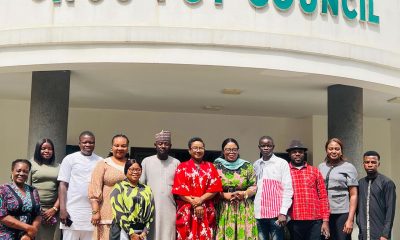
When the Tor Tiv, Professor James Ayatse, stood before President Tinubu after the Yelewata massacre and described with clarity the horror being visited upon Benue State communities, the president heard him. He has heard similar accounts from concerned citizens, from traditional rulers, from the Council of Bishops of Nigeria who sat across from him and told him the truth about what is happening to Christians in this country. The bishops did not go there to flatter him. They went there with documented evidence of a people being killed, displaced and occupied. The president’s visible displeasure at their presentation, followed by attacks on the bishops from voices within the presidency, tells you everything you need to know about where this administration stands.
This is the government the NHRC is now calling upon to arrest Sheikh Jingir.
The Commission speaks of monitoring inflammatory statements, of working with security agencies, of ensuring the 2027 elections are free from hate. These are fine words. But a commission that stayed quiet while MURIC rebranded Christian citizenship as a privilege, while Shari’ah councils demanded a purely Muslim government, while Gumi provided theological cover for terrorists, has lost the people’s trust and credible standing to now perform urgency over Jingir. The selectivity is itself a statement, and that statement is “a joke”.
Christians in Nigeria are not facing a hate speech problem. They are facing a structural, sustained and largely unpunished campaign of elimination, displacement and humiliation, backed by silence from the highest office in the land. Jingir’s words are a symptom. The disease is a presidency that has made its peace with the suffering of its Christian citizens.
Calling for his arrest without confronting that reality is not advocacy. It is noise. And the victims deserve far better than noise.
Celphas Iyorhen
A Concerned Citizen from the Middle-Belt.
THE NHRC’S CALL TO ARREST SHEIKH JINGIR IS AN INSULT TO THE INTELLIGENCE OF THE VICTIMS
Wednesday, 12th August, 2026
The National Human Rights Commission wants Sheikh Sani Yahaya Jingir arrested for hate speech. It sounds decisive. It sounds like justice is stirring. But when you place that call against the full and documented weight of what Christians in Nigeria have endured under this government, not just from Jingir, but from a parade of voices that have faced zero consequence, the NHRC’s intervention reads less like protection and more like performance. Nigerians deserve honesty, not acting.
Let us begin from the foundation. Before Jingir opened his mouth, the architecture of Christian marginalisation had already been constructed brick by brick. When President Bola Ahmed Tinubu chose a Muslim running mate, Sheikh Ibrahim Aliyu Kaduna had already issued a public threat: pick a Christian running mate and lose Muslim votes. Whether that threat directly shaped Tinubu’s choice is a matter for political analysts. What is not in dispute is that the then candidate, having observed the contempt, the nepotism and the imbalance that defined Buhari’s presidency, found no moral discomfort in replicating the same deviltry. The victims of that era were still counting their dead when the new government arrived in the same morally objectionable appearance.
Then came Professor Ishaq Akintola of MURIC. When the Christian Association of Nigeria raised objections to the Muslim-Muslim ticket, Akintola stepped forward not to address the legitimate constitutional grievance, but to lecture Christians on ingratitude. The framing was chilling in its honesty: appointments given to non-Muslims were not rights, they were favours. By that logic, Christians are guests in their own country, tolerated when convenient and reminded of their second-class status when they complain. The president watched this without a word. Silence, at that level and in that context, is not neutrality. It is endorsement.
In January 2026, the same Akintola wrote an open letter to former Vice President Atiku Abubakar arguing that Nigeria’s structure since colonial days had been built along Christian cultural lines and that this needed to change. Read that carefully. The executive director of a prominent Muslim rights organisation was publicly agitating for a reconfiguration of Nigeria along the lines of an Islamic state, ignoring the rest of the people they consistently referred to as “infidels”. The presidency was not stirred. The NHRC was not alarmed. No arrest was called for.
The Supreme Council for Shari’ah in Nigeria, under Abdurrasheed Hadiyyatullah, went further, criticising the government for appointing Christians at all in what they described as a Muslim administration. This was not whispered in a corner. It was a public declaration that Christian Nigerians have no rightful place in the leadership of their own country. Once again, no consequences followed.
Nasir El-Rufai, whose tenure as Kaduna governor saw Southern Kaduna Christians slaughtered with impunity, spent a significant portion of his post-government life deriding, mocking and bullying Christians in public. The state tolerated him. He only got himself into detention when he turned his aggression toward President Tinubu himself and threatened to remove him from power in 2027. The lesson wrote itself in plain language: in Nigeria today, you may torment Christians without consequence, but the moment you threaten the Jagaban’s mandate, the system moves against you. That is not a government protecting citizens. That is a government protecting itself.
Sheikh Ahmed Gumi has spent years using television stations and social media platforms to justify terrorism and bully its victims simultaneously. He walks free. He speaks freely. He appears freely. He was not important when he was serving in Nigerian military but he is now adore as a man in charge of terrorism.
When the Tor Tiv, Professor James Ayatse, stood before President Tinubu after the Yelewata massacre and described with clarity the horror being visited upon Benue State communities, the president heard him. He has heard similar accounts from concerned citizens, from traditional rulers, from the Council of Bishops of Nigeria who sat across from him and told him the truth about what is happening to Christians in this country. The bishops did not go there to flatter him. They went there with documented evidence of a people being killed, displaced and occupied. The president’s visible displeasure at their presentation, followed by attacks on the bishops from voices within the presidency, tells you everything you need to know about where this administration stands.
This is the government the NHRC is now calling upon to arrest Sheikh Jingir.
The Commission speaks of monitoring inflammatory statements, of working with security agencies, of ensuring the 2027 elections are free from hate. These are fine words. But a commission that stayed quiet while MURIC rebranded Christian citizenship as a privilege, while Shari’ah councils demanded a purely Muslim government, while Gumi provided theological cover for terrorists, has lost the people’s trust and credible standing to now perform urgency over Jingir. The selectivity is itself a statement, and that statement is “a joke”.
Christians in Nigeria are not facing a hate speech problem. They are facing a structural, sustained and largely unpunished campaign of elimination, displacement and humiliation, backed by silence from the highest office in the land. Jingir’s words are a symptom. The disease is a presidency that has made its peace with the suffering of its Christian citizens.
Calling for his arrest without confronting that reality is not advocacy. It is noise. And the victims deserve far better than noise.
Article
I Stand With the Catholic Bishops’ Conference of Nigeria (CBCN) on their Pastoral Visit to the President of the Federal Republic of Nigeria

By Timothy Dokpesi AdidiDear Church Fathers,
You have once again rekindled the hope of the Church. I am writing this open letter to you as a member of the Catholic community in Nigeria and a product of the Church. I am writing this letter not out of sentiment (although it will be interpreted as such) but out of a burning desire to put in perspective what the Catholic Church stands for. Your visit to President Bola Ahmed Tinubu of the Federal Republic of Nigeria was not necessarily political, as understood and misinterpreted. The joy of this visit lay in the collegial dimension it took on. It really brought out the beauty of the Catholic Church as known in the era of the Church Fathers through the ages. Your voice represented the old long saying, ‘Roma locuta est, causa finita est’ (Rome has spoken and the case is finished). A saying that comes from an early fifth-century sermon by Saint Augustine of Hippo, who stated, “The two councils sent their decrees to the Apostolic See, and the decrees quickly came back. The cause is finished.”
Your Excellencies, the visit was indeed timely and necessary. It reflects the unity and oneness of the Catholic Church. This was quite different from the usual ‘one-man squad,’ which sometimes confuses the true nature and identity of the Catholic Church. The visit you had definitely puts an end to the difference between when one speaks from the church and for the church. Your voice has changed the narrative in the nation’s political landscape, and these changes have given the Church a ray of hope in the current economic realities that confront the poor. Your Excellencies, you have also brought to the limelight the Catholic Social Teachings (CSTs). It has become very obvious that the CSTs are not theoretical; they are alive and impactful.
More so, in this regard, you have also reiterated and unraveled the concept of the Church as the Family of God, which was famously highlighted and formally adopted as the guiding pastoral image for the Church in Africa during the “Special Assembly for Africa of the Synod of Bishops” in 1994 and subsequently promulgated by Pope John Paul II in his post-synodal apostolic exhortation, “Ecclesia in Africa” (1995). As the President of the CBCN, Most Rev. Dr. Matthew Man-Oso Ndagoso was reading the mind of the Church; I truly see what the Catholic Church represents.
The Church is known to be non-partisan. This nonpartisan dimension of the Church is indifferent to the realities that characterize the membership of political parties that reside in the Catholic community.
The Catholic Church represents the true Body of Christ but does not belong to any political party. Hence, it underscores the fact that it is this nature of the Catholic Church that gives it the prerogative to speak truth to power. Your Excellencies, you indeed spoke truth to power. It reminds me of the draconian days of Sani Abacha when the likes of Bishop Matthew Hassan Kukah (then Fr. Kukah) and Fr. George Ehusani spoke truth to power as they constantly used the Catholic Secretariat to engage the military government.
Your Excellencies, you have done what you ought to do, and the world has seen your significant effort in calling a spade a spade. Your message defied any form of diplomacy and corporate negotiation. It was firm and without fear of intimidation. The gleaming red buttons and the red colors on your cassock reflect your acceptance of the consequences of your position you were ready to take. You were ready to die for the sake of the truth. You were ready to become martyrs for the sake of the members of the Catholic community and all of Christendom, knowing full well that the blood of martyrs is the seed of Christianity. You took the risk to surrender your lives like the Good Shepherd who laid down His life. This you have done for Nigeria and Nigerians. It is also important to know that you have done this not for the Catholic community alone; you have added your voice to liberate Nigerians and Africa by extension. You have set the path for economic recovery.
It is indeed worthwhile to know that the Prophetic mission of the faith is very much alive. Again, you have re-echoed the true understanding of prophecy in Ancient Israel. Your prophetic voice stands out against the misunderstanding of Biblical prophecy. A prophet is not a soothsayer, nor is he a prognosticator, neither is he person who forecast the future. A prophet is a mouth piece of God; he is one who addresses the socio-economic and political condition of his time and addresses the ill; thereby warning the leaders to do what is right or else face the wrath of God. You have issued a warning to the leaders of our time. May they take heed and let no one lead them astray.
On this note, I commit myself to the fidelity of the faith as seen in the Catholic Social Teachings and as deposited in the authority of your mission as Fathers of the Faith. In so doing, I renew my baptismal promises to align with the Faith that was handed over to you through the apostles. May your faith in the teachings that were handed down to you through the Apostles be constantly renewed and reinvigorated.
By Timothy Dokpesi Adidi, PhD
Article
Media Expo, Backlash From Soccer Governing Bodies: Is this the Road to Infantino’s Tragic End?
By Son Tertsegha, Abuja
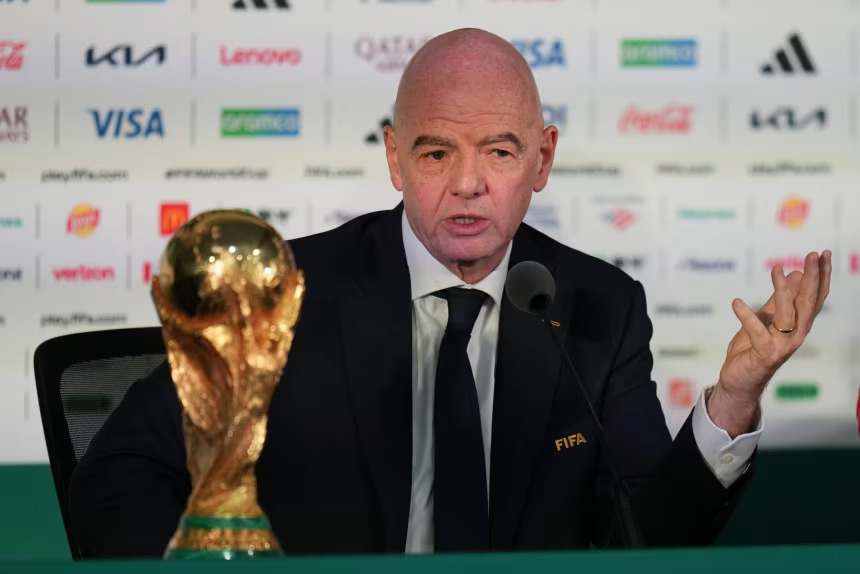
FIFA, world soccer’s governing body, and the man at its helm, Infantino, yet to revel in the euphoria of the successful, unprecedented dollar haul from the 2026 world cup, launched a controversial idea called FIFA Forward Enterprise, or FFE, that would have changed world cup history and financing: allowing billions of dollars in private commercial investment in the game.
But the predictable turn of dangerous signals from soccer bodies against his plans, FIFA President, Gianni Infantino, caved in. He reversed himself with the statement Friday evening that:
“Having listened carefully to all the views, it has become clear that the project has created divisions of a nature that, regardless of the level of support, are no longer in the interest of the objective set out in the first place.”
First to spill the beans earlier last week, was the British newspaper, The Times, which exposed the secret FIFA Forward Enterprise, or FFE, deal under which FIFA would have created a commercial rights and event operations company, 20% of which was to be sold to private investors with FIFA retaining ownership of 80%
The next pain in FIFA’s, precisely Infantino’s, neck was the prompt, fierce opposition from UEFA’s reaction, calling the proposal “irresponsible and indefensible.” It stated further that:
“The World Cup cannot be treated as an investment product,” stressing, “It is one of football’s greatest sporting legacies,” and that “the World Cup is not for sale.”
Coming out next was North America’s soccer governing body, the 41-member Confederation of North, Central American and Caribbean Association Football (CONCACAF) which rejected the plan, questioning “the need for private equity investment to fund new and existing FIFA Forward programs following the most profitable FIFA World Cup in history.”
CONCACAF, however, stopped short of making a boycott threat.
Then, on Friday, the Asian Football Confederation followed without clearly rejecting the plan, only to say that it stood “in solidarity with UEFA and CONCACAF in expressing serious concerns over FIFA’s proposal to introduce private investment into FIFA’s flagship competitions and the decision-making process around FFE.”
Further harm was to come on Friday, when Carlos Cordeiro, one of Infantino’s senior advisers, threw in the towel, saying in a statement that he could not “stand by while FIFA considers selling a stake in the World Cup.”
But Infantino’s defence that “The FIFA Forward Enterprise project was intended to provide a basis for further strengthening our FIFA Member Associations and our sport worldwide, especially in those countries where support is most needed,” in the morning of Friday, fell flat with Cordeiro’s resignation in the day.
Consequently, Infantino had to entirely drop the idea in the evening of the same day.
Intriguingly, the FFE saga has the image of President Trump and his son-in -law’s Kushner family looming large in the dark.
For different reasons, Infantino has reportedly received “mounting criticism in recent months over his close relationship with Mr. Trump leading up to the 2026 World Cup, which the U.S. hosted with Mexico and Canada. Last year, Infantino awarded Mr. Trump the inaugural FIFA Peace Prize.”
Earlier last month, during the World Cup tournament, the soccer world exchanged Mr. Trump said he pressed Infantino to review the red card that was given to U.S. striker Folarin Balogun during a knockout game against Bosnia and Herzegovina. Under FIFA rules, the red card required that Balogun be suspended for the team’s next match against Belgium.
“All I did, I asked for a review because I didn’t think it was a foul,” Mr. Trump said at the time. “… If they wouldn’t allow, you know, a top player, maybe the best, maybe among the best players on the team, I think it would have had a big stain. And I related, just that, I didn’t tell him what to do, I can’t tell him what to do.”
Curiously, in an unprecedented move, FIFA overturned Balogun’s suspension one day before the Belgium match, and without a detailed explanation.
FIFA confirmed in an earlier statement that Thrive Eternal, a venture spearheaded by Joshua Kushner, the brother of President Trump’s son-in-law Jared Kushner, was “expected to lead the proposed investor group.” Thrive Eternal is a subsidiary of Thrive Capital, an investment firm owned by Joshua Kushner.
FIFA had estimated that under the deal, the 211 member associations of FIFA would see their so-called FIFA Forward Funding rise from $8 million per four-year cycle to approximately $20 million.
Last week Tuesday, a source close to Thrive Capital told CBS News that criticism of the firm’s involvement was unjustified.
“I think the first assumption is that Trump was involved in FFE in any capacity, which is just not accurate,” the source told CBS News. “Josh himself does not have any links with the administration, he does not have any political roles, he has not donated to them, he is not involved in any capacity. If you look at his donation record, all of the causes he has donated to are Democrat … it’s kind of unfair to assume a lot about somebody just because of what their brother does.”
Asked by reporters during a Cabinet meeting Friday if FIFA officials or Infantino had spoken to him about Infantino’s plan, Mr. Trump responded, “No, I never spoke to him.”
Meanwhile, FFE has created “no confidence” votes against a once top pride of the football world. Now, global soccer administrators and governing bodies are up in arms, not only against Infantino’s FFE, but against the man himself.



Mother Subjects Daughter to Abuse, Admits: “I made $300 from my 8-yr-old daughter’s pornographic video’
Spread the loveBy Nick Ibe The viral video on the social media involving an 8-year old girl whose ordeal was...

Lawyer Assaulted by Police: NBA Gboko Branch Secures N500 Million General and Exemplary Damages in Makurdi Court
Spread the loveBy Our Reporter In the pursuit of justice for a colleague, B. B. Iliamkondo, Esq., who was recently...
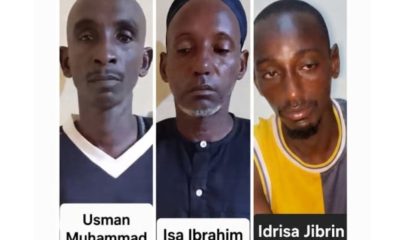

Alia Denounces Ayilamo Attack, Commiserated With Victims as DSS Arrests 3 Suspects
Spread the loveBy Felix Umande Governor Hyacinth Alia of Benue State has strongly condemned the deadly attack on Ayilamo Community...
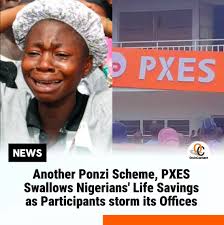

Nigerians Lose Savings to Another Ponzi Scheme: PXES
Spread the loveBy Our Reporter Nigerians who invested millions of naira in an online investment platform known as PXES are...
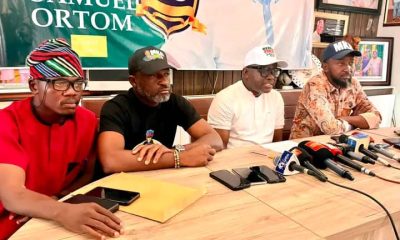

PDP Accuses Alia Of Diversionary Tactics, Questions Benue’s Use OF FAAC Funds
Spread the love–Ortom’s Media Aid Says Gov’t Silent on Revenue, IDPs as Focus Shifts to 2027 Campaigns By Felix Umande...

Alia Condemns Ayilamo Attack, Commiserates With Victims, As DSS Arrests 3 Suspects
Spread the loveBy Felix Umande Governor Hyacinth Alia of Benue State has strongly condemned the deadly attack on Ayilamo Community...

FG, States, Be warned We Will Strike, Without Warning –ASUU
Spread the loveBy Nick Ibe, Abuja Without urgently resolving all the pending salary and welfare issues, by the Federal Government...
Protest Against Xenophobia: NASS Orders Boycott of South African Organised, Hosted Legislative activities
Spread the love–Calls on State Assemblies to join By Isa Abdul, Abuja In a bold move against South Africa’s xenophobic...

Why Education is Dear to Me – By Peter Obi
Spread the loveAfter returning to Abuja on 8th September 2026, following our visits to Benue and Plateau States, I travelled...

After Two Decades: FG Pays 2,700 ex-Nigeria Airways Staff N18bn
Spread the loveBy Son Tertsegha, Abuja Over two decades after the national carrier, Nigeria Airways, was liquidated, the Federal Government...