
Foreign
US Sells ex-Gambian Dictator Jammeh’s $3.5m Mansion, Shares $2.5m to Victims

By Son Tertsea
The United States has returned about $2.5 million to The Gambia from the sale of a Maryland mansion linked to former President Yahya Jammeh, with the money set aside to compensate victims of his 22-year rule.
The funds are destined to compensate victims of Jammeh’s 22-year rule under The Gambia’s Victims Reparations Act of 2023.
US authorities seized and sold the property following investigations into corruption and money laundering.
Jammeh, who led The Gambia from 1994 to 2017, is implicated in widespread abuse, and the returned funds represent international cooperation to address such corruption.
US authorities ultimately forfeited and sold the Maryland mansion linked to former Gambian President Yahya Jammeh, generating $2,507,911.73 in net proceeds for return to The Gambia.
Property website Redfin records show that the mansion was sold for $2.65 million on June 6, 2023, and is now listed as off market.
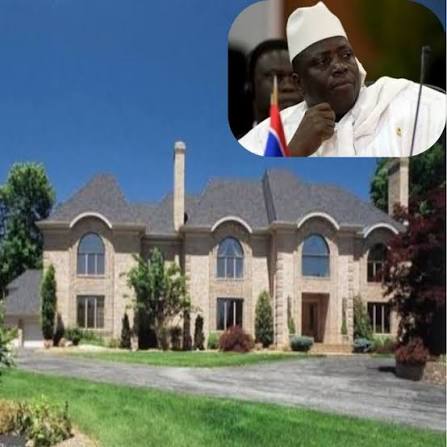
The Maryland mansion is the best-documented foreign property linked to Jammeh, with the US Department of Justice saying it was acquired for about $3.5 million through a trust established by his wife, Zineb Jammeh, using alleged corruption proceeds.
The department said Jammeh and his wife used misappropriated Gambian public funds and other alleged criminal proceeds to acquire the property for their personal use.
The 11,318-square-foot mansion sits on 2.3 acres at 9908 Bentcross Drive in Potomac, Maryland, and includes a heated swimming pool, guest house and seven-car garage.
The sale followed a US civil forfeiture case in which prosecutors alleged that Jammeh obtained millions of dollars through the embezzlement of public funds and bribes from businesses seeking monopoly rights in sectors of the Gambian economy.
The Maryland property, however, represented only a fraction of the wealth investigators linked to Jammeh and his associates.
The Organised Crime and Corruption Reporting Project previously reported that Jammeh and his associates looted or misappropriated at least $975 million during his rule.
A Gambian commission of inquiry separately estimated that Jammeh personally stole about $363 million from the country.
Jammeh, who led The Gambia from 1994 to 2017, is implicated in widespread abuse, and the returned funds represent international cooperation to address such corruption.
Funds earmarked for Jammeh-era victims
Under an agreement between Washington and Banjul, the $2.5 million will be used to compensate eligible victims under The Gambia’s Victims Reparations Act of 2023.
The law provides a framework for reparations to people affected by human rights violations and abuses committed between July 1994 and January 2017, covering Jammeh’s 22-year rule.
Assistant Attorney General A. Tysen Duva of the Justice Department’s Criminal Division described the recovery as an “important example of international cooperation” aimed at preventing illicit proceeds from being hidden through the US financial system.
“Returning these funds forfeited from the former leader to compensate his victims demonstrates our commitment to recover funds taken in violation of the rule of law and to return them for the benefit of victims in a lawful process,” Duva said.
Homeland Security Investigations said the case also showed efforts to prevent foreign officials from using the US financial system to conceal proceeds linked to corruption, bribery and embezzlement.
Our findings show that, the $2.5 million recovered from the U.S. sale of former Gambian President Yahya Jammeh’s Maryland mansion is transferred directly to The Gambia’s Victims Reparations Fund. Under a formal agreement signed by the U.S. government and The Gambia’s Ministry of Finance, the money is distributed according to the legal frameworks established under The Gambia’s Victims Reparations Act of 2023.
Furthermore, the funds are shared out and allocated through the following process: Targeted Beneficiaries: The money is specifically earmarked to compensate eligible victims who suffered from human rights violations, corruption, and abuse of power during Jammeh’s 22-year rule (from July 1994 to January 2017).
The TRRC Identification Process: Rather than arbitrary distribution, the specific victims entitled to receive these funds are identified through the exhaustive findings of The Gambia’s Truth, Reconciliation and Reparations Commission (TRRC).
Regulated Accountability: To ensure the funds reach the intended victims and are not lost to further corruption, the agreement incorporates strict oversight measures managed by local civil society watchdogs—such as Gambia Participates and Transparency International—alongside government frameworks to ensure a transparent, lawful distribution process.
By Son Tertsea
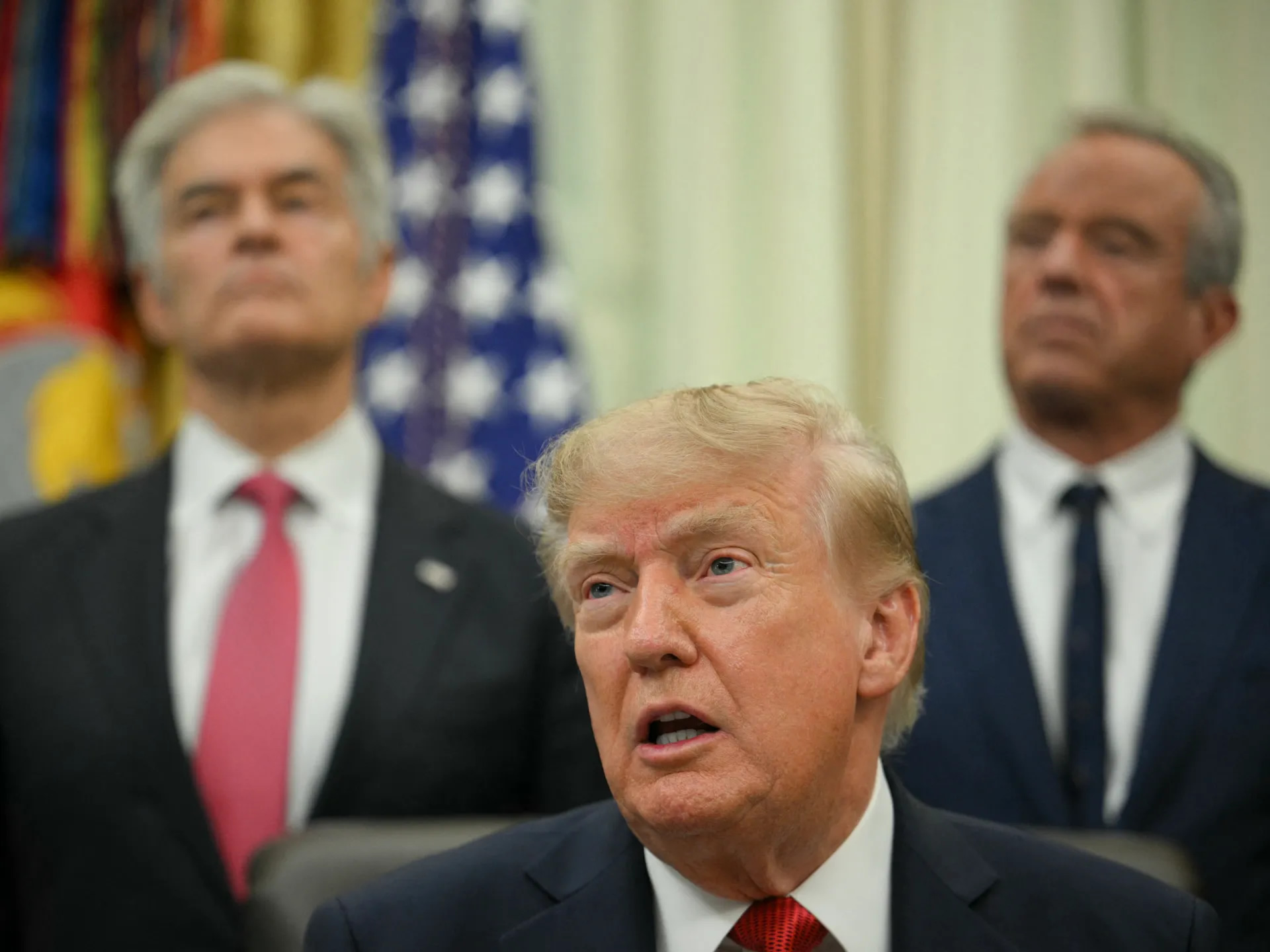
The trio of CNN, MS NOW and Politico have gained a court nod allowing them back into the White House on Thursday, six days after being banned by President Donald Trump.
The federal judge’s order stressed that the journalists should have their access restored.
District Judge Timothy Kelly gave the ruling overnight that revoking the three outlets’ White House press credentials “likely violated their constitutional due process rights.”
Reporters for CNN, MS NOW and Politico who attempted to return to the White House early Thursday ahead of a visit by Chinese President Xi Jinping were initially turned away by the Secret Service but were allowed in later around midday.
Journalists from other outlets surrounded CNN’s tent on the White House driveway and filmed reporter Betsy Klein as she reported live following her return. “Welcome back,” several journalists said.
CNN, MS NOW and Politico had requested an urgent court hearing on Thursday after their reporters were initially barred from the White House despite the judge’s order.
In his ruling, Kelly took issue with how the White House went about expelling the three news organisations.
“The ‘general rule’ is that ‘individuals must receive notice and an opportunity to be heard before the Government deprives them’ of a constitutionally protected interest,” the judge said.
Trump has long attacked media that have aired critical coverage of him, repeatedly blasting the press as the “enemy of the people.”
They filed a joint lawsuit asking for a temporary restraining order against the ban on the grounds that it violates the First Amendment of the US Constitution, which upholds the right to a free press.
Ahead of the ruling, the Department of Justice had argued that Trump can “control reporters’ access to restricted presidential areas, such as the Oval Office.”
“Access to the White House is a privilege — not a right,” it said.
– National security? –
The White House Press Office accused CNN in a letter to the cable news outlet of “trafficking in verifiable falsehoods about national security and other issues, and publishing sensitive or classified information,” with similar accusations levelled against MS NOW and Politico.
The letter to CNN cited several stories about the US-Iran war and a story on Trump’s plans to build a military bunker below the planned East Wing ballroom which allegedly “disclosed ‘top-secret’ construction details.”
Kelly, who was appointed by Trump during his first term, appeared unconvinced.
“The Court is skeptical — at least on this record — that Defendants’ interest in safeguarding national security is the actual motivation for, or is even advanced by, the revocation of Plaintiffs’ hard passes,” the judge said.
In a rare move, the top five US broadcasters said that they were halting pool coverage of the White House — where a broadcaster films on behalf of all television outlets for the day — in solidarity with CNN.
“The public has a vital interest in receiving accurate, independent information about its government. No administration should restrict a news organisation because it objects to its reporting,” ABC, CBS, CNN, Fox and NBC said.
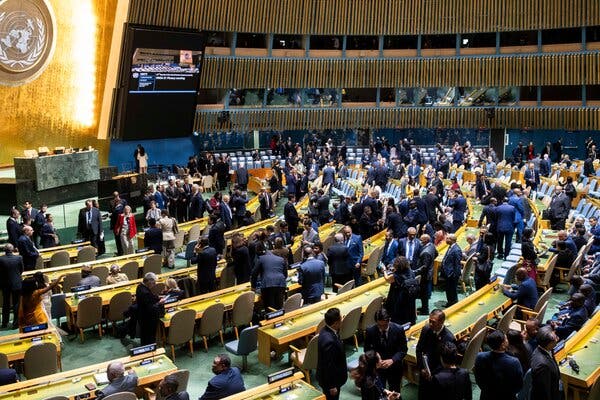
United States President Donald Trump threatened on Tuesday to “annihilate” Iran if Tehran fails to reach a deal with Washington, while declaring at the United Nations General Assembly further that Cuba’s communist government was failing and “will fall”.
After the combative speech, Iran’s delegation of mid-level officials and walked out of the United Nations General Assembly in protest.
Trump delivered a combative address to the 81st session of the UN General Assembly in New York, where he defended the United States’ months-long military campaign against Iran and warned that he could escalate the conflict rather than accept a settlement that allows Tehran to recover.
“I have a big decision to make,” Trump told world leaders gathered at the UN headquarters.
“Will a deal be made with Iran that lets them rebuild and create a far greater country than it ever was before, maybe one of the greatest in the Middle East or even the world?
“Or do I annihilate the Islamic Republic and do it quickly, never giving them a chance to kill and destroy people and countries again? Do I drive them into hell with no chance of survival and no hope of future greatness or generations?”
Trump nevertheless said he believed a deal with Iran would eventually be reached, but tied his expectation to the US midterm elections.
“I believe we’ll make a deal right after the election,” he said.
Trump also sought to distance himself from the electoral consequences of the November midterms, saying he was not personally on the ballot.
“I’m not running. I did that already and won in a landslide. The Republican Party is running, and I’ll be helping them, but I am not running,” he said.
The Iranian delegation walked out of the General Assembly Hall as Trump addressed the conflict, with most of the delegation leaving about 10 minutes into his speech.
Iran’s President Masoud Pezeshkian and Foreign Minister Abbas Araghchi were in New York for the UN gathering but were not in the hall during Trump’s address.
Trump devoted much of his roughly 40-minute address to defending his administration’s foreign policy and military actions, portraying the campaign against Iran as necessary to prevent Tehran from acquiring nuclear weapons and claiming that American military power had altered the balance of power in the region.
He also turned his attention to Cuba, saying his administration was seeking “a fundamental change in the situation in Cuba”.
“It’s an absolutely failed state — it’s failing like never before, and it will fall,” Trump said.
The Cuban delegation subsequently walked out of the General Assembly Hall.
Reuters reported that Trump said the Cuban government was under the greatest pressure it had ever faced and that his administration expected its political system to fall.
Trump’s remarks contrasted sharply with the emphasis on diplomacy from Brazilian President Luiz Inácio Lula da Silva, who addressed the assembly shortly before him.
Lula said the wars and escalating tensions confronting the international community could not be resolved through military force alone.
“We all know there will be no winners on the battlefield,” Lula said in Portuguese. “Diplomacy is the only option.”
UN Secretary-General António Guterres also urged world leaders to strengthen international cooperation rather than retreat into confrontation.
“Military power alone cannot secure peace,” Guterres said in his opening address to the gathering.
Trump’s address ranged beyond Iran and Cuba to other foreign-policy disputes, including Venezuela, Gaza, Ukraine and the International Criminal Court.
He claimed credit for ending the war in Gaza and presented the United States as a central force in resolving international conflicts, even as negotiations over the next phase of the Gaza conflict remained unresolved.
Turkish President Recep Tayyip Erdogan, in his own address, sharply criticised Israel, describing it as having a “genocidal mind-set.”
Israeli delegates subsequently left the General Assembly Hall as Erdogan spoke.
Qatar’s Emir Sheikh Tamim bin Hamad Al Thani also addressed the Gaza conflict, describing the situation there as “a genocide in every sense of the word.”
Trump’s UN appearance came against the backdrop of the continuing war with Iran and heightened international concern over the economic consequences of the conflict, including disruptions around the Strait of Hormuz and elevated energy prices.
Immediately after his address, Trump signed an agreement with Denmark concerning increased US military presence in Greenland, while maintaining Danish control of the territory.
Trump said the agreement would give the United States “permanent control over security and all other needs on that territory.”
“We will have the complete ability to do what is necessary to defend the American continent and also Europe and other places,” he said.
The US President has repeatedly expressed interest in acquiring Greenland, but when asked whether the agreement meant Washington had abandoned that objective, he did not rule it out.
The UN General Assembly, the organisation’s main deliberative and representative body, brings together leaders and delegations from its member states each year to address international conflicts, development, security and other global issues.
But the body is fast becoming a toothless bull dog as nations that once united in words and actions are falling apart. Many European States today disagree with the USA and the Arab states too are sharply divided with the cleavages having a devastating hold on the UN’s once overwhelming legitimacy and power.
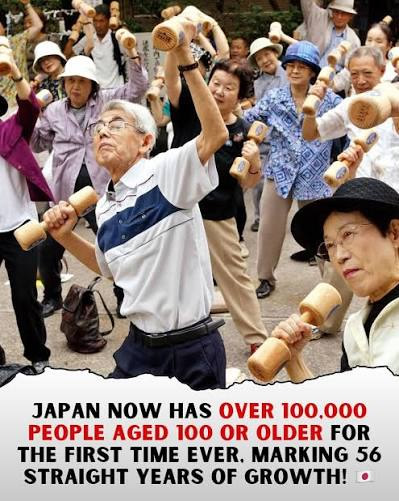
Japan is the first country to have more than 100,000 centenarians and has one of the longest life expectancies in the world.
Humans are living longer and longer. Now Japan has broken a new record for longevity: more than 100,000 people in the country are centenarians—some 107,677 of them are at least 100 years old.
Japan has one of the highest life expectancies in the world. Researchers believe this national longevity is likely linked to low rates of obesity, healthy diets, widespread health screenings and affordable health care, which lead to lower mortality rates from heart disease and cancer.
“I am very happy that so many people have been able to stay active for so long,” said Japan’s health minister Kenichiro Ueno at a news conference announcing the milestone in Tokyo on Tuesday.
Japan is “exactly where you would expect to see this first,” says Jay Olshansky, an epidemiologist at the University of Illinois Chicago. But he expects more countries to follow as large birth cohorts hit the 100-year mark and medical advances continue.
“Most people at older ages now are living on manufactured time—time that was created for us by our physicians and by the public health community,” he says.
But more people living long lives isn’t all good news. Japan also has one of the lower birth rates in the world. And its lower fertility rates and smaller working-age population are squeezing public resources and making caring for its older populations more difficult.
Additionally, a long life can be “a potentially dangerous scenario unless it’s accompanied by good health,” Olshansky says.
Japan’s oldest known person, Fuyo Kumamato, is 114 years old. (The oldest living person in the world, Ethel Caterham in the U.K., is 117 years old.) Researchers around the world are studying supercentenarians, people older than age 110, in hopes of keeping more people healthy for longer.
“What’s really critical about this is quality of life,” Olshansky adds. “Just living longer should not be the primary goal of medicine and public health anymore. It should be health extension or health span.”
Scientific American



US Sells ex-Gambian Dictator Jammeh’s $3.5m Mansion, Shares $2.5m to Victims
Spread the loveBy Son Tertsea The United States has returned about $2.5 million to The Gambia from the sale of...


Nasarawa Police Foil Murder Attempt, Net 4 Kidnappers, 2 Cultists
Spread the loveMichael Lim Four suspected kidnappers who allegedly plotted to kill their victim after collecting ransom have been arrested...

Bill Gates Warns AI Is ‘Powerful’ Enough To Destroy Humanity
Spread the love–There “absolutely” needs to be legislation regulating AI and law enforcement By Son Tertsea, Abuja Billionaire Bill Gates...

EFCC Chair: “I receive over 20,000 Corruption Petitions Yearly in Respect to Public Corruption
Spread the loveBy Son Tertsea, Abuja Fresh concerns have been raised over the scale of corruption in the public sector...


2027: Join APC or quit the Rainbow Coalition, Zamfara Gov tells Wike
Spread the loveBy Son Tertsea, Abuja The Minister of the Federal Capital Territory, Nyesom Wike, has been told to either...

Akume Urges CEOs of Federal Agencies To Take Tinubu’s Reforms To Grassroots, Counter Disinformation
Spread the loveBy Felix Umande The Secretary to the Government of the Federation (SGF), Senator George Akume, has charged Chief...

2027 Polls: S’Court Restores Portions of Electoral ActInvalidated by Appeal Court
Spread the loveBy Isa Abdul, Abuja Portions of the Electoral Act 2026 that were earlier invalidated by the Court of...

FCSC Boss: Amend Universities Acts for Smarter Funding, Governance Autonomy
Spread the loveBy Michael Lim A fundamental review of the legal framework governing Nigerian universities to grant them greater operational,...

Benue Assembly Passes Bill For Free Treatment Of Snakebites
Spread the loveBy Felix Umande The Benue State House of Assembly has passed a bill to be signed into law...

Press Wins War Against Trump: CNN, MS Now and Politico Back into White House
Spread the loveBy Son Tertsea The trio of CNN, MS NOW and Politico have gained a court nod allowing them...