
Defense and Security
Tinubu Signs New NIMC Law: Single Digital Identity to help fight insecurity, cybercrime


By Nick Ibe, Abuja
President Bola Tinubu has signed the National Identity Management Commission (NIMC) Act, 2026 into law, repealing the 2007 legislation.
The new legal framework is to create a secure, interoperable and inclusive digital identity ecosystem for Nigeria.
The President of the Senate, Senator Godswill Akpabio, is convinced that Nigeria’s strengthened national identity management system is currently yielding significant security dividends.
According to him, integration of government identity databases recently enabled security agencies to identify and apprehend suspected terrorism kingpins attempting to gain entry into the country.
On his part, Minister of Interior, Olubunmi Tunji-Ojo, said the presidential assent was a major milestone that would strengthen identity management and provide the foundation for a more secure Nigeria.
Director General of NIMC, Dr. Abisoye Coker-Odusote, also applauded President Tinubu for signing into law the NIMC Act 2026, saying the event marked a defining moment in the history of identity management in Nigeria.
The landmark legislation significantly expands the powers of the National Identity Management Commission by designating it as the Root Certification Authority for Nigeria’s National Public Key Infrastructure (PKI) and Digital Public Infrastructure (DPI), effectively placing the Commission at the centre of the country’s digital identity, authentication and electronic trust architecture.
The new law also reinforces the National Identification Number (NIN) as Nigeria’s foundational identity credential under the principle of ‘One Person, One Identity’, while empowering NIMC to facilitate secure and seamless data exchange among government institutions, financial organisations and private-sector entities.
The reforms are expected to strengthen digital governance, improve public service delivery, enhance cybersecurity and support the federal government’s ambition of building a one-trillion-dollar economy through technology-driven growth.
Speaking to journalists yesterday after the President signed the repealed and re-enacted National Identity Management Commission (NIMC) Bill into law at the State House, Abuja, Akpabio said “Minister of Interior has already started synchronising the NIMC together with other equipment that he has in his office. And they’re yielding results.
“Just last week, we were able to apprehend terrorist chiefs who were coming in from Saudi Arabia, in Katsina, of all places. When they landed, they just put their names on the computer; it brought out that these are criminals, and they arrested them.”
The new legislation, he explained, would overhaul Nigeria’s digital identity ecosystem, reinforcing national security, enhancing border control, and improving economic planning through a more robust and integrated identity management framework.
He revealed that the integration of the National Identity Management Commission (NIMC) database with the Ministry of Interior’s digital platforms marks a significant departure from an outdated legal framework that had remained largely unchanged for 19 years despite rapid advances in digital technology.
His words, “With this Act of Parliament today, there will be a lot of improvement. This has brought Nigeria at par with the global community. I believe strongly that this will improve digital awareness in Nigeria, will help in the economy, will help in infrastructural planning, will help in immigration and migration. At the end, I believe that Nigeria will be better for it. Digital identity will be better managed henceforth.”
Akpabio punctured claims that the National Assembly fast-tracked the legislation, saying federal lawmakers devoted nearly two years to extensive stakeholder consultations, public hearings, and a thorough review of international best practices before approving the bill.
“We had to go around to do public hearings, to send people outside Nigeria to find out what obtains in other climes. It wasn’t something we had to rush because we always want to ensure that any legislation we do outlives us.”
The Senate President added that the legislation forms part of the Tinubu administration’s wider security reforms, including the proposed introduction of state policing.
“We’ve done the same thing for 66 years, but the result is continuous insecurity in the country. So it’s important that… we all work together for the benefit of all Nigerians.”
On his part, Minister of Interior, Olubunmi Tunji-Ojo, told reporters that the presidential assent was a major milestone that would strengthen identity management and provide the foundation for a more secure Nigeria.
He said the amended Act empowers NIMC to harmonise identity records, synchronise government databases and improve interoperability among public institutions.
“It’s about identity management, it’s about harmonising identity, synchronizing database, and of course being able to ensure interoperability and ability to have secure handshake,” Tunji-Ojo said.
While refusing to disclose operational details of the country’s security systems, the Minister stressed the strategic importance of the legislation.
His words, “I won’t be able to go into the details because you’re talking about operational details of the security architecture… But you can be sure that this is going to be the foundation of our security architecture.”
Tunji-Ojo also praised President Tinubu for assembling what he described as a competent team to drive reforms.
“The President is… a talent hunter. This is very evident in what NIMC has been able to do under the leadership of the DG and the supervising ministry.”
Also speaking, Director General of the National Identity Management Commission, Coker-Odusote, described the new law as a landmark reform that bridges a 19-year gap in Nigeria’s identity management framework.
According to her, “The presidential assent to the National Identity Management Commission Bill, which was repealed and re-enacted, is a landmark milestone achievement for this administration and Nigeria. What this Bill will do is bridge that 19-year gap in line with technology best practices and digital transformation reforms globally.”
She stressed that the amended Act strengthens interoperability across government platforms, enhances citizen authentication and verification, and reinforces digital trust across ministries, departments and agencies.
“What we have been able to achieve with this Act also is to ensure that digital trust is cemented in our administration and administrative efforts in driving digital transformation across Nigeria.”
Coker-Odusote appreciated President Tinubu and the leadership of the National Assembly for supporting the legislation, describing identity management as one of the administration’s flagship reforms.
“We’re very happy that NIMC and identity is one of the key reforms of this administration,” she further said.
In a statement yesterday, NIMC described the legislation as the most significant overhaul of Nigeria’s identity management framework since the Commission was established nearly two decades ago.
According to the Commission, the rapid expansion of digital services, e-governance, electronic commerce, data protection requirements and evolving cyber threats made it imperative to replace the old law with a more robust and future-oriented legal framework aligned with international best practices.
Under the new Act, NIMC will be responsible for establishing and maintaining Nigeria’s National Public Key Infrastructure and Digital Public Infrastructure, providing trusted authentication systems, digital signatures, digital certificates, encryption services and identity verification frameworks designed to improve confidence in digital transactions and online services.
The legislation also introduces stronger safeguards for personal data and privacy in alignment with the Nigeria Data Protection Act and global standards, while prescribing stringent penalties for multiple registrations, identity theft, impersonation and other identity-related offences.
In a major inclusion initiative, the law introduces an innovative identifier system for vulnerable persons and mandates special measures to facilitate the enrolment of underserved populations, including individuals without permanent residences.
The Act further recognises both physical and digital identity credentials, all securely linked to an individual’s National Identification Number, thereby expanding opportunities for digital transactions and service delivery.
NIMC said the implementation of the new framework would enable faster and more secure identity verification, greater financial and digital inclusion, improved interoperability across government and private-sector platforms, and enhanced ease of doing business.



Defense and Security
Soldiers Demand End to “Repentant Terrorist” Integration, Link Deadly Attacks to Leaks
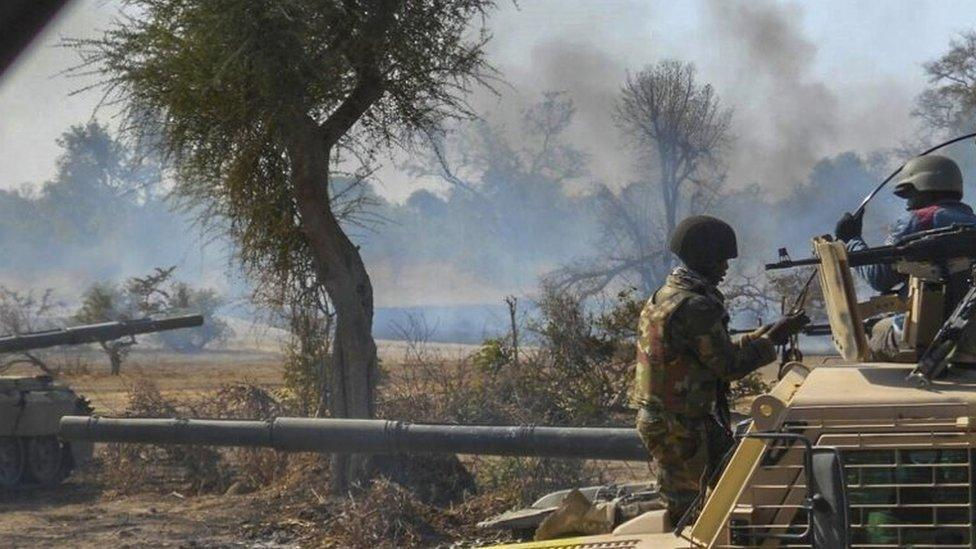
Nigerian soldiers battling Boko Haram insurgents in the North-East have renewed calls on military authorities and all levels of government to halt the integration of so-called repentant terrorists into the security services, alleging that the policy has caused insider leaks and deadly attacks.
A military source said frontline troops have begun a fresh appeal to their superiors, warning that the continued absorption of former insurgents is compromising operations.
According to the source, “in our camps now, we (soldiers) don’t trust these former Boko Haram members”.
“In fact, we have started distancing ourselves from them. They have their different places they sleep,” the source said.
The source continued: “We discovered recently that our operation and movements are being leaked to Boko Haram fighters and nobody would do that if not those ‘repentant’ terrorists.
“They are the ones selling us out now. This is why soldiers are appealing to the top commanders to stop forcing us to work with these people. We don’t trust them.”
The soldier further alleged that recent attacks on troops were linked to leaked operational details, adding that “most of the recent attacks, like a recent report published by SaharaReporters, were due to the leaked information of our strategy by these ‘repentant’ terrorists to Boko Haram.”
Last week, SaharaReporters reported that no fewer than nine Nigerian soldiers were confirmed killed following an explosion involving improvised explosive devices (IEDs) near Gubio in Borno State.
A top military source provided details of the incident to SaharaReporters during an exclusive interview.
The military source confirmed that investigation revealed that the explosives were planted by Boko Haram.
The source explained that the soldiers were travelling from Maiduguri town when the deadly incident occurred.
According to the source, “while coming from Maiduguri town on Saturday, they stopped at 1 camp on the road in order for them to continue their journey on Sunday.”
In October 2025, some soldiers in northeastern Nigeria accused the government-backed ‘repentant’ insurgents of leaking critical military strategies, positions, and weapon details to their former commanders.
The soldiers, who are currently serving in multiple bases across the Northeast, described the policy of integrating ‘repentant’ Boko Haram members into military operations as a “deadly mistake that continues to cost lives.”
One of the personnel told SaharaReporters that the so-called repentant fighters routinely briefed terrorist leaders about Nigerian Army movements and plans before major attacks.
“Before Boko Haram attack any military camp in the Northeast, they already know how we operate. These ‘repentant’ fighters tell them everything,” the soldier said during an interview in 2025.
“They expose how many men we deploy at the gate or entrance, the kind of weapons we carry, even the daily routine in the camp.”
He added that the leaks had made many soldiers extremely vulnerable.
“They tell Boko Haram that every evening between 4:00 pm and 7:00 pm, all soldiers must return to camp for what we call ‘stand 2’; the period when we observe enemy movements. They also tell them where our armoury is located and where we keep rifles, GMPGs, RPGs, PKTs, hand grenades, and bombs,” the source said.
According to the soldier, the sabotage also extends to logistics and supplies.
“They even tell them where our food store is so that when Boko Haram attacks, they can cart away our food to starve us. Because we load food monthly, they know the exact time supplies arrive,” the source said.
The source said that without insider information from these ‘repentant’ elements, most Boko Haram attacks would not have succeeded.
“If the terrorists fail to get this information, they might not succeed or even come back alive. But once they know our strength and routine, they strike with precision.

The Nigerian Air Force (NAF) said on Thursday that its Air Component of Operation HADIN KAI (AC OPHK) killed several terrorists and destroyed their structures, during targeted strikes executed within the Bula Madibale in the Gezuwa general area of Borno State on Wednesday.
it has also intensified air operations in the North East region, as part of measures to deny terrorists the freedom to regroup, reinforce, or mount further attacks on communities.
The Director of Public Relations and Information (DOPRI), Air Commodore Ehimen Ejodame, who disclosed this in a statement on Thursday said “The precision strikes were carried out on Wednesday, 17 September 2025, at about 10:50 am, after intelligence and surveillance confirmed unusual movements at Bula Madibale in the Gezuwa general area.
“Reconnaissance revealed a gathering of about 45 terrorists, some arriving on motorcycles and bicycles from different directions to join the assembly.
“Two terrorist flags were seen hoisted at the location, underscoring its use as a stronghold and rallying point. Acting on this credible intelligence, the AC OPHK launched a coordinated air interdiction.
“The strikes achieved devastating impact, eliminating several terrorists at the gathering point, while the flagged structure and other hostile assets at the gathering point were destroyed.
‘This operation underscores the NAF’s continued resolve to deny terrorists the freedom to regroup, reinforce, or mount further attacks on innocent communities. It also reassures Nigerians that the Armed Forces remain fully committed to restoring peace and stability, particularly in the North East”.



Prof Moti Appointed Acting VC Philomath University, Abuja
Spread the loveBy Son Tertsea The Governing Council of Philomath University, Abuja, has appointed Professor Ukertor Gabriel Moti as Acting...


Bala Mohammed’s Candour: A Lesson In Statesmanship For The Sour Grapes Opposition
Spread the loveBy Okoi Obono-Obla Governor Bala Mohammed of Bauchi State deserves unreserved commendation for his rare candour and statesmanship....


How FG’s Docility and FIFA’s Compromise on Mpasi Conspired Against Nigeria’s 2026 W’Cup Qualifier– Report
Spread the loveThe apex world soccer’s governing body, FIFA, knew that the Democratic Republic of Congo fielded an ineligible player...


Kogi Community Protests Building of Mortuary in Residential Area.
Spread the loveBy Isa Abdul The construction of an alleged mortuary close to public school and residential buildings has been...


100 Days To 2027 Polls: INEC Vows Neutrality, Says BVAS, Ballots Ready
Spread the loveBy Felix Umande The Independent National Electoral Commission, INEC, has assured Nigerians and the international community of its...


THE LAST TANGO: Tears, Tributes and A Final Goal As Messi Bows Out After 21 Years
Spread the loveBy Felix Umande Emotions ran high at the Estadio Monumental on Tuesday night as Lionel Messi signed off...


Church’s Duty to Empower Individuals, Create Opportunities and Improve Family’s Economic Well-being
Spread the loveBy Seyi Balogun, Lagos The need for the Church’s commitment to empowering its members through employment opportunities, entrepreneurship...

Taraba Explores ADR for Sustainable Peace Between Crop, Livestock Farmers
Spread the loveBy Michael Lim Conflict prevention between livestock farmers and host communities in Taraba State through the promotion of...


Financial Inclusion: Kwara Buys Dangote Refinery Shares For Female Teachers
Spread the loveBy Michael Lim Kwara State Government has announced plans to buy shares in the Dangote Refinery Initial Public...


Benue Govt Gives 2-Week Ultimatum To Owners Of Illegal Billboards, Threatens Mass Removal
Spread the loveBy Felix Umande The Benue State Government has decried the arbitrary erection of billboards across the state by...