
Opinion
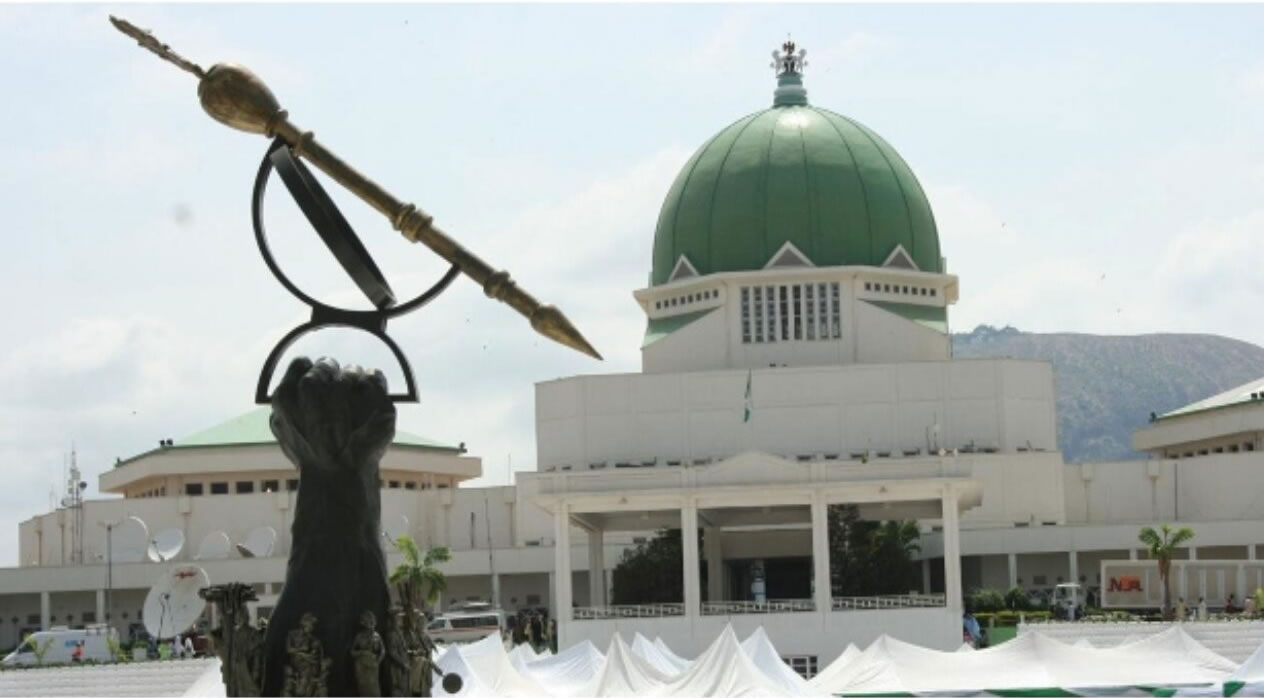
The Trials and Triumphs of a Resilient Nigeria’s 10th Senate

By Eseme Eyiboh
In the unfolding story of Nigeria’s democracy, the Senate remains one of its most enduring symbols of institutional resilience and national balance. Beyond the spectacle of debates and the colour of political persuasion, it is the grand arena where the destiny of the nation is shaped, refined, and defended through rules, order, and reason. It is the one chamber where passion must bow to procedure and where leadership must blend authority with decorum.
Under the current stewardship of Senator Godswill Akpabio,GCON the Nigerian Senate has again shown that discipline is not the enemy of democracy but its lifeblood. In a political climate often prone to impulsive rhetoric and theatrical defiance, the Senate’s commitment to its Standing Orders has reaffirmed the solemn truth that democracy thrives only when its institutions are respected and its rules upheld.
At a time when political tempers can easily flare and institutional boundaries are tested, the Senate has chosen the steadier path of order. Its resilience is not borne out of the absence of conflict but from the maturity to resolve such tensions through due process. It is this adherence to procedure that transforms the Senate from a mere congregation of political actors into a citadel of constitutional governance. The Tenth National Assembly has therefore become more than a legislature; it has risen to become the custodian of Nigeria’s democratic rhythm, ensuring that the music of governance remains in tune even when discordant notes arise.
● The Architecture of Order
Every functioning democracy stands or falls by the strength of its institutions. Rules are the unseen architecture that hold those institutions together, shaping not only how decisions are made but also how power is exercised and limited. The Nigerian Senate’s Standing Orders are not ceremonial relics from the past. They are the living constitution of the institution, carefully designed to preserve fairness, consistency, and the sanctity of the legislative process.
The discipline of parliamentary conduct is a universal marker of political civilisation. In the United Kingdom’s House of Commons, the authority of the Speaker is absolute and unchallenged, ensuring that debates proceed with respect and precision. No member, regardless of party or popularity, may openly defy the Speaker’s ruling without consequences. In Canada’s Parliament, even the fiercest partisans understand that procedure is sacred. Heated disagreements are channelled through decorum, not chaos. Similarly, in Australia, the Senate’s ability to hold the executive accountable depends not on the whims of politics but on the meticulous enforcement of rules that keep legislative integrity intact.
Without a doubt, Nigeria’s Senate belongs in that global fellowship of parliaments that recognise chaos as the heart of anarchy and order as the soul of democracy. Its insistence on upholding internal discipline and protecting the authority of its leadership is, therefore, neither personal nor punitive. It is institutional self-preservation. When the chamber asserts that it will not be held hostage by the disruptive instincts of any single member, it is affirming the primacy of collective responsibility over individual grandstanding. This is how strong legislatures endure: not by silencing dissent, but by ensuring that dissent respects the bounds of procedure.
In many ways, the Akpabio-led Senate has re-introduced a tone of seriousness into the conduct of legislative affairs. The presiding officer’s calm firmness, coupled with his inclusivity, has reminded both senators and citizens that freedom within order is the truest form of democracy. Leadership of this sort does not seek applause; it seeks stability. By upholding its Standing Orders, the Senate has reclaimed its moral authority and demonstrated that rules, properly enforced, are not instruments of oppression but shields against institutional decay.
● A Record of Uncommon Legislative Action
To judge a legislature by its distractions is easy, but to measure it by its legislative work is wiser. By that measure, the Tenth Senate has already left an imprint that few in Nigeria’s democratic history can rival. In barely two years, the Senate has processed over 90 bills, with more than 50 receiving presidential assent. To be clear, these are solid, impactful achievements; they are substantive interventions in the nation’s economic, social, and security architecture.
Among them are landmark reforms such as the Nigeria Tax Administration Act and the Joint Revenue Board Act, which harmonise tax collection across the federal, state, and local governments, thereby reducing duplication and boosting fiscal efficiency. These laws lay the groundwork for a more coherent revenue system that can fund Nigeria’s development priorities sustainably. The Electricity Act (Amendment) has opened the power sector to decentralised innovation by placing generation and distribution within concurrent legislative jurisdiction, allowing states to take greater ownership of electrification drives.
Equally significant is the Student Loans (Access to Higher Education) Act, which has established the Nigerian Education Loan Fund, a mechanism designed to democratise access to tertiary education and build the nation’s human capital. Through this law, thousands of young Nigerians from modest backgrounds can now dream beyond financial constraints.
In matters of national security, the Senate has enacted the Control of Small Arms and Light Weapons Act and reformed the Defence Industries Corporation to modernise local arms production and improve oversight. It has strengthened the Police Act and advanced the legal framework for community policing, ensuring that law enforcement is both professional and accountable. Social welfare has not been neglected either. The Senate’s approval of an increased national minimum wage reflects its sensitivity to the economic pressures faced by ordinary citizens.
Beyond these legislative milestones, the Senate has exercised its oversight powers with renewed vigour. Ministerial nominees have faced rigorous scrutiny, and budgetary processes have been more transparent than in previous sessions. Committee reports are now subjected to fuller debate, while public hearings are reclaiming their role as forums of accountability rather than ceremonial formality. This spirit of constructive collaboration with the executive, balanced by a firm assertion of institutional independence, has restored public confidence in the Senate’s purpose and performance.
Senator Akpabio’s leadership style has been pivotal in this transformation. Combining political experience with procedural discipline, he has stabilised the chamber and inspired cooperation across party lines. The result is a Senate that legislates with urgency but without recklessness, that debates with passion but within the boundaries of respect. It is a model of legislative management that other emerging democracies might do well to emulate.
● Discipline as Democracy’s Anchor
In any democracy, the question is never whether there will be dissent. Instead, it is always about how it will be handled. The real measure of a democratic institution is how it handles internal turbulence. The Tenth Senate has faced its fair share of provocations and personality clashes, yet it has consistently chosen the path of principle over populism. When it insists that rules must be followed and that leadership must be respected, it is not acting out of pride but out of duty. Every time the Senate enforces its Standing Orders, it sends a message that Nigeria’s democracy is strong enough to discipline itself.
In the world’s most respected parliaments, members who flout rules face swift consequences. In the British House of Commons, suspension or expulsion is not rare when a member’s behaviour undermines parliamentary dignity. In Canada, contempt of Parliament remains one of the gravest offences, warranting public apology or even exclusion. Nigeria’s Senate has every right to apply similar standards, for to allow disorder in the name of political freedom is to invite the slow death of the institution itself.
There is a reason democracies that survive for centuries place such premium on decorum. Discipline is the invisible thread that connects authority to accountability. A Senator who disregards procedure may think he is exercising personal liberty, but in truth, he is unravelling the very order that gives that liberty meaning. The Senate, as the upper chamber of Nigeria’s legislature, bears the burden of showing restraint even when provoked and firmness even when misunderstood.
Under Akpabio’s guidance, that balance has largely been achieved. His steady hand has preserved the Senate’s institutional dignity while ensuring that disagreements, inevitable in a plural polity, never degenerate into institutional disrespect. His colleagues, through their support, have shown that the Senate’s unity is not fragile but founded on shared commitment to the republic’s greater good. This collective resilience is what distinguishes a mature legislature from a mere gathering of political actors.
As democracy worldwide faces disillusionment, with parliaments in many countries besieged by populist anger and public cynicism, Nigeria’s Senate stands out as a stabilising force. Its insistence on rule-based conduct, its robust legislative output, and its respect for leadership all reinforce the idea that democratic governance is not sustained by emotion but by discipline. In times of uncertainty, Nigerians can look to their Senate as a beacon of institutional steadiness, where procedure triumphs over impulse and order over anarchy.
● A Legacy of Institutional Maturity
Every democratic generation must reaffirm its faith in its institutions. For Nigeria, the Senate remains one of the surest proofs that despite imperfections, the system endures. It is the forum where politics matures into policy and ambition yields to service. Its current trajectory under Akpabio’s stewardship shows that a disciplined legislature can coexist with vibrant debate, and that leadership tempered by wisdom can guide even the most divided chamber towards a common purpose.
The trials of the Senate are many: public scepticism, partisan rivalry, and the ever-present temptation of populist showmanship. Yet its triumphs are greater still. By choosing law over noise, the Senate has shown that Nigeria’s democracy can heal itself from within. Each bill passed, each order enforced, and each moment of collective restraint strengthens not just the chamber but the republic it represents.
The true triumph of the Senate lies in its rediscovery of itself as a body governed by rules, led by example, and anchored in service to the nation. In doing so, it has become a model for the continent and a reassurance to Nigerians that the spirit of democracy, though tested, remains alive and well.
As the nation moves through uncertain times, the Senate’s resilience will remain a cornerstone of Nigeria’s democratic stability. Its fidelity to order and leadership not only safeguards the present but also lights the path for future generations. For, in the end, it is not the noise of politics that defines a nation’s greatness but the calm persistence of its institutions. In that regard, the Nigerian Senate stands triumphant, disciplined, dignified, and resolutely democratic in all terms.
•Rt. Hon. Eseme Eyiboh mnipr is the Special Adviser on Media/Publicity and official Spokesperson to the President of the Senate.





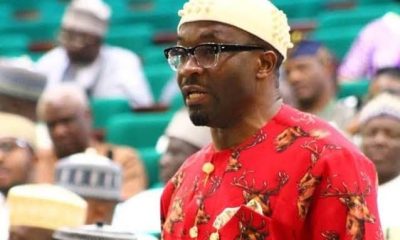


By Rufai Oseni
The Minister of Works is a key player in President Bola Ahmed Tinubu’s government who is not performing well to help Mr President win the hearts of many Nigerians ahead of the crucial January 2027 Election.
I have been a staunch supporter of President Tinubu even before the 2023 Presidential Election.
I strongly disapprove of the performance of Works Minister, Sen. David Umahi. His failure is causing huge embarrassment and hatred to PBAT because of the hardship brought upon Nigerians on federal roads despite the trillions of naira released for road rehabilitation projects by PBAT.
I doubt if since May 29, 1999 there has been any Nigerian President who has shown so much commitment and determination to fix federal highways than President Tinubu
Believe me, if I were the Minister of Works under a very patriotic, committed and determined leader like President Tinubu, I would have restored these critical federal highways within the last three years with such trillions of naira released for this purpose. I say this from my knowledge and experience as an Engineer who headed Delta State Government Direct Labour Agency (DLA), an Agency statutorily charged with the construction, rehabilitation and maintenance of roads and who in August 2011 was saddled with the tough task of urgently restoring hundreds of kilometers of roads in my State that had collapsed and became death traps leading to fatal accidents and deaths of our people and commuters.
In less than two years and with only about three billion naira released by the State Government, I reconstructed and rehabilitated these collapsed roads, constructed some new ones and also opened up many new roads in our rural communities to enable our farmers to commute easily to their farms and transport their produce to urban cities.
The records are there, he said, for anyone to go verify. He added that: Some of the asphalt paved roads I did over thirteen years ago are still standing firm today as if they were constructed just one week ago. I guarantee that these roads will last another ten years or more.
A patriotic and committed PBAT should not end up being daily abused by Nigerians who are rightly angry because of the hell they go through traveling on these roads; instead, Mr President should be receiving their praises and prayers if only his Minister of Works rightly utilized the funds released to him by the President to fix these roads.
I can tell Nigerians that President Tinubu is more pained and heartbroken than anyone else seeing reports of the hell Nigerians still go through traveling across our country on these federal roads.
Frankly if this disturbing situation continues on our federal highways I worry that Nigerians may express their anger against PBAT at the January 2027 Presidential Election except Mr President swiftly takes decisive action right now
The Minister’s Concrete Pavement Policy has been a disaster and a source for huge waste of public funds. It is ridiculous and makes no engineering and economic sense at all! What has Concrete Pavements got to do on Lokoja to Abuja, Abuja to Kaduna highways? I am surprised that some State Govs even adopted his Concrete Pavement Policy and wasting their States’ Funds.
It is wrong for the Minister to promise that within the next two weeks he will restore the collapsed sections of Benin-Agbor-Asaba and Benin-Sapele-Effurun Fedeal Highways. He knows that this is not possible in this peak of rainy season. Only palliative works can be done just to allow vehicles to maneuver.
It is also wrong for the NDDC to be directed to take over responsibility meant for the Ministry of Works and for which trillions of naira have been released to the Ministry. Statutory Funds approved and released to NDDC are not meant for such Federal Road Projects; they are meant to take care of very special and pressing needs of our people of the Oil and Gas Producing States of Niger Delta Region
By Philip Nyam
Last month, I was part of a delegation that participated in the Seminar on Young Leaders under the Global Development Initiative (GDI), organised by the University of International Business and Economics (UIBE), in Beijing, China. We came from diverse countries including Angola, Antigua and Barbuda, Gambia, Grenada, the Kurdish Iran, Nigeria, Sierra-Leone, Macedonia, and South Africa. Available records show that the UIBE has, since 2000, with the approval of the Chinese Ministry of Commerce, conducted more than 140 bilateral and multilateral training programmes, hosting over 350,000 participants.
The UIBE is by every standard a welcoming academic environment, a great citadel of learning renowned for building leaders for tomorrow. It is axiomatic that one of the problems plaguing developing or underdeveloped countries is poor leadership. This effort is to lay a solid foundation and bridge the gap.
The GDI, of course, is China’s ambitious proposal for worldwide development, launched by President Xi Jinping at the UN General Assembly on September 21, 2021. The idea is simple and urgent: Push the UN 2030 Agenda and the SDGs, but anchor them in what developing countries need most. Poverty reduction, food security, vaccines and health, financing for development, climate change and green development, industrialisation and the digital economy. In other words, the GDI is China’s call for a shared future, and it is a project that puts developing countries first.
So, for two weeks at UIBE, we lived inside that idea. Despite the fact that some of us were visiting China for the first time, we quickly integrated. We were taught China’s basic national conditions and achievements since reform and opening up. We studied how China is implementing the UN 2030 Agenda through poverty alleviation. We took lectures on China’s political system, the digital economy, artificial intelligence, intellectual property, Chinese history, Chinese culture, and the cultivation of young leaders under GDI. The participants were also exposed to the philosophy behind Chinese steady development: “If you want to be rich, build the roads”. The lecturers were professional and down-to-earth; the supervisors and volunteers were amazing, and the people were generally friendly and welcoming. And so, we read, digested, and assimilated what we were taught.
Between classes, China opened itself to us. We tasted our way through Beijing and Sichuan’s rich cuisine. In Chengdu, capital city of Sichuan Province, we watched Sichuan Opera face-changing until we couldn’t tell where the mask ended and the wonder began. We sat for tea and learned the quiet discipline in every pour. At the Panda Base, we met giant pandas and red pandas, black-and-white ambassadors that everyone falls for. We climbed the Great Wall and felt history under our feet. We had the rare opportunity of participating in the Fourth China International Supply Chain Expo, and we visited the Museum of Foreign Economic and Trade Relations.
It was indeed a masterclass in policy and culture. But some encounters don’t fit into a seminar schedule. They slip between lectures, between the Great Wall and a bowl of hotpot, and end up rewriting the whole trip for you. And the lesson I keep returning to came from a narrow lane lit by lanterns. It didn’t happen in a lecture hall; it happened in Kuanzhai Alley of Chengdu.
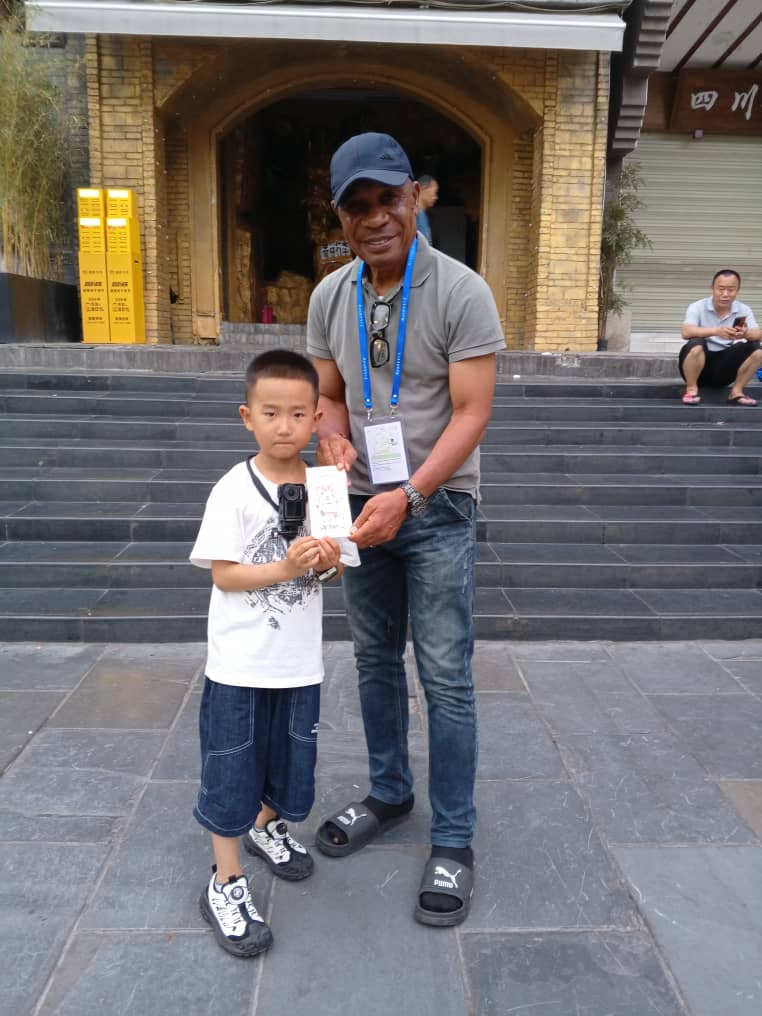
My encounter with a six-year-old boy named Eno. It was a rare encounter that has left an indelible impression on me. Kuanzhai’s Alley is Chengdu’s living room. Red lanterns, teahouse chatter, the smell of spice in the air. We were taking a walk into the Alley when a small voice stopped me. Eno was six. Bright eyes. Questions ready before his hello finished. “Where from? Your name? Do you love football?” At six, he spoke good English. He knew Cristiano Ronaldo. He asked about pandas and why only Chengdu keeps them so close. He asked about the ongoing World Cup in the USA, Canada, and Mexico. He talked like a child with maps and goals in his head, but he listened like someone older. No shyness, no demand. Just courage wrapped in courtesy.
Then came the gesture I did not expect. Eno pressed a small picture of a panda into my hand. “Wish you well,” he said, and gave it free. No blood, no prior knowing. A stranger’s hand, offering love without a sound. I felt it immediately. I had to look away for a second. Because tears rose unbidden. In that moment, Eno was not just a boy in an alley. He was the idea behind GDI made human: spreading love, uniting humanity, one small act at a time. To me, Eno is not just a little boy in an alley; he is China’s welcome, wide and deep.
That small panda picture now lives in my sitting room in Nigeria. I guard it. Some days it’s just paper and ink. Other days it’s a window back to Chengdu, to lantern light, to a boy who decided a stranger should feel welcome.
Eno taught me something the lectures circled but could not say as plainly: kindness needs no reason. It just begins. Love needs no reason to be sweet. If GDI is about building a more connected, equitable world, I saw it in miniature that afternoon. Policy, trade, and technology matter. So do pandas, football, and a child’s unguarded generosity.
I hope to reconnect with Eno someday. Until then, I’ll keep looking for that golden light in Kuanzhai’s alleys, and I’ll keep telling the story of the six-year-old who reminded a visitor from Nigeria that the soul of a city, a nation, can fit in one small hand.
…Philip Nyam participated in the just-concluded Seminar on Young Leaders under the GDI in Beijing.
By Son Tertsea, Abuja
A disturbing development in the Nigerian political space came with the judgment of a Lokoja federal court with its call on INEC to deregister the National Democratic party, NDC.
The devastating effects of this judicial pronouncement on all candidates for the 2027 general elections nominated on the platform of the Nigeria Democratic Congress (NDC) and the entire polls cannot be overemphasised.
The Lokoja Federal High Court Lokoja earlier granted the party recognition as a political party in Nigeria.
Justice Isah Dashen delivered Friday judgement in Suit No. FHC/LKJ/CS/49/2025, to set aside its December 10, 2025 judgment, which had ordered the Independent National Electoral Commission (INEC) to recognise and register the NDC.
The court upheld an application by the Peace Movement Party (PMP), which argued that it was a necessary party in the suit.
The judge further held that failure to include the PMP amounted to a denial of fair hearing and rendered the previous judgment invalid.
Justice Dashen ordered that the parties return to the position they were in before the December 10, 2025 judgment, pending the fresh determination of the substantive case.
The judge also held that some material facts were not brought before it during the earlier proceedings, a development that contributed to its decision to set aside the judgment.
The NDC and the Peter Obi Media Reach (POMR) described the court’s decision as a temporary legal hurdle.
NDC National Chairman, Sen. Moses Cleopas Zuwoghe, said the party had directed its team of lawyers to challenge the order at the Court of Appeal.
In a statement on Friday, Zuwoghe assured the public and candidates of the party in the forthcoming 2027 elections that “our party is on course,” stressing that “the NDC has not been deregistered.”
He stated that: “The public knows that by December 2025, the Nigeria Democratic Congress as an association complained of INEC’s refusal to register us as a political party, whereupon we proceeded to the Federal High Court. The Federal High Court upheld our constitutional right to freedom of association under the Constitution and compelled INEC to register us, which INEC did.
“Since then, we have started political activities, embarked on the registration of members, held congresses from ward to national levels, held conventions and concluded primaries to all offices following INEC’s timetable. We have been fully participating in all INEC activities without let or hindrance.
“NDC also fielded candidates and fully participated in the just-concluded bye-elections in Nasarawa and Enugu states.
“Candidates for the House of Assembly, House of Representatives, Senate, Governorship, Presidential, and Vice-Presidential positions have been duly nominated, and we are in the process of formally submitting them to INEC in accordance with INEC’s timetable.
“The association that filed the complaint is unknown to us. The Peace Movement Party (PMP) is not a registered political party in Nigeria. They claimed, in a motion (not even a substantive suit or appeal), that the court should set aside its earlier judgment on the purported ground that, in 2015, they had sought registration as a political party with the victory sign as their symbol and were denied.
“It is important to note that they are not an association applying for registration now under the exercise that started last year. They are also not a registered political party in Nigeria participating in the political process now, as we are.
“Furthermore, the court, having delivered a final judgment in our suit against INEC, had become functus officio. The court had also dealt with all related issues concerning associations claiming they wanted to use the same symbol and colours. The court, in its judgment, overruled INEC when those issues were raised, and there is no appeal against that judgment.
“Therefore, we are surprised that, on an application by an association claiming that it wanted to register as a political party with the victory sign in 2015, an association that is not a registered political party and is not seeking registration now to participate in the current political process, His Lordship came to the conclusion that they have locus standi, and furthermore, that he has jurisdiction to do what he did.
“Accordingly, we have been informed that His Lordship made an order setting aside the court’s earlier decision of December 2025.
“There was no order directing our deregistration. However, we are dissatisfied with the decision that has been made, and we have instructed our team of lawyers to immediately proceed to the Court of Appeal to challenge the jurisdiction and propriety of His Lordship’s order.
“We assure the general public and particularly our candidates at all levels that our party is on course. The NDC has not been deregistered, and we are challenging today’s order at the Court of Appeal as soon as possible. We have no doubt that justice will be done.”
The party condemned what it described as efforts by those who seek to shrink the democratic space and stifle opposition voices and alternatives.
“Nigerians have a right to a full range of opinions, ideas and alternatives; and political platforms and candidates should be allowed to participate in the 2027 general election process, which has already gone midway.
“It is too late for anyone to attempt to use the judiciary to derail or narrow Nigeria’s multi-party democratic space. If the said association (Peace Movement Party) were a party affected by the judgment on our initial suit, the only option open to it was to appeal the verdict, an option which it did not take. Even at that, the window open for such appeal has since closed and any such appeal by now has become statute-barred.
“To now try to upturn that verdict through the back door, via a motion, is not only unheard-of, but also illegal and an outright abuse of court process.”
The judgment is coming exactly 10 days after the Court of Appeal in Abuja ordered a stay of execution of the judgment of the Federal High Court, Abuja, ordering INEC to deregister the African Democratic Congress (ADC), Action Peoples Party (APP), Action Alliance (AA), Accord Party (AP), and Zenith Labour Party (ZLP).
The three-member panel of the appellate court led by Justice Abubakar Mohammed, accused Justice Peter Lifu of the Federal High Court in Abuja of flouting an order it made on May 22, which directed him to suspend proceedings before him.
The appellate court had held that Justice Lifu’s action amounted to an affront and judicial rascality on the hierarchy of courts.
It described the lower court’s action as “the highest form of judicial impertinence,” stressing that the Supreme Court previously held that a judge who acted in such manner “is unfit for the bench as it amounts to judicial rascality.”
Legal luminary, Femi Falana in statement entitled ‘Nigerian Judges and Lawyers Should Be Prevented From Sabotaging the 2027 Election,’ expressed concern over recent judgments delivered by judges of the Federal High Court on the powers of INEC regarding election timelines.
The senior advocate recalled that Justice Mohammed Umar of the Federal High Court invalidated INEC’s timeline for the conduct of party primaries and nomination of candidates ahead of the 2027 elections.
The court also nullified INEC’s May 10 deadline, directing political parties to submit their membership registers and databases as part of the requirements for participation in the polls.
According to him, the court held that the timeframe announced by INEC for political parties to conduct primaries and submit, withdraw, or replace candidates “is inconsistent with the provisions of the Electoral Act, 2026.”
The suit was filed by the Youth Party against INEC
He further noted that INEC had appealed the ruling and filed a motion for a stay of execution pending the Court of Appeal’s determination of the appeal.
Falana said the situation became more complicated after another judge of the Federal High Court, Justice James Omotosho, ruled in a separate suit filed by the Social Democratic Party (SDP) that INEC possesses the constitutional authority to fix timelines for political party primaries and other electoral activities ahead of the 2027 elections.
He argued that the two judgments created uncertainty within the political system.
Therefore, he urged NJC and NBA to urgently investigate the circumstances surrounding the judgments in Youth Party vs. INEC and SDP vs. INEC, warning that failure to address the issue could threaten the credibility of the 2027 elections.
He added that judges and lawyers must avoid actions capable of undermining the credibility of future elections, warning that legal disputes should not become tools for disrupting democratic processes.
He drew parallels with Nigeria’s political history, warning that failure to address the situation immediately could reopen painful memories of 1993. He warned:
“Unless the judges and lawyers involved are called to order, the 2027 election may be sabotaged by judges and lawyers.”



Mother Subjects Daughter to Abuse, Admits: “I made $300 from my 8-yr-old daughter’s pornographic video’
Spread the loveBy Nick Ibe The viral video on the social media involving an 8-year old girl whose ordeal was...

Lawyer Assaulted by Police: NBA Gboko Branch Secures N500 Million General and Exemplary Damages in Makurdi Court
Spread the loveBy Our Reporter In the pursuit of justice for a colleague, B. B. Iliamkondo, Esq., who was recently...


Alia Denounces Ayilamo Attack, Commiserated With Victims as DSS Arrests 3 Suspects
Spread the loveBy Felix Umande Governor Hyacinth Alia of Benue State has strongly condemned the deadly attack on Ayilamo Community...

Alia Condemns Ayilamo Attack, Commiserates With Victims, As DSS Arrests 3 Suspects
Spread the loveBy Felix Umande Governor Hyacinth Alia of Benue State has strongly condemned the deadly attack on Ayilamo Community...


FG, States, Be warned We Will Strike, Without Warning –ASUU
Spread the loveBy Nick Ibe, Abuja Without urgently resolving all the pending salary and welfare issues, by the Federal Government...
Protest Against Xenophobia: NASS Orders Boycott of South African Organised, Hosted Legislative activities
Spread the love–Calls on State Assemblies to join By Isa Abdul, Abuja In a bold move against South Africa’s xenophobic...

Why Education is Dear to Me – By Peter Obi
Spread the loveAfter returning to Abuja on 8th September 2026, following our visits to Benue and Plateau States, I travelled...

After Two Decades: FG Pays 2,700 ex-Nigeria Airways Staff N18bn
Spread the loveBy Son Tertsegha, Abuja Over two decades after the national carrier, Nigeria Airways, was liquidated, the Federal Government...

To Boost Sch Enrollment: Nasarawa Plans Mobile Courts To Arrest, Prosecute Parents Of Out Of School Children
Spread the loveBy Michael Lim, Jos As part of measures to tackle the growing number of out-of-school children in Nasarawa...
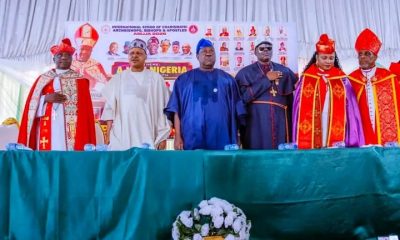

Akume to Religioud Leaders Make Peacebuilding Part OF National Security Ahead of 2027
Spread the loveBy Felix Umande The Secretary to the Government of the Federation, Senator Dr. George Akume, CON, on Wednesday...