
Business and Economy
Tinubu Seeks Fresh Approval For Slimmer ₦65.17trn 2026 Budget, Sends Revised Fiscal Plan To Reps


By Felix Umande
President Bola Tinubu has asked the House of Representatives to repeal and re-enact the 2026 Appropriation Act, proposing a reduced total expenditure of ₦65.17 trillion.
The President transmitted the Repeal and Re-enactment Bill alongside a revised Federal Government fiscal framework in a letter read on the floor of the House by Speaker Abbas Tajudeen.
The revised figure represents a cut from the ₦68.32 trillion earlier approved.
President Tinubu said the review is intended to align the budget with existing obligations and provide for the regularisation of expenditures incurred by the Nigerian National Petroleum Company Limited (NNPCL) on behalf of the Federation.
In a separate letter, the President also asked the National Assembly to approve a consolidated compendium of the Laws of the Federation.
The compendium was reviewed by a technical committee supervised by the Attorney General of the Federation and Minister of Justice, Lateef Fagbemi.






By Nick Ibe, Abuja
Support for small businesses, despite increased federal allocations, has been rated by the House of Representatives as poor.
Consequently, it’s proposing a minimum monthly intervention fund of N1bn from each state to boost Micro, Small and Medium Enterprises (MSMEs).
The Speaker of the House, Tajudeen Abbas, regretted that state governments had the financial capacity to establish dedicated funds for entrepreneurs but had not showing sufficient commitment to supporting grassroots economic development.
Abbas said this on Monday through the House Majority Leader, Prof. Julius Ihonvbere, at a stakeholders’ engagement organised by the House Committee on Small and Medium Enterprises in Abuja, noting the survival of many small businesses depended largely on the resilience of their owners rather than meaningful government support.
He argued that state and local governments must take greater responsibility for creating economic opportunities, stressing that the Federal Government alone could not address the country’s economic challenges.
“There is no governor in this country that cannot put one billion a month in a special fund for MSMEs in his state. There is no state that cannot do it,” he stressed.
The Speaker lamented that entrepreneurs who had managed to survive Nigeria’s difficult business environment were doing so largely without meaningful assistance from government institutions and intervention agencies.
“Those that are surviving are surviving not because of government and agencies, but in spite of government and agencies,” Abbas noted.
He further criticised the bureaucratic procedures attached to accessing government intervention funds, arguing that excessive administrative requirements had undermined the effectiveness of programmes designed to support small businesses.
“I’m a systems man, but I know this system is not working. And it will not work when you bureaucratise a procedure. A lot of red tape,” he said.
Abbas further condemned high lending rates, warning that double-digit interest rates were inimical to the growth of small businesses.
He said entrepreneurs needed affordable and flexible financing arrangements that would allow their businesses to stabilise and generate returns before repayment obligations became due.
The Speaker urged state governors to establish transparent funding mechanisms, with effective monitoring and clearly defined eligibility criteria, to ensure that genuine entrepreneurs, particularly those operating at the grassroots, benefited from the proposed interventions.
He also called on Nigerians to hold elected officials accountable at all levels, noting that the performance of state and local governments had direct implications for employment generation and economic prosperity.
Earlier, Chairman of the House Committee on Small and Medium Enterprises, Dr Pascal Agbodike, said the engagement was aimed at moving beyond identifying challenges confronting MSMEs to developing practical legislative and institutional solutions.
Agbodike said the committee had invited relevant government agencies, financial institutions and development partners to explain their intervention programmes and account for the gaps between budgetary provisions and the actual benefits reaching entrepreneurs.
He expressed concern that despite appropriations by the National Assembly for relevant institutions and programmes, many small business owners remained unable to access the support intended for them.
“We are lawmakers. Ours is simple, to appropriate the necessary funds. But when we appropriate those funds, how is it being trickled down to the common man in the street?” he asked.
The lawmaker said the committee would examine the activities of institutions, including the Central Bank of Nigeria (CBN) and the Bank of Industry (BOI), to determine why available funding had not translated into improved access to credit for small businesses.
He expressed optimism that the engagement would produce concrete recommendations and measurable improvements in MSME support programmes within 100 days.
Also speaking, Director-General of the Presidential Enabling Business Environment Council (PEBEC), Princess Zahrah Mustapha Audu, identified affordable financing, reduced regulatory bottlenecks and stronger partnerships with state governments as critical to unlocking the potential of MSMEs.
Audu disclosed that PEBEC monitors 69 ministries, departments and agencies, adding that the council had introduced the ReportGov digital platform to enable businesses to report difficulties encountered in their dealings with government institutions.
She said complaints submitted through the platform were automatically referred to the relevant agencies for resolution within 72 hours, with PEBEC intervening where necessary.
The PEBEC chief stressed the need for stronger collaboration with state governments to develop financing arrangements that would make loans accessible to entrepreneurs without conventional collateral requirements.
She advocated partnerships between state governments and development finance institutions, including the BOI, Bank of Agriculture and Nigerian Export-Import Bank, through which state governments could provide counterpart funding to reduce lending risks.
According to her, PEBEC had facilitated similar arrangements in about 15 states, creating opportunities for business associations to participate in financing partnerships with development finance institutions.
Audu also called for patient capital to enable small businesses to expand and generate sufficient returns before meeting repayment obligations.
“For me, the solution for SMEs is patient capital,” she said, urging the CBN to review prevailing interest rates to make commercial lending more affordable.
In his contribution, a former member of the Anambra State House of Assembly and consultant, Charles Ezeani, called for legislative intervention to establish government-backed credit guarantee institutions to address the difficulties MSMEs face in accessing loans.
Ezeani identified excessive documentation, cumbersome lending procedures and stringent collateral requirements as major obstacles preventing small business owners, particularly rural entrepreneurs, from benefiting from government-backed financing schemes.
He said many entrepreneurs lacked the technical capacity to meet commercial banks’ requirements, even after obtaining preliminary approvals from development finance institutions.
He particularly faulted the lengthy process of obtaining letters of intent from commercial banks, arguing that the additional requirements often frustrated applicants and delayed access to funds.
Ezeani proposed the establishment of credit guarantee institutions with the capacity to provide adequate guarantees to banks, thereby reducing the risks associated with lending to small businesses.
“Government institutions should have the capacity to give guarantees of almost zero collateral to the downtrodden.”
He maintained that strengthening credit guarantee mechanisms, simplifying lending procedures and improving coordination among intervention agencies would enable more entrepreneurs to benefit from government financing programmes.
By Son Tertsea, Abuja
The three tiers of government, federal, states and local governments, have shared the Federation Account Allocation Committee (FAAC) sum of N2.441 trillion.
The amount was from the October 2026 Federation Account Revenue, which was shared at the FAAC meeting held in Abuja on Wednesday.
The N2.441 trillion comprised distributable statutory revenue of N1.688 trillion and Value Added Tax (VAT) revenue of N752.488 billion.
A communiqué issued by the Federation Account Allocation Committee (FAAC) indicated that gross revenue of N3.811 trillion was available in the month of October 2026.
Total deduction for cost of collection was N128.797 billion while total transfers, refunds and savings stood at N1.241 trillion.
According to the communiqué sent to media houses by Bawa Mokwa, Director of Press of the Office of the Accountant-General of the Federation, Wednesday night, gross statutory revenue of N2.999 trillion was received for the month of October 2026.
This was lower than the sum of N3.096 trillion received in the preceding month by N97.323 billion.
Gross revenue of N812.446 billion was available from the Value Added Tax (VAT) in October 2026. This was lower than the N816.872 billion available in the month of September 2026 by N4.426 billion.
The communiqué stated that from the N2.441 trillion total distributable revenue, the Federal Government received a total sum of N856.065 billion and the state governments received a total sum of N809.909 billion.
The Local Government Councils received N568.701 billion, while the sum of N206.384 billion (13% of mineral revenue) was shared to the benefiting State as derivation revenue.
On the N1.688 trillion distributable statutory revenue, the Federal Government received N780.816 billion and the State Governments received N396.040 billion.
The Local Government Councils received N305.331 billion and the sum of N206.384 billion (13% of mineral revenue) was shared to the benefiting States as derivation revenue.
From the N752.488 billion distributable Value Added Tax (VAT) revenue, the Federal Government received N75.249 billion, the State Governments received N413.868 billion and the Local Government Councils received N263.371 billion.
In October 2026, Excise Duty and CET Levies increased marginally, while Petroleum Profit Tax (PPT), Hydrocarbon Tax (HT), Petroleum Royalties, Import Duty, Companies Income Tax (CIT), CGT & SDT, Value Added Tax (VTA), Mineral Royalties, and Gas Flared Penalty, Rental Gas Flared Fee and Misc. Oil Revenue all decreased.
By Seyi Balogun, Lagos
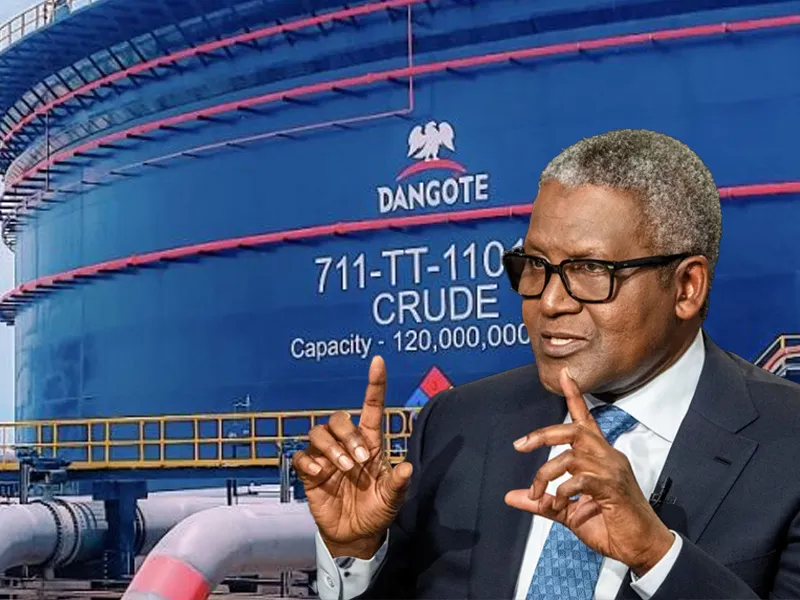
Following the overwhelming response to Dangote Petroleum Refinery’s initial public offering (IPO), attracting share applications worth approximately ₦5.85 trillion from about 3.8 million investors, Nigeria’s capital market has recorded a major investment milestone.
The subscription value is about three times the refinery’s initial fundraising target of ₦2.15 trillion, highlighting the level of interest in the country’s largest private-sector refining investment and the growing appetite for equity participation in major Nigerian businesses.
The offer opened on September 14 and closed on October 27, making 4.1 billion shares available at ₦525 each. However, applications reached approximately 11.15 billion shares, reflecting demand that significantly exceeded the number initially offered.
The figures point to a broad investor base, with retail investors accounting for the largest number of applications. Nearly 3.8 million individual subscribers represented about 84.39 per cent of the investor base, indicating considerable interest among Nigerians in acquiring ownership stakes in the refinery.
Their participation, however, tells a different story when measured by investment value. Retail applications amounted to approximately ₦32.69 billion, representing just 0.56 per cent of the total subscription value.
In contrast, three applicants accounted for approximately 46.72 per cent of the shares requested, with applications valued at about ₦2.73 trillion. The disparity highlights how a relatively small group of major investors can account for a substantial share of capital in large public offers, even when individual investors dominate participation.
International interest also contributed significantly to the subscription figures. Applications from investors outside Nigeria reportedly reached $2.1 billion, while domestic investors accounted for approximately $1.9 billion.
South Africa’s Public Investment Corporation, which manages pension assets for public-sector workers, was among the international institutions reported to have expressed interest in the offer. Nigerian pension fund managers also indicated interest in acquiring shares.
The offer reportedly attracted investors from 120 countries, including all 54 African nations, extending the refinery’s investment appeal beyond Nigeria’s borders.
The strong subscription response comes as the company advances plans for a $14.3 billion expansion programme over five years. Dangote Refinery intends to increase its refining capacity from approximately 650,000 barrels per day to 1.4 million barrels per day by 2029.
The proposed expansion is expected to strengthen its position in the global petroleum industry while increasing its ability to supply refined products across Nigeria and other African markets.
The public offer forms part of the company’s broader financing strategy for this expansion. Alongside the expected IPO proceeds, the refinery plans to leverage internally generated cash flow and additional financing to support its investment programme.
To accommodate demand beyond the original offer, the Securities and Exchange Commission has reportedly permitted an additional oversubscription of up to 30 per cent, subject to regulatory approval. This could increase the final amount raised beyond the initial target.
However, the ₦5.85 trillion recorded represents applications submitted by investors, not the actual proceeds from the offer. The final amount will depend on the shares allotted following the completion of the regulatory and allocation processes.
As attention shifts to the final allotment and subsequent listing on the Nigerian Exchange, the offering presents an important development for Nigeria’s investment landscape.
For the refinery, the scale of investor interest provides an opportunity to broaden its ownership structure and secure additional funding for its expansion ambitions. The next phase will be measured by how effectively it translates that confidence into operational growth, business performance and long-term shareholder value.


Tinubu Seeks Fresh Approval For Slimmer ₦65.17trn 2026 Budget, Sends Revised Fiscal Plan To Reps
Spread the loveBy Felix Umande President Bola Tinubu has asked the House of Representatives to repeal and re-enact the 2026...


Gov. Alia Condoles Plateau State Governor Over Brother’s Death
Spread the loveBy Son Tertsea, Abuja Governor Hyacinth Iormem Alia has expressed deep sadness over the death of Arch. Morris...

Gov Alia Mourns Loss of APC Faithful in Tragic Accident
Spread the loveBy Vincent Tyosuugh The Governor of Benue State, Rev. Fr. Hyacinth Alia, has received with shock and heavy...

Why Nigeria Can’t Host World Cup – Infantino, FIFA President
Spread the loveBy Nick Ibe, Abuja Nigeria is currently assessed as lacking the necessary infrastructure required to host the FIFA...
States Charged to Support Small Businesses in Nigeria With N1 bn Monthly
Spread the loveBy Nick Ibe, Abuja Support for small businesses, despite increased federal allocations, has been rated by the House...

Angola Opens First Gold Refinery to Keep More of the Metal’s Value Home
Spread the loveAngola has opened its first gold refinery, a $20.7 million investment by state diamond company Endiama that will...


The Imperative of Multiple Media Revenue Sources – Elazeh
Spread the loveThe Group Managing Director of Leadership Newspapers, Muazu Elazeh, has urged Media organisations across Africa to diversify their...


Why Nigeria’s Rice Revolution Falls With 90 Mills Shutdown Across States
Spread the loveNigeria’s much-celebrated rice revolution is facing a major reversal, with more than 90 out of the country’s 260...


FG to Review Electricity Tariff Model Without Cost Hikes
Spread the loveBy Nick Ibe, Abuja Nigeria’s electricity tariff model is being reviewed but the tariff increase ruled out in...

Fani-Kayode Raises the Alarm over Attacks on Nigerians in South Africa
Spread the loveBy Isa Abdul, Abuja Worries have been raised over unexplained deaths of Nigerians, alleged wrongful conduct of some...