
Energy and Power
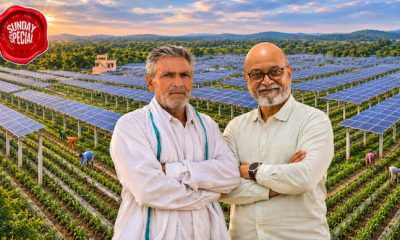
Indian Farmers Growing Food below, Generating Power Above Earn 10 Times More

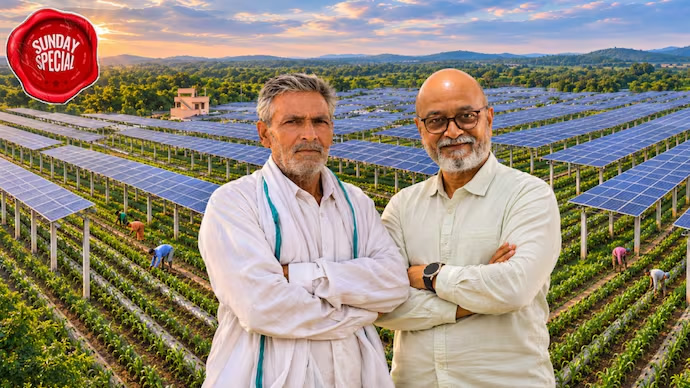
In India, a small but growing number of farmers are cultivating crops on their land while selling electricity generated by solar panels above.
The technological innovation, called agrivoltaics, is turning the same piece of land into two sources of income, with a Rajasthan farmer earning 10 times more than earlier.
Indian farmers are making this possible with crops beneath solar panels, and agrivoltaic plants on his farmland. is experimenting with crops beneath solar panels, and Anand Jain is exploring to add more agrivoltaic plants on his farmland.
A couple of years back, Kajod Mal Jat, a farmer from rural Jaipur in Rajasthan, having become an urjadata (energy provider), missed being an annadata (food provider). The solar panels he had put up on his field were generating electricity and money. But the land beneath them could no longer grow crops. Similarly, hundreds of kilometres away, in Madhya Pradesh’s Sagar district, innovator-farmer Anand Jain was determined not to let solar panels take away his joy of farming.
Today, both farmers are growing cash crops on their farms beneath and generating electricity from solar panels above, which they are selling to the government and earning big. Jat and Jain are annadatas and urjadatas at the same time. And, this has been made possible by a technology called agriphotovoltaics, or Agri-PV, or agrivoltaics, which combines farming and solar power generation on the same piece of land.
The technology, now taking its first steps on the ground in India, promises to revolutionise agriculture by boosting farmers’ incomes severalfold.
It’s already doing so.


By Nick Ibe, Abuja
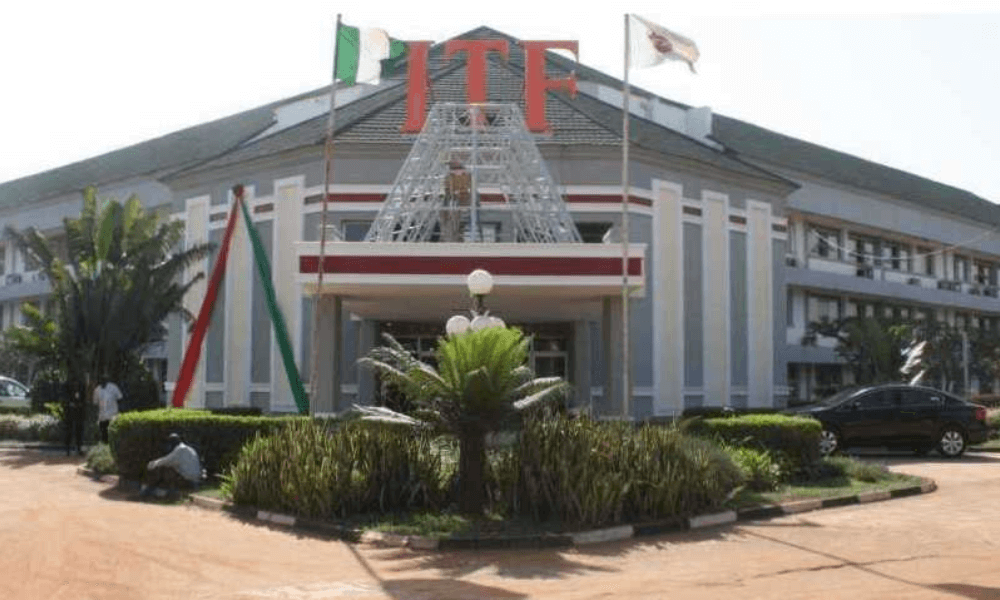
The Industrial Training Fund, ITF, has started the process to permanently abandon the national grid by converting its facilities in Jos, Plateau State, to solar power. The move is to reduce dependence on the national grid and diesel generators.
To achieve this goal, the fund has completed and commissioned solar installations at its Area Office and Staff School in Jos, while work is ongoing at its Model Skills Training Centre and the Director-General’s residence.
The ITF also plans to install a larger solar power system at its Jos headquarters as part of its transition to off-grid electricity supply across its facilities.
The development was disclosed in a statement issued by the fund on Friday in Abuja.
It partly read: “The Director-General of the Industrial Training Fund has declared an irreversible war on darkness and epileptic power supply, unveiling an ambitious plan to take all ITF infrastructure in Jos completely green and off-grid.”
Speaking during the commissioning of the completed projects, the Director-General of the ITF said unreliable electricity supply was undermining productivity and the delivery of skills training.
He said the fund can not effectively prepare Nigerians for modern industrial workplaces while depending on an unstable power supply.
“We cannot train Nigerians for the industries of tomorrow with the power failures of yesterday. If we want productivity, we must generate our own clean power. Jos will be our model city for green energy.”
Accordingly, ITF Area Office is enjoying an installed solar photovoltaic system with a capacity of 100kWh, alongside 100kWh of battery storage and a 50kW inverter.
The ITF Staff School has a 100kWh solar installation and 100kWh battery storage system, which the fund said would provide electricity for teaching and other school activities.
Work is ongoing at the Model Skills Training Centre and Academy, where the ITF plans to install a 350kW solar system supported by 500kWh of battery storage.
The facility, which has a maximum load requirement of about 70kW, houses training workshops, machinery and information and communications technology laboratories.
The Director-General’s residence is also undergoing a solar installation involving a 100kW photovoltaic system and 128kWh of battery storage.
The largest proposed installation is at the ITF headquarters in Jos, where the fund plans to deploy a 500kW solar system and a 1.5MWh battery system.
According to the statement, the headquarters currently has a peak electricity demand of about 139kW.
The solar option is to move away from the persistent electricity supply challenges in Nigeria, which force businesses, schools and public institutions to rely on costly diesel and petrol generators to maintain operations.

By Lazarus Oko
By reducing farmers’ dependence on rainfall and attracting carbon credit financing for agricultural projects, the National Agricultural Land Development Authority on Tuesday revealed it is developing climate-smart farm estates powered by solar energy and electric machinery.
This was disclosed at a session on Green Industrialisation, Critical Minerals and Energy Security at the 2026 United Nations Climate Change Conference in Antalya, Türkiye, by the Executive Secretary and Chief Executive Officer of NALDA, Cornelius Adebayo, .
The CEO spoke during the session, which focused on climate-smart farming, stating that the agency was piloting a farm estate where land clearing would be done with electric bulldozers, while electric tractors were solar-powered. In his words:
“Our hope as an agency is to earn carbon credits from such farm estates and farm locations.
“We use zero-emission areas. We’re introducing electric bulldozers; we’re introducing electric tractors in that particular location. And we are introducing solar power irrigation for full irrigation of the scheme. Everything, every single thing within that facility is climate conscious. Every single thing. And that is our first location that is supposed to be a fully clean location.”
The agency’s plan comes as Nigerian farmers contend with increasingly unpredictable rainfall, which has disrupted planting seasons and exposed rain-fed agriculture to climate risks.
Adebayo said the experience of the current planting season had reinforced the need to move towards irrigation-based farming.
In his words, “The rains were not predicted in Nigeria. And the farmers- a lot of farmers that don’t do the planting yet were the lucky ones. The ones that did the planting were quite unlucky this year. So it shows that we need to move from rain-fed to climate-smart to irrigation-based farming. And this is one direction that Nigeria is going in headway.”
NALDA was working with investors to provide solar irrigation facilities to farmers, with users paying for the services based on the hectares cultivated, he disclosed. The model, he said, would make the facilities easier to extend to more farming communities.
However, the chief executive acknowledged that electric machinery and clean-energy systems cost more than conventional equipment. But the Bank of Industry and other development finance institutions were bridging the financing gap by providing capital at lower interest rates.
NALDA boss further stated that the agency is promoting an anchor-based farming arrangement designed to reduce the financial burden and production risks faced by smallholder farmers.
Under the model, farmers receive land, training, extension services, seeds, fertiliser and other inputs through an anchor investor. The investor also arranges mechanisation services and buys the produce after harvest, deducting the cost of services and inputs supplied.
Adebayo said the arrangement meant farmers would not have to raise all the capital needed to cultivate their land before planting.
“The person that is taking the risk for that expansion is the anchor, not the smallholder. So it’s just making everything easier for that smallholder farmer to scale up. If the crop fails, it’s really the anchor that takes the hit,” he said.
He added that agricultural insurance and risk-sharing institutions would provide additional protection, although the anchor investor would bear the largest share of the production risk.
The agency is also linking farm development to rural security, arguing that farmers working in organised clusters are easier to protect than those operating on scattered plots.
Adebayo said NALDA planned to use drones to monitor farm boundaries and detect threats around its estates, while security agencies could be deployed more effectively to concentrated farming communities.
He said the model was also intended to attract young people by providing housing, solar-powered electricity, clean water and recreational facilities within farm settlements.
NALDA was established in 1992 under an Act of Parliament to support agricultural land development, improve the use of rural land resources, expand food production and create employment.
The authority was reactivated in 2020 after years of inactivity, with integrated farm estates among its programmes.
In a separate technical presentation at the Nigerian Pavilion, NALDA outlined how its Green Hope Project was combining agroforestry, food production and youth participation to address environmental degradation and strengthen food security.
The CEO’s Special Adviser on Projects, Al-Mustapha Ibrahim, said the agency’s Green Hope Project had mobilised more than 400 volunteers to plant approximately 5,000 trees across five sites in Ogun, Plateau, Kwara states and the Federal Capital Territory.
The project covered 50 hectares and included mango, avocado and coconut trees intended to support both environmental restoration and future food production.
The sites include Odogbolu in Ogun State, where 1,000 trees were planted across 10 hectares with 80 volunteers; Barkin Ladi in Plateau State, with 500 trees across five hectares and 40 volunteers; and Oke Onigbin in Kwara State, where 1,500 trees were planted across 20 hectares with 120 volunteers.
The remaining locations are Iporin in Kwara State, where 1,000 trees were planted across five hectares with 80 volunteers, and the University of Abuja, where another 1,000 trees were planted across 10 hectares with 80 volunteers.
The presentation identified mango, avocado and coconut among the food-producing tree species planted under the initiative. Beyond restoring vegetation, the trees are expected to provide fruits for household consumption and commercial sale as they mature, creating additional income opportunities for farming communities.
NALDA said the initiative was designed to make environmental restoration part of agricultural production rather than treating tree planting as a stand-alone exercise. The trees are expected to improve land cover, protect soil, support biodiversity and strengthen the resilience of agricultural landscapes to climate-related pressures.
The agency further incorporated perimeter fencing to protect newly planted areas, stressing the need for site protection and post-planting management to ensure the trees survive and mature.
The project received support from the Agricultural Research and Training Institute, the National Council on Climate Change and the National Horticultural Research Institute.
The collaboration, according to the presentation, demonstrated the importance of partnerships among government agencies and technical institutions in addressing agricultural and environmental challenges.
The initiative also targets young people through practical participation in tree planting and environmental education, with more than 400 volunteers involved in the first phase, giving them opportunities to work with agricultural and environmental stakeholders and build experience in sustainable agriculture.

By Felix Umande
The former Chief Press Secretary to former Governor Samuel Ortom, Terver Akase, has launched a blistering attack on the Speaker of the Benue State House of Assembly, Rt. Hon. Berger Alfred Emberga, over the failure to implement the Benue State Electricity Law, 154 days after it was signed.
In a strongly-worded statement, the former CPS questioned whether the law had gone on annual leave or had been instructed to remain in darkness until further notice.
He recalled that on June 8, 2026, Governor Hyacinth Alia signed the Benue State Electricity Bill into law amid fanfare, with speeches about improving power supply, attracting investors and stimulating economic development.
“It was a big occasion. Everybody at the ceremony was excited. At last, Benue was going to take charge of its electricity future!” he said.
But, he lamented, 154 days have passed with no tangible step towards implementation.
“Has the law gone on annual leave? Is it waiting for another executive signature? Or has the electricity sector been instructed to remain in darkness until further notice?” he queried.
The former CPS contrasted Benue’s stagnation with Abia State, where Governor Alex Otti signed the electricity law on March 17, 2025, established the Abia State Electricity Regulatory Authority (ASERA), and moved swiftly to concrete interventions.
He noted that Aba and eight surrounding LGAs in Abia now benefit from the Geometric Power arrangement, while a mini-grid regulatory framework has also been introduced to encourage private investment in rural electricity.
“Meanwhile, in Benue, 154 days after the governor signed our own electricity law, we are still waiting to see the first tangible steps towards implementation. The electricity law appears to have been signed into a state of permanent suspense!” he said.
He challenged the Speaker on the House’s constitutional oversight responsibility, stressing that the legislature did not pass the law merely to provide another document for government archives, but legislation intended to change the lives of the people.
“Now that the Executive has signed it, what is the House doing to ensure that the law is implemented? Has the relevant House committee summoned the responsible officials to explain the delay? Has the government presented an implementation roadmap? What is the status of the proposed electricity regulatory agency?” he asked.
He warned that oversight is not a ceremonial function.
“Mr Speaker, with all due respect sir, oversight is not a ceremonial function. It is not enough to pass a law, watch the governor sign it, take photographs and move on to the next legislative business,” he said.
“Abia is already discussing electricity investments and delivering power through its independent arrangement. Benue is still discussing the electricity law that was signed five months ago.”
He concluded with a direct challenge to the Assembly:
“Honourable Speaker, can the House switch on its oversight light? The people are waiting for electricity, not another signing ceremony. A law signed in June should not still be searching for its first practical expression in November.”


Tinubu Unveils Five-year Defence Plan To End 17-year Insecurity, Recruits 78,000 Soldiers
Spread the loveBy Felix Umande President Bola Tinubu is determined to end the 17-year scourge of insecurity ravaging parts of...

As Tinubu Supporters and Saboteurs Claim Arises: Benue APC Split Deepens
Spread the loveBy Felix Umande The crisis in the Benue State chapter of the All Progressives Congress has deepened, with...

Dangote Refinery IPO Nets ₦5.85 Trillion From 3.8 Million Investors
Spread the loveBy Seyi Balogun, Lagos Following the overwhelming response to Dangote Petroleum Refinery’s initial public offering (IPO), attracting share...


Dangote Sinotruk’s First Locally Assembled Electric Trucks Out in Lagos
Spread the loveBy Seyi Balogun, Lagos A new phase in Nigeria’s automotive manufacturing industry and its transition to cleaner transportation...


52 African Countries Converge on Abuja for Asset Recovery, Corruption Discourse
Spread the loveBy Son Tertsea, Abuja The first General Assembly of the African Asset Recovery Practitioners Forum (AARPF), scheduled to...


Three Travellers Kidnapped, Driver Shot by Gunmen in Benue South
Spread the loveBy Lazarus Oko Three travellers have been kidnapped and a driver shot by gunmen during an attack on...


SCD: Before Marriage, Know Your Genotype Kwara Tells Youths– Parents Tasked
Spread the loveBy Lazarus Oko As a deliberate effort to curb the prevalence of sickle cell disease, the Kwara State...

Indian Farmers Growing Food below, Generating Power Above Earn 10 Times More
Spread the loveIn India, a small but growing number of farmers are cultivating crops on their land while selling electricity...


JAMB’s New Tech for Easier Registration, Exam Fraud Check, CBT Centres’ Monitoring –Registrar
Spread the loveBy Son Tertsea, Abuja Ahead of the 2027 Unified Tertiary Matriculation Examination, UTME, the Joint Admissions and Matriculation...


Benue APC Split Deepens As Akume Group is Tagged “Saboteurs not Supporters of Tinubu”
Spread the loveBy Felix Umande The crisis in the Benue State chapter of the All Progressives Congress has deepened, with...