
Business and Economy
BUILDING A BUSINESS: Maria Cabral Menezes worked as a trader before deciding to risk it all and start her own business.


Maria Cabral Menezes, 27, never set out to be an entrepreneur — let alone one behind a product that achieved $10,000 in sales in less than 36 hours.
Menezes moved to the U.S. from Brazil to study at the University of Pennsylvania, where she majored in behavioral economics, retailing and international development. After graduating in 2021, she joined JPMorgan Chase as a global equities trader, then moved to Citadel as a trader after a year.
“I came to the U.S. to go down the most typical finance path ever,” Menezes tells Entrepreneur in a new interview. “I was not meant to be an entrepreneur, at least I didn’t think I was.”
As a trader, Menezes encountered a pain point. When she traveled for conferences, she would try to rewear the same blazer two or three days in a row and not feel very confident that it was clean enough. She would also go to the gym in the morning and travel around for the rest of the day with sweaty clothes stuffed into a duffel bag.
Then there was the chair. Menezes would tell her friends about the chair she had at home, piled up with clothes she had worn once. The clothes were too clean to wash, but not fresh enough to rewear and feel confident. She would end up paying to dry clean them.
“I remember thinking, I wish there was something like a dry shampoo, but for your clothes,” Menezes says. “A spray that allows you to re-wear an item between washes so that you’re not constantly over-washing your clothes or over dry cleaning, which is not good for the actual clothing itself if you lightly wore it.”
Menezes started researching the market. She found that laundry companies mostly focused on detergent. They didn’t consider the 99% of the time when clothes were nowhere near the washing machine.
That was the inspiration for Menezes’ brand, WashWise, and its hero product, the Reset Spray. The $29 product markets itself as “dry clean in a bottle” and a “dry shampoo for clothes.” It reduces wrinkles in fabric, cleanses and neutralizes odors in a way that is skin- and fabric-safe. The spray comes in two fragrances and two sizes, including a travel option. Menezes launched the product last month.
“My goal is that when you take any piece of clothing out, you’re going to think, Is this dirty? Is this clean?” Menezes says. “And if it’s in between, we’re WashWising it.”
Though the Reset Spray was built with sustainability in mind, WashWise positions it more as a time-saving product. It’s selling convenience to consumers who travel, work out, wear synthetic fabrics or simply do not want to run a load of laundry after every light wear.
“We’re basically giving people time back,” she says.
Menezes believes that framing helps the product reach multiple audiences. The phrase “dry shampoo for clothes” may immediately register with women who already use dry shampoo, she says, but the use cases extend beyond that customer.
“It’s not just the woman who understands ‘dry shampoo for clothes,’” she says. “It’s also the Wall Street bro who sometimes has wrinkles in between meetings, or the college kid who is messy and doesn’t do laundry as much as they should.”
Menezes says the brand’s consumer research found that one bottle of product could replace up to $300 in dry-cleaning costs, six hours of laundry time and 110 gallons of water, although those results will depend on an individual consumer’s habits.
How she developed the spray
Menezes started developing the product by first examining what a washing machine does for clothes so that she could copy it in a spray format. She was still working at Citadel last year when she came into contact with a chemist via LinkedIn.
“I bounced the idea off of her, and we started really at home, putting all of these formulations together in my living room,” Menezes says. “Eventually we came up with a formulation we felt so confident about that we were ready to go speak to contract manufacturers.”
Menezes estimates the internal process involved 10 to 15 iterations. The eventual manufacturer made two minor reformulations, focused more on product preservation and scale than on the formula’s core function.
“By the time we went to them, we already had something that was proven in our own house,” she says.
The full path from meeting the chemist to the first production run took more than a year. It was not a straightforward process. Menezes initially explored a separate idea: a water-soluble bag for sweaty workout clothes that would dissolve in the wash and contain odor-neutralizing agents.
Then she identified an obvious flaw.
“When something is sweaty, it’s going to melt the bag before it ever gets to your home,” she says. “It was just such an oversight.”
She tabled that product, though Menezes says WashWise may eventually introduce another solution for handling especially sweaty clothing until it can be washed.
A finance mindset, applied to consumer products
The spray also presented a complex formulation challenge. Many ingredients used for odor neutralization can interfere with fragrance, Menezes says, while other components can work against wrinkle reduction or cleansing performance.
“The hardest part was finding ways in which we were learning enough about these ingredients to find innovative ingredients that work symbiotically,” she says.
Menezes left Citadel once she believed the product had legs and could be manufactured. She had worked on WashWise briefly alongside her full-time job but says the intensity of a finance career made a true side hustle unrealistic.
“The moment I hit all those checks and knew this was feasible, that’s when I decided to leave,” she says. She has worked on WashWise full-time since June of last year.
Before raising outside funding, Menezes says she invested between $50,000 and $70,000 of her own savings. WashWise raised $1.2 million from investors including Hims & Hers co-founder Jack Abraham, Oats Overnight founder Brian Tate, cents founder Alex Jekowski and FJ Labs in August.
Menezes has not paid herself in more than a year, choosing instead to invest resources in hiring and customer acquisition.
“I see the value of every dollar I’m putting in,” she says. “I would rather put every dollar into something that has a huge multiplier effect.”
Her finance background has shaped how she operates the company. Menezes says her primary takeaway from Citadel is insisting on process: questioning why each task is done, if it can be improved and how it could function at a much larger scale.
“In order to survive in a place like Citadel, your process needs to be bulletproof,” she says. “There’s no, ‘We do this just because we do this.’”
The difference between startup life and finance
The move from public-market investing to private-company building forced Menezes to get comfortable with uncertainty. In finance, she could measure results quickly and precisely. Market performance follows an investment decision. Startup choices, including hiring decisions, brand strategy and long-term partnerships, are less easy to evaluate.
“It’s taught me to be a lot more intuitive,” she says. “There’s less quantitative stuff to grasp onto.”
For Menezes, disciplined process and intuition are not opposites. She says that thoroughly examining routine decisions makes her better prepared when an unexpected decision requires speed and judgment.
“The moment something comes at me out of the blue and I have to make a fast decision, I feel like I’m the best prepared version of myself to make that decision,” she says. “I feel very confident in trusting myself.”
Building demand before checkout opened
WashWise’s launch in early August was more than a year in the making, but its early sales surge rested heavily on audience-building in the months before launch.
Rather than waiting to reveal a polished product, Menezes documented the company’s development across TikTok and Instagram. She posted packaging options, new boxes, formulation updates and questions for prospective customers. Her audience was relatively small, about 3,000 followers on Instagram and roughly 600 on TikTok at the time of this interview. However, followers were highly engaged.
“Anytime we wanted advice, we always went on social media to ask for it,” she says.
That approach gave early followers a sense of ownership. By the time WashWise launched, the product did not arrive as a surprise.
“If you’ve been a friend of mine and you’ve followed along, you probably know just as much of WashWise as myself, because I really tried to share it all,” Menezes says.
She also created a TikTok series called “Deglamorizing Founder Life,” in which she candidly discusses setbacks and difficult days. The posts gave her a way to build a founder-led brand without turning entrepreneurship into a polished highlight reel.
“Actually building is really hard,” she says. “So that’s one thing I’ve been doing. Whenever I have a rough day, and building is tough, I share that because I think it’s important too.”
A strategy that worked
That transparency ran against some conventional public-relations advice. Menezes says members of her PR team worried that building too visibly would remove an element of surprise from the eventual launch. She saw it differently.
“I’m like, no, I want people to see the journey because it means that once we turn the orders on, there’s a lot of demand already there,” she says.
The strategy appears to have worked. Menezes says WashWise built “a really, really big list of people who were ready to purchase” before launch.
More importantly, customers already understood the vocabulary. The company used phrases like “chair robe,” a reference to that chair full of once-worn clothes, and “dry shampoo for clothes” repeatedly enough that they became shorthand for the problem WashWise was trying to solve.
“We really owned words that hadn’t been out there as part of this new habit we’re trying to create,” she says.
The Reset Spray hit $10,000 in sales in less than two days after launching August 10. Menezes says that her goal is to make WashWise a household name and change people’s habits with the Reset Spray and other products she’s currently developing.
“Let’s do it once; let’s do it really well,” she says. “Let’s have all our marketing and all our focus on this one product, and then let’s do it again and keep repeating it.”
She added that the approach was similar to what Dyson does: Think outside the box, develop one product, really nail it, then move on.
“We’re giving it the time it needs to establish ourselves as innovators in the laundry space before going for the next one,” she says.
Business and Economy
Refinery IPO Didn’t Hit 10m Investors’ Target: But Shows Investment Habit Changing Fast in Africa — Dangote

By Seyi Balogun, Lagos
The initial public offering (IPO) of the Dangote Industries Limited (DIL), for the company’s refinery business did not achieve its 10 million investors target, Aliko Dangote, chairman of the group said..
Though falling short of the target, the IPO attracted “millions of investors”, according to Dangote, who revealed this at the 25th annual conference of the Women in Management, Business and Public Service (WIMBIZ) in Lagos.
The billionaire said the number of investors is yet to be officially determined, but attributed the shortfall to the limited time available for the offer and difficulties some prospective investors faced in accessing it.
“We cannot tell the figure right away because we have not reported to this, but we’ve gotten an amazing demand from various people,” Dangote said.
“If you look at it, the largest participating shareholders, like here now, was I think GTBank. When they did their own, it was 200,000. Okay, we are talking about millions of people that participated.
“Even in Kenya, Safaricom was the largest, less than 900,000. Saudi Aramco worldwide was about five million. So, and I’m sure we are not that far away.
“We didn’t hit the 10 million because of time constraint, and a lot of people, they didn’t know how to access.
“But it’s the shared trust of public enterprise that we have today in Africa, and that’s why people are now beginning to remove that money under their mattresses to go and invest.”
Tagged ‘The People’s IPO’, the Dangote refinery IPO, offered 4.1 billion shares at N525 each, with a minimum subscription of 10 shares costing N5,250.
The offer opened on September 14 and was extended to October 27.
Dangote had said the company was targeting 10 million retail investors as part of efforts to broaden ownership of the refinery beyond institutional and high-net-worth investors.
Reuters reported that more than two million investors had subscribed through digital channels before the offer closed, while the IPO attracted about N6.4 trillion in orders from Nigerian retail and institutional investors — roughly three times the targeted offer size.
Dangote said subscriptions came from 120 countries, including all 54 African countries.
Asked whether the IPO had changed his view on how Africa could mobilise capital from within the continent, Dangote said, “I think yes, it has actually changed. It has changed things dramatically. Things are really changing very fast”.
By Nick Ibe, Abuja
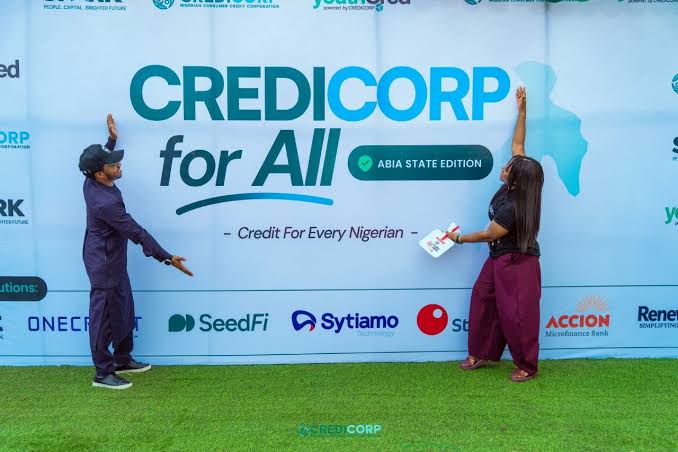
To access consumer loans using basic mobile phones is all that is needed without requiring internet connectivity or smartphones with the introduction of the Federal Government’s USSD-based credit service designed for Nigerians .
Known as SPARK, the service was unveiled by the Nigerian Consumer Credit Corporation (CREDICORP), to expand access to credit, particularly for first-time borrowers with limited or no formal credit history.
Interested Nigerians have been advised to watch for the service’s wider rollout with 347333# unveiled as the USSD code for accessing SPARK. But the service may not yet be fully operational nationwide.
However, CREDICORP said the product was expected to be widely available before the end of 2026.
The initiative is designed to help borrowers establish repayment records that could improve their credit profiles and create opportunities to access further financial services.
CREDICORP’s broader consumer credit programmes cover five thematic areas aimed at improving access to essential goods, household equipment and productive assets.
They include, Mobility: Compressed natural gas (CNG) and electric vehicles, Digital devices: Laptops, smartphones and tablets, Energy solutions: Generators and solar panels, Home improvement: Furniture, household appliances and building materials, and Life essentials: Healthcare, apparel, food and beverages.
These categories outline CREDICORP’s broader consumer credit priorities. However, not all the listed goods and services can currently be financed through SPARK specifically.
The FG introduced SPARK in Aba, Abia State, where the corporation highlighted consumer credit opportunities for more than 1,000 residents.
The event brought together beneficiaries, participating financial institutions, local vendors and government representatives to demonstrate how consumer credit could support livelihoods and economic activities.
Activities included credit-access demonstrations for market women and traders, presentations on the YouthCred initiative for young Nigerians, and the showcasing of credit-backed tricycles for transport operators.
The event also featured locally assembled tricycles made available through CREDICORP’s Securing Consumer Access for Local Enterprises initiative, known as S.C.A.L.E.
CREDICORP Managing Director and Chief Executive Officer, Uzoma Nwagba, said the initiative was intended to extend consumer credit beyond traditional financial institutions. In his words:
”Consumer credit should not be a privilege reserved for a few. It should be an opportunity available to every working Nigerian
“Today in Aba, Abia State, in Nigeria’s South East, we are demonstrating what that means in practical terms: credit for market women, a financial head start for young people, productive assets for transport operators, and with SPARK, a simple way for Nigerians to begin building their credit histories. This is how we make credit work for the people.”
Chinenye Mba-Uzoukwu, chief principal to Abia State Governor Alex Otti, said the state government was creating an environment in which businesses could grow and responsible consumer credit could reach more residents. Mba-Uzoukwu said, while representing the governor at the event:
“Under Governor Alex Otti’s leadership, Abia State is putting the conditions in place for businesses to grow, investments to flourish and responsible credit to reach more of our people.
“By strengthening the enabling environment for enterprise, we are making it easier for initiatives such as CREDICORP to support traders, young people and hardworking families across the state.”
Similarly, Armstrong Ume Takang, Managing Director of the Ministry of Finance Incorporated and a CREDICORP board member, said the showcase demonstrated how government policies could translate into economic opportunities.
“Through CREDICORP, we are seeing how well-structured public investment can stimulate enterprise, support local manufacturers and deliver measurable economic impact directly to citizens,” Takang said.
CREDICORP said it had facilitated more than ₦53.5bn in consumer credit for over 351,000 Nigerians since commencing operations, with women accounting for approximately 59 per cent of beneficiaries.
What Nigerians should know
SPARK is a credit service, not a grant. Borrowers who obtain loans will be expected to repay them according to the agreed terms.
The corporation has not provided comprehensive public details of SPARK’s loan limits, interest rates, repayment periods or full eligibility requirements in the reports announcing the product.
Prospective SPARK beneficiaries should also avoid unofficial websites, agents or individuals demanding upfront payments in exchange for guaranteed loan approval.
Business and Economy
JPMorgan Alters Banking in Nigeria, Gets CBN Approval, As Esther Alade Joins Merchant Bank
By Seyi Balogun, Lagos
The Central Bank of Nigeria (CBN) has approved plans by global financial services giant JPMorgan to establish a merchant bank in Nigeria, opening a new chapter in the lender’s presence in the country’s financial sector.
The proposed institution, to be known as JPMorgan Merchant Bank Nigeria Limited, has received, according to Legit.ng, approval-in-principle from the apex bank.
The American banking giant JPMorgan Chase has taken another step by appointing former Central Bank of Nigeria (CBN) acting governor, Sarah Omotunde Alade, as an independent non-executive director of JPMorgan Merchant Bank Nigeria Limited. The appointment brings one of Nigeria’s most experienced monetary policy expert’s into the governance structure of the proposed bank as the US financial institution seeks to strengthen its presence in Africa’s largest economy.
Alade, who spent 24 years at the CBN, brings extensive experience in economic management, banking operations, financial markets and public finance.
Her appointment comes amid expectations that JPMorgan’s expansion could create fresh opportunities for Nigerian businesses seeking international financing, investment advisory services and access to global capital.
Alade served as acting governor of the CBN in 2014 following the suspension of then governor Sanusi Lamido Sanusi. She assumed the position on February 20, 2014, overseeing the apex bank during a sensitive period for Nigeria’s monetary policy and financial markets. Before that appointment, she had served as deputy governor in charge of Economic Policy since March 26, 2007. Her responsibilities included monetary policy, economic research, statistics, trade and exchange, and financial markets.
As an independent non-executive director at JPMorgan Merchant Bank Nigeria, Alade will provide strategic guidance and board-level oversight rather than manage daily banking operations.
From university lecturer to CBN leadership Alade began her professional career in 1977 at the Ministry of Finance and Economic Development in Ilorin, Kwara State. She subsequently joined the University of Ilorin as a lecturer before moving to the CBN in 1993 as an assistant director in the Research Department. At the apex bank, she headed several departments responsible for government finance and fiscal analysis. In 2004, she became director of Banking Operations, later chairing the board of the Nigeria Inter-Bank Settlement System (NIBSS).
She also served as secretary of the National Payments System Committee, contributing to the development of Nigeria’s financial infrastructure.
Alade retired from the CBN in March 2017 after more than two decades of service. Buhari appoints Alade economic adviser Her retirement did not mark the end of her involvement in national economic policymaking. In November 2019, former President Muhammadu Buhari appointed her Special Adviser on Finance and the Economy.
Nigerian bank expands, set to begin full commercial operations in November
Alade holds an Economics degree from the University of Ife, now Obafemi Awolowo University, a master’s degree from the University of Melbourne and a PhD from the University of Ilorin.
What JPMorgan’s expansion means for Nigeria
JPMorgan’s planned merchant banking operations could strengthen competition in Nigeria’s corporate and investment banking sector. Unlike conventional retail banks, merchant banks primarily serve businesses, institutional investors and large organisations through specialised financial services.
These include capital raising, corporate finance, investment advisory and structured financing. The proposed institution could also provide Nigerian companies with stronger connections to international capital markets. However, the range of services JPMorgan Merchant Bank Nigeria can offer will depend on its regulatory approvals and licensing conditions.
Alade’s appointment signals the institution’s intention to draw on experienced Nigerian financial leadership as it develops its local operations.



Arrested Ugandan Woman Came With Bible: On Way Back, Hid 87 Cocaine Wraps in Her Private Part
Spread the loveBy Seyi Balogun, Lagos The National Drug Law Enforcement Agency, NDLEA, operative have arrested a 34-year-old Ugandan woman,...


EFCC to Collaborate, Identify Licensed Operators to Run Illegal Oil, Mineral Facilities in Ogun State
Spread the loveBy Seyi Balogun The Economic and Financial Crimes Commission, EFCC, is exploring ways of bringing licensed operators into...

For Rural Character, Limit Artificial Light Pollution: South African Towns Ban Streetlights, Perimeter Fences
Spread the loveBy Malcolm Libera A handful of small coastal towns in the Western Cape have restrictions on streetlights, security...


TETFund Commissions Publishing Centre In UNIZIK To Boost Textbook, Academic Material Production
Spread the loveBy Nick Ibe The Tertiary Education Trust Fund (TETFund) Friday commissioned the Academic Publishing Centre (APC) at Nnamdi...


Refinery IPO Didn’t Hit 10m Investors’ Target: But Shows Investment Habit Changing Fast in Africa — Dangote
Spread the loveBy Seyi Balogun, Lagos The initial public offering (IPO) of the Dangote Industries Limited (DIL), for the company’s...


EFCC Digs into Alleged N100bn Benue Technical Colleges Contracts Scam
Spread the loveBy Vincent Tyosuugh An investigation has been launched into the alleged fraud surrounding the award of over N100...


Amaechi Warns ADC Judgment Could Trigger Civil War, Urges Calm As Party Appeals
Spread the loveBy Felix Umande The vice-presidential candidate of the African Democratic Congress (ADC), Rotimi Amaechi, has warned that the...


Stolen Govt Funds Donated to RCCG: Adeboye Ordered Refund of Billions – EFCC
Spread the loveBy Nick Ibe, Abuja The General Overseer of the Redeemed Christian Church of God, Pastor Enoch Adeboye, once...
Nigerians are Irked by Yahaya Bello’s Prolonging Fraud Case. But it’s not Our Fault– EFCC
Spread the loveBy Nick Ibe, Abuja Non conclusion of high profile court cases has earned the Economic and Financial Crimes...


FG Cancels National Teachers’ Institute’s 2026 Degree, NCE Admissions, Affiliations Over Breaches
Spread the loveBy Son Tertsea, Abuja Due to regulatory breaches involving admissions, accreditation and university affiliations, the Federal Government has...