
Business and Economy
FAAC Allocation: 3 Tiers of Govt Get 22% Less as N2.34trn is Shared in August

By Son Tertsea, Abuja
The September meeting of the Federation Account Allocation Committee, shared among the three tiers of government what represents a 22.2 per cent drop from the record N3.007tn distributed in the previous month.
N2.338tn was shared by the Federal Government, states and local government councils.
The N2.338tn shared at the meeting held on Thursday in Abuja represents revenue generated in August 2026, according to a statement issued by the Office of the Accountant-General of the Federation.
The decline amounted to N669bn compared with the N3.007tn shared in July.
The PUNCH had reported that the July allocation was the highest monthly FAAC distribution recorded in 2026 and the largest in reviewed records dating back to 2019.
The statement by the Director of Press and Public Relations in the OAGF, Bawa Mokwa, read, “A total sum of N2.338tn, being August 2026 Federation Account Revenue, has been shared to the Federal Government, States and the Local Government Councils.”
The decline in the amount available for distribution followed a sharp drop in statutory revenue.
According to the FAAC communiqué, gross statutory revenue fell by N1.508tn, or 34.6 per cent, to N2.850tn in August from N4.359tn in July.
“Gross statutory revenue of N2.850tn was received for the month of August 2026. This was lower than the sum of N4.359tn received in the preceding month by N1.508 trillion,” the statement read.
The decline reversed the significant increase recorded in July, when gross statutory revenue rose by N658.09bn from N3.700tn in June to N4.359tn.
However, Value Added Tax collections maintained an upward trend, rising by N40.88bn in August.
Gross VAT revenue stood at N834.843bn, representing a 5.1 per cent increase from the N793.968bn recorded in July.
The statement said, “Gross revenue of N834.843bn was available from the Value Added Tax in August 2026. This was higher than the N793.968bn available in the month of July 2026 by N40.875bn.”
In total, N3.685tn in gross revenue was available in August.
From the amount, N125.142bn was deducted as cost of collection, while transfers, refunds and savings gulped N1.221tn.
This left N2.338tn for distribution among the three tiers of government, comprising N1.565tn in distributable statutory revenue and N773.233bn in distributable VAT.
A breakdown of the allocation showed that the Federal Government received N804.897bn, while the 36 states received N794.313bn.
The 774 local government councils received N555.142bn, while N184.388bn, representing 13 per cent of mineral revenue, was paid to benefiting states as derivation revenue.
From the N1.565tn distributable statutory revenue, the Federal Government received N727.573bn, states got N369.035bn and local governments received N284.511bn.
Another N184.388bn was paid to benefiting states as derivation revenue.
For the N773.233bn distributable VAT revenue, the Federal Government received N77.323bn, states received N425.278bn, while local governments got N270.632bn.
The communiqué also showed mixed performances across the major revenue streams during the month.
It said Petroleum Profit Tax, Hydrocarbon Tax, VAT, Common External Tariff levies and excise duty increased significantly in August.
In contrast, Companies Income Tax, Capital Gains Tax, Stamp Duties Tax, petroleum royalties, mineral royalties, gas-flared penalties, import duty, rental gas-flared fees and miscellaneous oil revenue declined considerably.


Business and Economy
Dangote IPO Subscription: Teachers, Artisans, Civil Servants, Students, Others Become Millionaires in 2 Years
By Seyi Balogun, Lagos
Those buy and hold shares in Dangote Petroleum Refinery and Petrochemicals could potentially become millionaires within one or two years, if the company’s share price rises significantly, according to the President of Dangote Industries Limited, Aliko Dangote.
In an interview with Arise TV Tuesday, Dangote stated this while discussing the refinery’s initial public offering on the Nigerian Exchange.
The refinery’s shares are being offered at N525 each, with Dangote expressing optimism that the price could eventually rise to between N5,000 and N10,000, depending on market forces.
Asked whether he expected the N525 offer price to rise to about N10,000, Dangote said, “I pray so, yes.”
Pressed on whether that was his prediction, he said, “Yeah, it can get up to that, you know, depending on where, you know. I’ve seen shares listed at 100; they go to 1,000.”
He added, “But our own, it will get to maybe 5, 10,OOO, you know. So, at least what you are looking at, if you invest something like maybe N100,000, you know, within one year, two years or so, you are talking about becoming a millionaire.”
Dangote urged investors not to sell their shares prematurely, saying they could benefit from dividends over time.
“So, why do you want to sell it? You remain there, you will be collecting money,” he said.
He also said investors who earned dividends in dollars could be better protected against naira depreciation.
“And, at a point when you have your kids studying abroad, even if there is devaluation of the currency, of the naira, you are safe.
“You are safe because your dividend, you will be collecting in dollars.”
According to PUNCH Online, investors flooded the Nigerian Exchange on Monday as the initial public offering of Dangote Petroleum Refinery and Petrochemicals attracted billions of naira in subscriptions within minutes of its opening.
The N2.15tn IPO, formally opened at the NGX trading floor in Marina, Lagos, comprises 4.1 billion ordinary shares offered at N525 per share.
The minimum subscription is 10 shares, valued at N5,250, with the offer opening on September 14, 2026, and is scheduled to close on October 13, 2026, subject to the terms contained in the prospectus.
The offer is open to retail, institutional and eligible African investors.
Dangote had urged Nigerians, including teachers, artisans, civil servants and students, to invest in the refinery, describing the offer as an opportunity for ordinary Nigerians and Africans to become part owners of the asset.
“The Dangote refinery IPO is more than an investment opportunity; it is an opportunity for millions of Nigerians and Africans to build lasting wealth through ownership of a world-class industrial asset. We have built a refinery that is already delivering strong revenues, solid profitability, and significant value to the economy,” he said.
Dangote said the IPO was also the beginning of a broader plan to list more companies within the Dangote Group.
“We fully share all our prosperity with the people. That’s why we call this a ‘People’s IPO.’ We know the journey has actually just started. It’s not only about the refinery,” he said.
He added that the group intended to list all its operating companies in the future.
“We, as a group, will list every single company that will operate. I don’t know about the others, but I know our own market cap, even at a 10 times P/E ratio by 2030, should not be less than $350bn,” he stated.
Dangote also said the Nigerian Exchange would serve as the primary platform from which the group could pursue dual listings on other global exchanges.
“From this exchange, then we can go to any other place. Nigeria and Africa are our base. We want to make sure that we join our continent,” he said.
He described the IPO as an opportunity for Nigerians to participate in the growth of a major industrial asset.
“We are not merely offering shares; we are offering Nigerians an opportunity to participate in a transformational chapter of our economic history. This is a strategic investment in an asset that is creating jobs, conserving foreign exchange, enhancing energy security and strengthening Africa’s industrial capacity,” he stated.
Dangote disclosed that the refinery generated approximately N19.47tn in revenue in the first half of 2026, while profit after tax stood at N2.55tn.
At the offer price of N525 per share, the refinery is expected to have an implied market capitalisation of about N65.22tn.
Meanwhile, a Bloomberg report said Dangote’s net worth could rise to as much as $58.2bn following the IPO, representing an increase of about $22.9bn from his estimated wealth of $35.3bn, according to the Bloomberg Billionaires Index.
The Chairman of NGX Group, Umaru Kwairanga, described the transaction as a defining milestone for Africa’s capital markets and evidence of the capacity of African capital to finance large-scale projects.
Lagos State Governor, Babajide Sanwo-Olu, said the IPO would create investment opportunities for a broad range of Nigerians.
“This transaction is changing perceptions about what is possible in Africa. It is creating opportunities for a broad spectrum of investors, from small business owners and market traders to institutional investors and technology entrepreneurs,” he said.
The Ooni of Ife, Oba Adeyeye Enitan Ogunwusi Ojaja II, also commended the accessibility of the offer, noting that the N5,250 minimum entry point allowed retail investors to participate in national wealth creation.
The Chief Executive Officer of Dangote Petroleum Refinery, David Bird, said the refinery had become the largest single supplier of refined petroleum products into Europe while maintaining safe, reliable and efficient operations.
Bird added that the company remained focused on achieving its Vision 2030 objective of becoming the world’s largest integrated refinery and petrochemical complex.
By Isa Abdul, Abuja
According to data from the Central Bank of Nigeria, Deposit Money Banks in Nigeria closed a net 476 branches and cash centres between 2022 and 2025, reducing their physical presence by 8.8 per cent in three yesrs.
CBN’s 2025 Statistical Bulletin shows figures for the Financial Sector with the number of bank branches and cash centres across the country declining from 5,410 in 2022 to 4,934 in 2025.
The decline occurred despite an increase in the number of banks operating in the country over the period, pointing to a gradual contraction in physical banking locations.
An analysis by The PUNCH showed that the number of branches fell by 37 from 5,410 in 2022 to 5,373 in 2023. The pace of contraction accelerated in the following year, with 229 locations disappearing as the total dropped to 5,144 in 2024. Banks closed another net 210 locations in 2025, bringing the number down to 4,934.
Consequently, about 92 per cent of the 476 net reduction recorded over the three-year period occurred in 2024 and 2025. The CBN explained that the figures cover branches and cash centres operated by commercial, merchant and non-interest banks. The data were sourced from the apex bank and the Nigeria Deposit Insurance Corporation.
The reduction in physical banking locations came even as the number of banks increased from 32 in 2022 to 33 in 2023 and 35 in 2024, before declining slightly to 34 in 2025. The number of branches operated abroad remained unchanged at two throughout the period.
A state-by-state analysis showed that Lagos recorded the largest decline in absolute terms. The country’s commercial hub had 1,602 branches and cash centres in 2022, but the figure fell to 1,532 in 2023 and 1,521 in 2024 before dropping further to 1,444 in 2025.
This meant banks closed a net 158 locations in Lagos within three years, representing a 9.9 per cent reduction. The state alone accounted for about one-third of the net decline recorded nationwide.
Despite the reduction, Lagos remained the dominant location for physical banking operations, accounting for about 29 per cent of the country’s 4,934 branches and cash centres in 2025.
The Federal Capital Territory also recorded a decline. The number of locations in Abuja stood at 400 in both 2022 and 2023 before falling to 391 in 2024 and 362 in 2025. This represented a net reduction of 38 branches and cash centres, or 9.5 per cent, over the three-year period.
Ekiti suffered one of the steepest contractions, with its branch network almost halving from 107 locations in 2022 to 57 in 2025, representing a decline of 50 locations or 46.7 per cent.
Enugu followed with a reduction of 44 locations from 162 to 118, while Oyo lost 41, declining from 237 to 196. Other states that recorded sizeable declines included Ondo, where the number fell from 127 to 105; Plateau, from 80 to 61; Osun, from 113 to 96; Cross River, from 83 to 67; and Rivers, from 290 to 275.
The decline was also evident in some of the major commercial centres in northern Nigeria. Kano increased its physical banking locations from 164 in 2022 to 175 in 2023 and 183 in 2024. However, the number fell sharply to 157 in 2025, leaving the state with seven fewer locations than it had three years earlier.
Kaduna followed a similar pattern, rising from 148 locations in 2022 to 156 in 2023 and 164 in 2024 before dropping to 146 in 2025.
Some states, however, recorded an expansion in their banking networks. Delta added 23 locations, with its total increasing from 173 in 2022 to 196 in 2025. Edo also rose from 155 to 165, while Jigawa increased from 31 to 37 and Kogi from 63 to 68.
The data further showed wide disparities in the distribution of physical banking infrastructure across the country. While Lagos alone had 1,444 locations in 2025, Yobe had 23, Taraba 26 and Zamfara 28. Bayelsa and Gombe had 31 each, while Ebonyi recorded 32.
For instance, Lagos alone accounted for more than 29 per cent of all branches and cash centres nationwide in 2025, highlighting the concentration of physical banking infrastructure in the country’s major economic centre.
The latest figures indicate that the contraction in the industry’s physical footprint has accelerated in recent years, underscoring how rapidly banking is migrating from brick-and-mortar to electronic platforms.
The PUNCH recently reported that the Central Bank of Nigeria called for greater adoption of alternative payment channels to expand access to financial services and stimulate economic activity.
Acting Director, Corporate Communications and Investor Relations Department of the CBN, Hakama Sidi-Ali, made the call at the 2026 CBN Fair in Lokoja, Kogi State.
Represented by Zubairu Salihu, Branch Controller of the CBN Lokoja Branch, she said alternative payment channels were particularly important for farmers, traders, small businesses and informal-sector operators who may have limited access to conventional banking services.
–Services include electric vehicle charging, liquefied petroleum gas, CNG, others
By Nick Ibe, Abuja
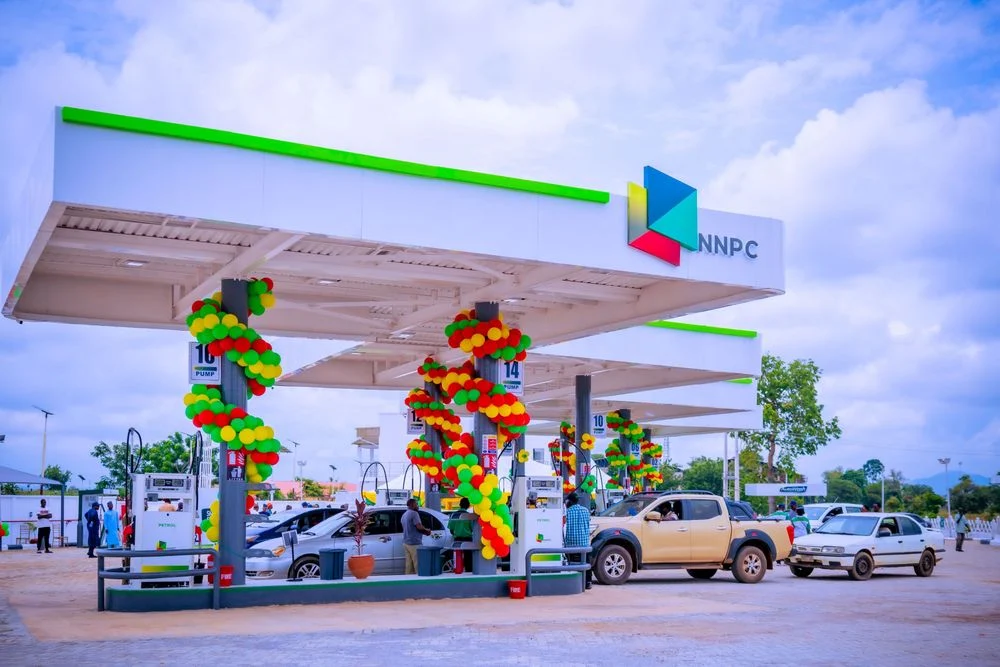
The Nigerian National Petroleum Company Limited has introduced the self-service fuel pumps at selected NNPC Retail stations, allowing motorists to dispense petrol themselves using a mobile application.
This, partly, is NNPC’s new policy to deploy between 50 and 70 smart, self-service stations across the country in the next six months.
This model is different from the old fashion pattern where attendants dispensed fuel to customers. The self-service model allows customers to select the amount of fuel they want, make payment through an app and use a code to activate the pump.
NNPC Retail shared the guide on its X handle on Friday giving motorists details of how to use the system.
The step-by-step guide on how to buy and dispense fuel yourself at participating NNPC stations:
Step 1: Motorists who want to use the self-service facility should first download the NRL Fuel App. Get the download link from the NNPC X handle.
Step 2: Open the app, tap Fuel Purchase, and select your fuel type.
Step 3: Browse the station list and choose an NNPC Retail station offering the self-service option.
Look for the green Self-Serve badge next to the station name. Tap it to select.
Step 3: After selecting the station, enter the amount you wish to spend on fuel. Review the quantity and price, then tap Pay from Wallet. The system will process the transaction based on the amount entered.
Step 4: Once the payment is successful, the app will generate a digital receipt. It contains your Order ID, your Self-Service Code, and a QR Code.
Step 5: At the pump, enter your 8-digit self-service code on the terminal and press the hash key. Once validated, pick up the nozzle and fuel up—exactly the amount you paid for.
NNPC Executive Vice President, Downstream, Mumuni Dagazau, said the new model was part of the company’s plan to transform conventional filling stations into broader energy and mobility hubs.
At the newly commissioned smart station on Bill Clinton Drive, Airport Road, Abuja, NNPC Retail Executive Director, Retail Operations and Mobility, Shettima Baba-Kukawa, said customers could complete transactions on their phones and dispense the exact amount of fuel purchased.
NNPC said the smart stations would combine conventional petrol sales with services such as electric vehicle charging, liquefied petroleum gas, compressed natural gas and other mobility services.



Death Toll Climbs in Minna NSCDC Mining Workers’ Detention to 37
Spread the love–Niger NSCDC Commandant Suberu Siyaka Aniviye suspended By Michael Lim Deaths of alleged illegal miners being held in...

Gov Bago: N500k Minimum Wage is What My Graduate Farm Workers Earn
Spread the love–Says importing food over $3 billion in a year scary By Seyi Balogun Graduate farm workers earn a...


Idoma Youth Groups Tell Alia’s Aide: “We can’t be recruited, instigated or mobilized against our own brothers and sisters”
Spread the love–Groups Give ultimatum for retraction of “RECKLESS INSULT” else … By Felix Umande Two major Idoma youth bodies...

Lebara Enters Nigeria’s Telecom Market Using 0724 Number Series With Physical and eSims
Spread the loveBy Seyi Balogun Nigeria’s newest telecoms operator, Lebara, has launched full commercial operations nationwide. The company is entering...

FAAC Allocation: 3 Tiers of Govt Get 22% Less as N2.34trn is Shared in August
Spread the loveBy Son Tertsea, Abuja The September meeting of the Federation Account Allocation Committee, shared among the three tiers...

Emir Sanusi Counsels Investors: “Don’t sell Homes or Spend School Fees on Dangote shares”
Spread the loveBy Michael Lim Selling residential houses or children’s school fees to purchase shares in Dangote Refinery has been...


Benue State Govt Explains: “High-Level Underpass Not Condemned, Contractor Only Directed To Correct Finishing At No Extra Cost”
Spread the loveBy Felix Umande The Benue State Government has dismissed reports circulating on social media suggesting that the High-Level...


2027: Christian youth group says Haske is the man to beat in AdamawaBy Aliyu Musa
Spread the loveThe Adamawa State Youth Christian Movement for Change (ADSYCMC) has endorsed Abdulrahman Bashir Haske, the governorship candidate of...


Sardauna unrest :Nguroje calls for caution, restraintBy Aliyu Musa
Spread the loveThe former Deputy Speaker of the House of Representatives,Honourable Babangida Nguroje has called on all parties in the...


‘Certificate Forgery’: Court Grants Atiku’s Motion to Serve Tinubu Documents through APC
Spread the loveJustice Inyang Ekwo of the Federal High Court in Abuja has granted the request in an ex-parte motion...