
Faith and Moral Issues
Akume to Religioud Leaders Make Peacebuilding Part OF National Security Ahead of 2027

By Felix Umande
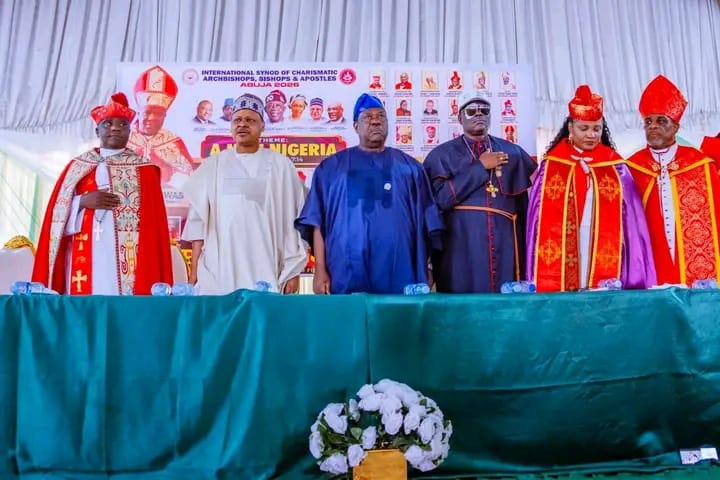
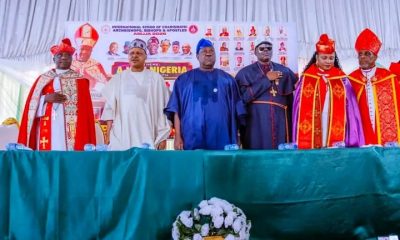
The Secretary to the Government of the Federation, Senator Dr. George Akume, CON, on Wednesday urged religious leaders to treat peacebuilding as a core component of national security and to help steer Nigerians toward unity as the country approaches the 2027 general elections.
Akume spoke at the National Ecumenical Centre, Abuja, during the opening of the 12th Synod of the Charismatic Bishops Conference of Nigeria, where he represented President Bola Tinubu.
Acknowledging the hardship arising from ongoing economic reforms, the SGF said the administration understands the burden on citizens.
“Government recognises the fact that these reforms come with some inevitable pains and that Nigerians have significantly endured. We commend our citizens for their patriotism and resilience and assure them that it would never be in vain as promised by the President,” he said.
Citing World Bank reports on improved macroeconomic stability, Akume said government attention is now shifting to household recovery.
“This government is focusing on recovery of household incomes from poverty and will never relent until reform succeeds and translates to affordable food, jobs, better infrastructure, health services and dignity for the ordinary citizen. That is where the Renewed Hope Agenda truly lies,” he stated.
He explained that the agenda is “rooted in our determination to minimise hardship, create opportunities, simplify the fiscal regime and provide reliefs for vulnerable individuals and businesses,” with expanded programmes in education, health, social protection and community resilience.
On security, Akume disclosed “encouraging intelligence-led breakthroughs, including the rescue in August of 308 abducted citizens from Kwara and Niger States.”
However, he warned that terrorism, banditry, kidnapping and communal conflict “continue to wound families and communities.”
“National security cannot be the responsibility of soldiers, police officers and intelligence agencies alone. Security also begins with trust, social cohesion, early warning and responsible speech,” he said.
The SGF charged the Church to take a leading role, noting that “religious leaders occupy a very important intersection in the prevention and management of these issues because they are recognised influential social mobilisers and actors in peace building. The Church must therefore see peace building as part of national security.”
With 2027 elections approaching, Akume urged the bishops to protect the democratic process.
“Elections will come and go, but Nigeria must remain. As Charismatic Bishops and fathers of faith, you have a decisive role to play, not in determining the winner, but in helping to ensure that Nigeria does not lose,” he said.
He called on them to encourage “peaceful and conscientious participation” and to speak out against “anti-democratic practices such as vote-buying, hate speech and the weaponisation of ethnicity or religion.”
Akume also cautioned against the politicisation of religious platforms:
“I urge you to please refrain from turning the pulpit into an instrument of incitement instead of the sanctuary of conscience. An election is a contest for office; it must never become a war for survival.”
The SGF asked the Synod to deliberate on collaboration with government in youth empowerment, education, peacebuilding, civic responsibility and humanitarian service.
“Government needs the moral reach of the Church and the Church needs an enabling civic environment to thrive. Above all, Nigeria needs both, to work perfectly, for the common good,” he said.
Commending the Church for its prayers and humanitarian interventions, Akume said the President “deeply values” its contributions to peace, national cohesion and moral formation.
He concluded by declaring the 12th Synod open and praying that “God grant Nigeria peace and bless our nation.”


Faith and Moral Issues
Scientists Make Revolutionary Discovery By Opening Jesus’ Tomb For First Time In Hundreds Of Years
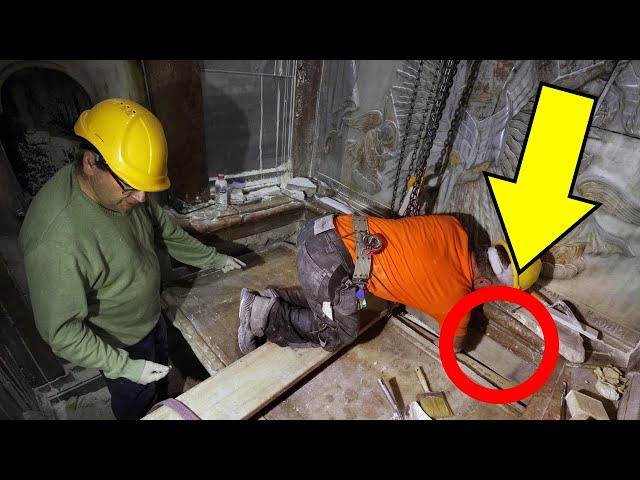
Modern-day Israel has some of the most revered Christian holy sites, but the Church of the Holy Sepulcher, said to be the tomb of Jesus, is the most important. After centuries of water deterioration and structural damage, scientists began a long-overdue renovation of the tomb in October 2016. Beneath a marble slab removed for the first time in hundreds of years, a never-before-seen discovery was found.
The most significant tomb in the Christian religion.
The narrations within the New Testament intricately detail the construction of Jesus’ tomb in close proximity to the site of his crucifixion, meticulously designed to enshroud both his mortal remains and the noble cross upon which he met his tragic fate.
The annals of history resound with unwavering certainty regarding the hallowed significance of the Church of the Holy Sepulcher—a revered beacon of faith and pilgrimage today.
The Quest for Christ’s Sepulcher
Commencing on a poignant quest engendered by an imperial decree, Helena, the venerable mother of Constantine, embarked upon a sacred mission to unearth the elusive resting place of Jesus—rekindling the embers of a past discovery, with the guiding light of Bishop Eusebius illuminating her path towards the venerated sepulcher.
Steeped in the annals of ancient history, around the epoch of 326 CE, the illustrious Roman Emperor Constantine the Great orchestrated the grand inauguration of the first church on the very sanctified grounds that cradled the divine mysteries of Christ’s life and resurrection, destined to serve as a sanctuary not only for his imperial majesty but also as a custodian of the profound spiritual heritage woven into the fabric of Christianity.
Initial renovations
From its inception by Emperor Constantine’s mother to the enduring impact of the Crusaders, each chapter in its narrative has contributed to the intricate tapestry of reverence that cloaks this revered sanctuary.
Over the passage of centuries, the Church of the Holy Sepulcher has stood as a timeless witness to the ebb and flow of history, bearing the indelible imprints of successive transformations that have shaped its sacred presence on the religious landscape.
Spiritual Revival
The enduring legacy of the Crusaders resonates within the very stones of the church, marking a pivotal era that left an indelible mark on its architectural form and spiritual essence.
Their influence transcends mere physical renovations, delving deep into the spiritual marrow of the structure, infusing it with layers of significance and historical gravitas that resonate to this day. Amidst the shifting tides of time, the Franciscan friars emerged as custodians of restoration, embarking on a noble quest to revive the dilapidated grandeur of the church after the poignant collapse of the bell tower in 1545. Their meticulous efforts not only breathed new life into the timeworn walls but also reaffirmed the sanctity of the edicule enshrining the sacred tomb of Jesus, underscoring their unwavering commitment to preserving this venerated place of worship for generations to come.
Spiritual Revival
The crypt was sealed
In 1555, Franciscan monks took a significant step to safeguard the sanctity of the tomb by sealing its entrance.
They sealed the crypt.
With solemn reverence, they carefully positioned a sturdy marble slab over the ancient limestone tomb, shielding it from the touch of eager pilgrims who sought a connection to the hallowed resting place of Jesus. This act of guardianship effectively closed the tomb off from direct access, preserving its sacred aura for generations to come.
Housejogger
Faith and Moral Issues
“Your Voices Must Be Raised Against Terrorism And The Misuse of Religion” — Tinubu to Religious Leaders

By Felix Umande
President Bola Ahmed Tinubu has called on religious and spiritual leaders across Africa and beyond to consistently speak out against terrorism, kidnapping, banditry and the manipulation of faith to justify violence, saying no genuine service to God can be built on the destruction of innocent human life.
The President made the call on Sunday in Kano in a goodwill message delivered by the Secretary to the Government of the Federation, Senator George Akume, at the Grand Maulud of Sheikh Ahmad Al-Tijani, RTA.
Addressing the World Khalifa of the Tijjaniyya Order, scholars, spiritual leaders and adherents from Nigeria and other countries, President Tinubu said religious institutions have a critical responsibility in confronting extremism and promoting peace.
“Your voices must be raised consistently against the murder of innocent people, against terrorism, kidnapping, banditry and the misuse of religion to justify cruelty,” the President said.
“Your institutions and networks must become stronger in the advocacy for peace education, religious literacy, scholarship and the formation of upright young men and women.
“You must also remind political leaders of justice, responsibility and compassion, while reminding citizens that legitimate grievances must never become permission for lawlessness or violence. Above all, our spiritual fathers must continue to teach that no genuine service to Allah is advanced by destroying the innocent human life that Allah has made sacred.”
President Tinubu noted that the gathering was coming at a consequential moment, with societies confronted by conflicts, climate shocks, food and energy crises, violent extremism and the dangerous manipulation of identity and religion.
Citing a UNHCR report that 117.8 million people were forcibly displaced worldwide at the end of 2025, he said the scale of global challenges makes the intervention of spiritual leaders “increasingly indispensable.”
According to him, spiritual leaders “guard the frontiers of conscience” through their capacity to heal wounds, resolve grievances and dissolve deep-seated hatred.
He said the Tijjaniyya community, with its extensive networks across West Africa, North Africa and beyond, possesses moral capital that could be deployed for reconciliation, countering violent extremism, youth guidance and humanitarian solidarity across the Sahel and wider region.
The President said the Federal Government recognizes the critical roles of religious and traditional leaders in deepening tolerance, countering misinformation and identity-based division, and promoting peaceful coexistence.
He reaffirmed Nigeria’s commitment to regional cooperation, counter-terrorism, maritime security, economic integration and dialogue, noting that Nigeria’s position at the intersection of West Africa, the Sahel, Lake Chad Basin and the Gulf of Guinea makes its peace consequential to the region.
“Our position means that peace in Nigeria has consequences far beyond Nigeria. It also means that religious communities with deep transnational connections, such as the Tijjaniyya, can be valuable partners in building an architecture of social peace that complements the work of governments and regional institutions,” he said.
President Tinubu assured that the government would continue to uphold freedom of worship while strengthening collaboration with religious and traditional institutions to promote peace, mutual respect and national cohesion.
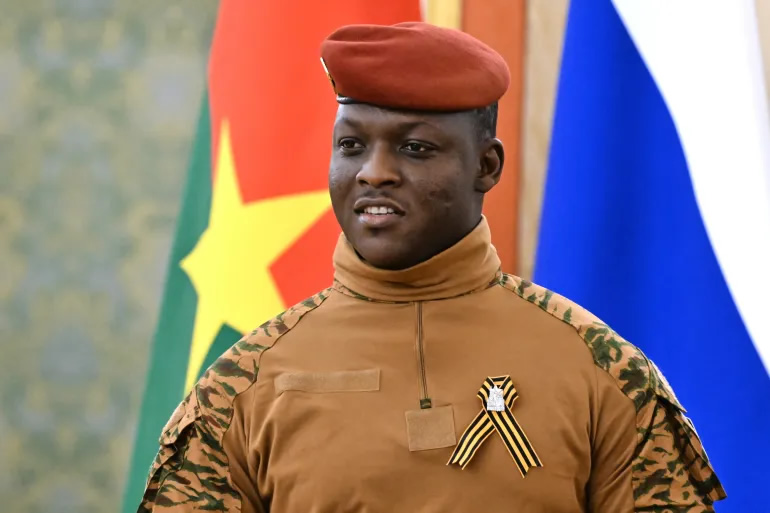
Traore has opened a new front with Burkina Faso’s Muslim community over arrests.
New legislation and arrests are driving a rift between Burkina Faso’s military government and Muslim scholars.
Captain Ibrahim Traore’s relationship with Muslim leaders has come under strain as his government tightens control over religious affairs.
Burkina Faso’s transitional leader Ibrahim Traore has announced plans to bring back students studying Islamic law in Arab countries
Once backed by influential Muslim scholars, Burkina Faso’s military leader is now facing a growing rift over arrests, new legislation and his campaign against what he describes as religious extremism.
Burkina Faso’s transitional leader, Captain Ibrahim Traore, has sharply escalated his confrontation with influential Muslim scholars, declaring that what he calls “radical Islam” has no place in the country and warning that “the battle has begun” against those he accuses of promoting religious extremism.
Addressing scholars whom he accused of spreading extremist ideas, Traore declared: “If this is your Islam, we will fight it. Extremists must change. If they do not, the battle has begun.”
His remarks underscore a widening rift between the government and parts of Burkina Faso’s Muslim community. Once an important source of support for the military leader, several influential Sunni scholars are now at odds with the authorities over the Religious Freedoms Law, the detention of prominent imams and the government’s campaign against religious extremism.
Traore argued that religion should spread through example rather than coercion or violence. He also questioned why some Muslims opposed the new legislation and warned that imams who use sermons to promote extremist ideas would be suspended.
At the same time, he pledged state support for scholars who advocate what he described as a peaceful interpretation of Islam, while accusing foreign powers of exploiting religion to destabilise Burkina Faso.
Students studying abroad
Traore also announced plans to recall Burkinabe students studying Islamic law in Arab countries, claiming that more than 800,000 were pursuing religious education abroad without acquiring practical professional skills.
He warned that those who refuse to return could risk losing their Burkinabe citizenship.
The announcement followed a government directive issued in late June requiring students seeking to study abroad to obtain prior approval from the Ministry of Higher Education.
Authorities said the measure was intended to ensure overseas study programmes better align with the country’s development priorities.
The tighter controls on religious education came as Burkina Faso’s transitional parliament unanimously adopted the Religious Freedoms Law on June 20.
The government says the legislation is intended to reinforce the state’s secular character. It introduces prison terms and fines for practices that authorities classify as religious abuses, including the forced begging of children and breaches of financial transparency rules by religious organisations.
From ally to adversary
The law deepened already growing tensions between the government and sections of the Muslim community.
In late May, Imam Mohamed Ishaq Kindo, one of Burkina Faso’s most prominent Sunni scholars, was arrested after criticising the draft legislation.
Referring to the arrest and the protests that followed, Traore dismissed the unrest as the work of “a small minority of extremists”.
After worshippers gathered to demand Kindo’s release, authorities closed the largest Sunni mosque in the capital, Ouagadougou, citing public order concerns.
Agence France-Presse (AFP), citing a security source, reported that about 100 of the imam’s supporters were transferred to a military camp for what officials described as “civic training”.
Kindo’s arrest followed the mid-April detention of Imam Mahmoud Barro in Bobo-Dioulasso under similar circumstances. According to the Timbuktu Institute, a Dakar-based think tank specialising in peace and security issues, Kindo’s whereabouts have not been disclosed since the protests were suppressed.
According to the institute, the confrontation extends beyond the Religious Freedoms Law. It marks the breakdown of the tacit understanding that had developed between Traore’s government and influential Muslim scholars, whose backing helped bolster his standing after he seized power.
By turning against former allies, the institute argues, Traore risks weakening an important source of political legitimacy without resolving the security crisis that his government has used to justify its increasingly assertive measures.
An Israeli dimension
Alongside the domestic tensions, Traore recently received Israel’s new ambassador to Burkina Faso, Simon Seroussi, in Ouagadougou to present his credentials.
The meeting followed a report by Africa Intelligence, a Paris-based publication specialising in African political and business affairs, that the ambassador’s accreditation request, submitted in the summer of 2025, had remained pending before being quietly approved.
Traore’s public reception of the ambassador appears to mark a shift from the caution previously shown by his inner circle, which had sought to preserve his anti-Western image. It also comes as Israeli security agencies expand cooperation with members of the Alliance of Sahel States (AES), the bloc formed by Burkina Faso, Mali and Niger, whose governments have expressed interest in Israeli security technology.
As Traore declares that “the battle has begun” against what he describes as religious extremism, while the Religious Freedoms Law takes effect and the fate of detained scholars remains unclear, a broader question emerges: will the government’s efforts to assert greater control over sources of public legitimacy strengthen its authority, or deepen its confrontation with one of Burkina Faso’s most influential social forces?



Mother Subjects Daughter to Abuse, Admits: “I made $300 from my 8-yr-old daughter’s pornographic video’
Spread the loveBy Nick Ibe The viral video on the social media involving an 8-year old girl whose ordeal was...

Lawyer Assaulted by Police: NBA Gboko Branch Secures N500 Million General and Exemplary Damages in Makurdi Court
Spread the loveBy Our Reporter In the pursuit of justice for a colleague, B. B. Iliamkondo, Esq., who was recently...
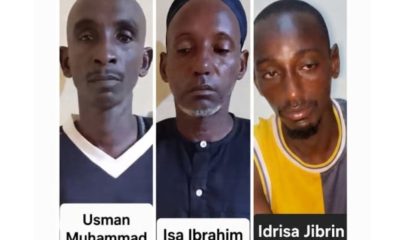

Alia Denounces Ayilamo Attack, Commiserated With Victims as DSS Arrests 3 Suspects
Spread the loveBy Felix Umande Governor Hyacinth Alia of Benue State has strongly condemned the deadly attack on Ayilamo Community...

Alia Condemns Ayilamo Attack, Commiserates With Victims, As DSS Arrests 3 Suspects
Spread the loveBy Felix Umande Governor Hyacinth Alia of Benue State has strongly condemned the deadly attack on Ayilamo Community...


FG, States, Be warned We Will Strike, Without Warning –ASUU
Spread the loveBy Nick Ibe, Abuja Without urgently resolving all the pending salary and welfare issues, by the Federal Government...
Protest Against Xenophobia: NASS Orders Boycott of South African Organised, Hosted Legislative activities
Spread the love–Calls on State Assemblies to join By Isa Abdul, Abuja In a bold move against South Africa’s xenophobic...

Why Education is Dear to Me – By Peter Obi
Spread the loveAfter returning to Abuja on 8th September 2026, following our visits to Benue and Plateau States, I travelled...

After Two Decades: FG Pays 2,700 ex-Nigeria Airways Staff N18bn
Spread the loveBy Son Tertsegha, Abuja Over two decades after the national carrier, Nigeria Airways, was liquidated, the Federal Government...

To Boost Sch Enrollment: Nasarawa Plans Mobile Courts To Arrest, Prosecute Parents Of Out Of School Children
Spread the loveBy Michael Lim, Jos As part of measures to tackle the growing number of out-of-school children in Nasarawa...

Akume to Religioud Leaders Make Peacebuilding Part OF National Security Ahead of 2027
Spread the loveBy Felix Umande The Secretary to the Government of the Federation, Senator Dr. George Akume, CON, on Wednesday...