
Faith and Moral Issues
Hausawa Muslim and Christian and Traditional Worshippers are in Support of The Motion for Religious Freedom and Accountability Act 2026


The Hausawa Tsantsa Movement Mesa Ta Tashi hereby issues this press statement to formally express appreciation to Congressman Rerly M. Moore for his legislative initiative through the proposed Religion Freedom and Accountability Act 2026. This motion is viewed as a significant contribution toward strengthening global conversations around religious liberty, institutional responsibility, and protection of vulnerable populations affected by extremism and abuse carried out in the name of religion. We acknowledge the importance of legislative oversight in ensuring that religion remains a force for peace, justice, and coexistence across societies.
We further note the reported proposal within the motion to examine and possibly designate certain individuals and organizations, including the Miyetti Allah Cattle Breeders Association, under terrorism-related scrutiny where credible evidence exists. As law-abiding citizens committed to peace, the Hausawa Muslim, Christian, and traditional worshipping communities support lawful, evidence-based processes that promote national and international security while respecting due process and human rights standards. Any designation must be based on verified intelligence, legal review, and international best practices.
Our support for this motion is rooted in the long-standing history of coexistence among religious communities within Hausawa society. Across generations, Muslims, Christians, and adherents of traditional beliefs have shared markets, neighborhoods, and cultural values centered on mutual respect and social stability. The protection of religious freedom is therefore not only a constitutional matter but also a cultural necessity for sustaining peace in diverse societies.
In addition, we respectfully encourage Congressman Moore to extend his legislative and diplomatic attention to issues surrounding the operations and accountability frameworks of religious enforcement bodies such as the Hisbah Command operating in Kano State. While moral and social regulation structures may exist within constitutional frameworks, there remains a need for transparency, accountability, and alignment with universally accepted human rights principles to prevent misuse of authority or discrimination against minorities.
We also call for objective international dialogue on the application of Sharia-inspired policies within constitutional democracies, particularly where such policies intersect with pluralistic societies. In regions historically influenced by the Sokoto Caliphate legacy and traditional emirate governance structures such as that of Katsina, it is important that governance models evolve in ways that protect religious minorities while preserving cultural heritage and social harmony.
Furthermore, the Hausawa Tsantsa Movement Mesa Ta Tashi reiterates its commitment to peaceful advocacy, social justice, and constructive engagement with global partners. We believe that meaningful reforms and legislative actions must aim to reduce violence, counter extremism, and promote inclusive governance systems that give equal protection to all citizens regardless of faith, ethnicity, or cultural background.
Finally, we extend our appreciation once again to Congressman Rerly M. Moore for initiating discussions that may strengthen global standards on religious accountability and freedom. We remain hopeful that continued engagement between international policymakers and local communities will help build safer societies, reinforce the rule of law, and promote sustainable peace across regions facing religious and security challenges.
Written by Hajiya Kaltume Alumbe Jitami, Hausawa Tsantsa Movement Mesa Ta Tashi
Faith and Moral Issues
Akume to Religioud Leaders Make Peacebuilding Part OF National Security Ahead of 2027
By Felix Umande
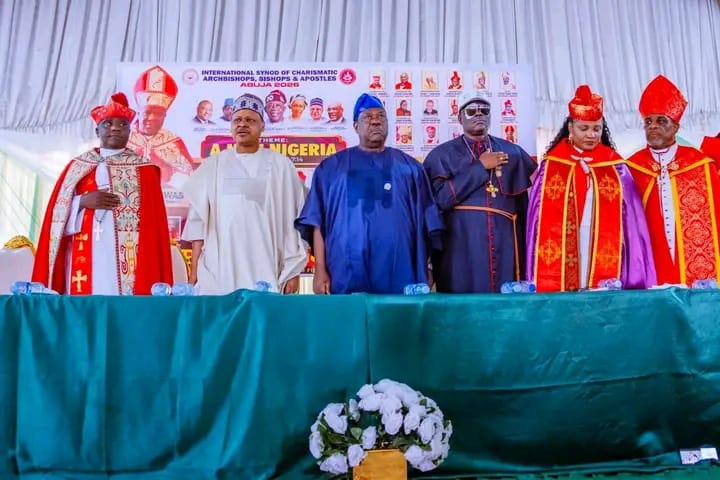
The Secretary to the Government of the Federation, Senator Dr. George Akume, CON, on Wednesday urged religious leaders to treat peacebuilding as a core component of national security and to help steer Nigerians toward unity as the country approaches the 2027 general elections.
Akume spoke at the National Ecumenical Centre, Abuja, during the opening of the 12th Synod of the Charismatic Bishops Conference of Nigeria, where he represented President Bola Tinubu.
Acknowledging the hardship arising from ongoing economic reforms, the SGF said the administration understands the burden on citizens.
“Government recognises the fact that these reforms come with some inevitable pains and that Nigerians have significantly endured. We commend our citizens for their patriotism and resilience and assure them that it would never be in vain as promised by the President,” he said.
Citing World Bank reports on improved macroeconomic stability, Akume said government attention is now shifting to household recovery.
“This government is focusing on recovery of household incomes from poverty and will never relent until reform succeeds and translates to affordable food, jobs, better infrastructure, health services and dignity for the ordinary citizen. That is where the Renewed Hope Agenda truly lies,” he stated.
He explained that the agenda is “rooted in our determination to minimise hardship, create opportunities, simplify the fiscal regime and provide reliefs for vulnerable individuals and businesses,” with expanded programmes in education, health, social protection and community resilience.
On security, Akume disclosed “encouraging intelligence-led breakthroughs, including the rescue in August of 308 abducted citizens from Kwara and Niger States.”
However, he warned that terrorism, banditry, kidnapping and communal conflict “continue to wound families and communities.”
“National security cannot be the responsibility of soldiers, police officers and intelligence agencies alone. Security also begins with trust, social cohesion, early warning and responsible speech,” he said.
The SGF charged the Church to take a leading role, noting that “religious leaders occupy a very important intersection in the prevention and management of these issues because they are recognised influential social mobilisers and actors in peace building. The Church must therefore see peace building as part of national security.”
With 2027 elections approaching, Akume urged the bishops to protect the democratic process.
“Elections will come and go, but Nigeria must remain. As Charismatic Bishops and fathers of faith, you have a decisive role to play, not in determining the winner, but in helping to ensure that Nigeria does not lose,” he said.
He called on them to encourage “peaceful and conscientious participation” and to speak out against “anti-democratic practices such as vote-buying, hate speech and the weaponisation of ethnicity or religion.”
Akume also cautioned against the politicisation of religious platforms:
“I urge you to please refrain from turning the pulpit into an instrument of incitement instead of the sanctuary of conscience. An election is a contest for office; it must never become a war for survival.”
The SGF asked the Synod to deliberate on collaboration with government in youth empowerment, education, peacebuilding, civic responsibility and humanitarian service.
“Government needs the moral reach of the Church and the Church needs an enabling civic environment to thrive. Above all, Nigeria needs both, to work perfectly, for the common good,” he said.
Commending the Church for its prayers and humanitarian interventions, Akume said the President “deeply values” its contributions to peace, national cohesion and moral formation.
He concluded by declaring the 12th Synod open and praying that “God grant Nigeria peace and bless our nation.”
Faith and Moral Issues
Scientists Make Revolutionary Discovery By Opening Jesus’ Tomb For First Time In Hundreds Of Years
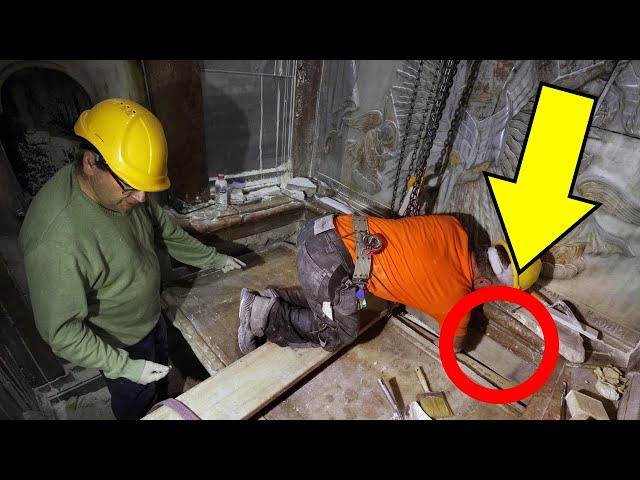
Modern-day Israel has some of the most revered Christian holy sites, but the Church of the Holy Sepulcher, said to be the tomb of Jesus, is the most important. After centuries of water deterioration and structural damage, scientists began a long-overdue renovation of the tomb in October 2016. Beneath a marble slab removed for the first time in hundreds of years, a never-before-seen discovery was found.
The most significant tomb in the Christian religion.
The narrations within the New Testament intricately detail the construction of Jesus’ tomb in close proximity to the site of his crucifixion, meticulously designed to enshroud both his mortal remains and the noble cross upon which he met his tragic fate.
The annals of history resound with unwavering certainty regarding the hallowed significance of the Church of the Holy Sepulcher—a revered beacon of faith and pilgrimage today.
The Quest for Christ’s Sepulcher
Commencing on a poignant quest engendered by an imperial decree, Helena, the venerable mother of Constantine, embarked upon a sacred mission to unearth the elusive resting place of Jesus—rekindling the embers of a past discovery, with the guiding light of Bishop Eusebius illuminating her path towards the venerated sepulcher.
Steeped in the annals of ancient history, around the epoch of 326 CE, the illustrious Roman Emperor Constantine the Great orchestrated the grand inauguration of the first church on the very sanctified grounds that cradled the divine mysteries of Christ’s life and resurrection, destined to serve as a sanctuary not only for his imperial majesty but also as a custodian of the profound spiritual heritage woven into the fabric of Christianity.
Initial renovations
From its inception by Emperor Constantine’s mother to the enduring impact of the Crusaders, each chapter in its narrative has contributed to the intricate tapestry of reverence that cloaks this revered sanctuary.
Over the passage of centuries, the Church of the Holy Sepulcher has stood as a timeless witness to the ebb and flow of history, bearing the indelible imprints of successive transformations that have shaped its sacred presence on the religious landscape.
Spiritual Revival
The enduring legacy of the Crusaders resonates within the very stones of the church, marking a pivotal era that left an indelible mark on its architectural form and spiritual essence.
Their influence transcends mere physical renovations, delving deep into the spiritual marrow of the structure, infusing it with layers of significance and historical gravitas that resonate to this day. Amidst the shifting tides of time, the Franciscan friars emerged as custodians of restoration, embarking on a noble quest to revive the dilapidated grandeur of the church after the poignant collapse of the bell tower in 1545. Their meticulous efforts not only breathed new life into the timeworn walls but also reaffirmed the sanctity of the edicule enshrining the sacred tomb of Jesus, underscoring their unwavering commitment to preserving this venerated place of worship for generations to come.
Spiritual Revival
The crypt was sealed
In 1555, Franciscan monks took a significant step to safeguard the sanctity of the tomb by sealing its entrance.
They sealed the crypt.
With solemn reverence, they carefully positioned a sturdy marble slab over the ancient limestone tomb, shielding it from the touch of eager pilgrims who sought a connection to the hallowed resting place of Jesus. This act of guardianship effectively closed the tomb off from direct access, preserving its sacred aura for generations to come.
Housejogger
Faith and Moral Issues
“Your Voices Must Be Raised Against Terrorism And The Misuse of Religion” — Tinubu to Religious Leaders

By Felix Umande
President Bola Ahmed Tinubu has called on religious and spiritual leaders across Africa and beyond to consistently speak out against terrorism, kidnapping, banditry and the manipulation of faith to justify violence, saying no genuine service to God can be built on the destruction of innocent human life.
The President made the call on Sunday in Kano in a goodwill message delivered by the Secretary to the Government of the Federation, Senator George Akume, at the Grand Maulud of Sheikh Ahmad Al-Tijani, RTA.
Addressing the World Khalifa of the Tijjaniyya Order, scholars, spiritual leaders and adherents from Nigeria and other countries, President Tinubu said religious institutions have a critical responsibility in confronting extremism and promoting peace.
“Your voices must be raised consistently against the murder of innocent people, against terrorism, kidnapping, banditry and the misuse of religion to justify cruelty,” the President said.
“Your institutions and networks must become stronger in the advocacy for peace education, religious literacy, scholarship and the formation of upright young men and women.
“You must also remind political leaders of justice, responsibility and compassion, while reminding citizens that legitimate grievances must never become permission for lawlessness or violence. Above all, our spiritual fathers must continue to teach that no genuine service to Allah is advanced by destroying the innocent human life that Allah has made sacred.”
President Tinubu noted that the gathering was coming at a consequential moment, with societies confronted by conflicts, climate shocks, food and energy crises, violent extremism and the dangerous manipulation of identity and religion.
Citing a UNHCR report that 117.8 million people were forcibly displaced worldwide at the end of 2025, he said the scale of global challenges makes the intervention of spiritual leaders “increasingly indispensable.”
According to him, spiritual leaders “guard the frontiers of conscience” through their capacity to heal wounds, resolve grievances and dissolve deep-seated hatred.
He said the Tijjaniyya community, with its extensive networks across West Africa, North Africa and beyond, possesses moral capital that could be deployed for reconciliation, countering violent extremism, youth guidance and humanitarian solidarity across the Sahel and wider region.
The President said the Federal Government recognizes the critical roles of religious and traditional leaders in deepening tolerance, countering misinformation and identity-based division, and promoting peaceful coexistence.
He reaffirmed Nigeria’s commitment to regional cooperation, counter-terrorism, maritime security, economic integration and dialogue, noting that Nigeria’s position at the intersection of West Africa, the Sahel, Lake Chad Basin and the Gulf of Guinea makes its peace consequential to the region.
“Our position means that peace in Nigeria has consequences far beyond Nigeria. It also means that religious communities with deep transnational connections, such as the Tijjaniyya, can be valuable partners in building an architecture of social peace that complements the work of governments and regional institutions,” he said.
President Tinubu assured that the government would continue to uphold freedom of worship while strengthening collaboration with religious and traditional institutions to promote peace, mutual respect and national cohesion.



Death of 37 Miners in Custody: Ajia Calls for Independent Investigation, Accountability
Spread the loveA chieftain of the All Progressives Congress (APC) and the Dan Amanan Fune Emirate of Yobe State. Alhaji...


Body Operating With Name National PTA, Unknowed to Edu Ministry
Spread the loveBy Son Tertsea, Abuja The body operating under the name National Parent-Teacher Association (PTA) of the Federal Unity...

Peter Obi Distances Self From Purported Letter to Obi of Onitsha
Spread the loveBy Nick Ibe A letter purportedly written by him to the Obi of Onitsha, Igwe Nnaemeka Achebe, against...


2027 Elections: Police Must Never Be Seen As Political Tool, Tinubu Warns
Spread the loveBy Felix Umande President Bola Ahmed Tinubu has charged the Nigeria Police Force to maintain the highest standards...
Tinubu To Return At Weekend After Extended Working Vacation In London, Paris – Presidency
Spread the loveBy Felix Umande President Bola Ahmed Tinubu will return to Nigeria at the weekend following the extension of...

Benue Govt Suspends Muslim Pilgrims Board Chairman, Secretary Over Alleged Mismanagement
Spread the loveBy Felix Umande The Benue State Executive Council has approved the suspension of the Chairman and Executive Secretary...


BUILDING A BUSINESS: He Started an eBay Side Hustle at 14 – Then Grew It Into a $92 Million
Spread the loveKey TakeawaysLior Pozin started dropshipping on eBay at 14.By age 21, he was making $6,000 per month dropshipping,...

Plateau Imposes Curfew on 3 LGAs, Bans Use Of Motorcycles
Spread the loveBy Michael Lim, Jos A dusk-to-dawn curfew on Barkin Ladi, Bokkos and Mangu Local Government Areas of Plateau...

Tinubu Praises Kaduna Gov Uba Sani’s Free CNG Mass Transit … As Benue Increases Fares for Commuters
Spread the loveBy Son Tertsea President Bola Ahmed Tinubu has praised Kaduna state government for deploying Compressed Natural Gas, CNG,...

Foreign Medical Tourism to Drop as Nigeria Records First Tele-robotic Surgery Success in West Africa
Spread the loveBy Son Tertsea Nigeria’s first tele-robotic surgery on September 20, 2026 at the Redeemer’s Health Village (RHV), in...