
Opinion
Faleye: Taking the Employees’ Compensation Scheme To State Governors

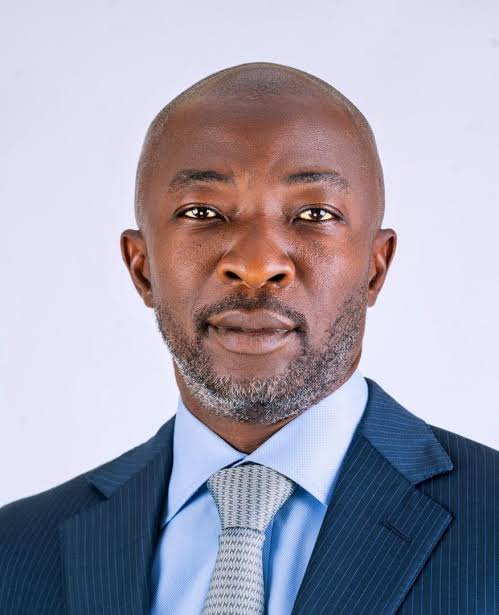
Dr Emmanuel Ulayi
When Barrister Oluwaseun Faleye assumed duties as the Managing Director/Chief Executive of the Nigeria Social Insurance Trust Fund (NSITF) on July 15, 2024, it was clear that a new dawn had arrived for the Fund. He left no one in doubt that a reformer had finally berthed at the agency and that he possessed the requisite wherewithal to transform the NSITF and usher in a breath of fresh air into the welfare of the Nigerian worker.
With less than two years into his tenure, Barrister Faleye has succeeded in instilling Nigerians’ confidence in the Fund by building strong institutional trust through deliberate and concerted efforts. One such initiative is the repackaging and aggressive promotion of the Employees’ Compensation Scheme (ECS) in the public sector, along with inter-agency engagement, to give the scheme the visibility it needs. The Managing Director has been leading from the front in preaching the gospel of the Employees’ Compensation Scheme, taking it to the doorsteps of the governors.
No doubt, the idea of engaging governors directly as a means of marketing the ECS has started yielding positive results. So far, the MD has been able to take his campaign of selling the benefits of the ECS to at least three governors from three geopolitical zones, and the responses have been amazing.
In the North East, the Managing Director has engaged the Governor of Taraba State, Agbu Kefas, with whom both agreed to partner on the ECS. While meeting the governor at the Government House in Jalingo, the Managing Director called for deeper institutional collaboration between the Fund and the Taraba State Government to strengthen the implementation of the Employees’ Compensation Scheme (ECS).
He told the governor that the engagement was far from ceremonial, describing it as part of a deliberate strategy to build structured partnerships with “progressive state governments committed to workers’ welfare and institutional sustainability.” Faleye emphasized that the Employees’ Compensation Scheme is not merely a statutory obligation but a critical social protection instrument that guarantees dignity for workers and stability for employers.
“When a worker is injured, disabled, or loses his life in the course of duty, the response of government defines public trust and reinforces confidence in leadership,” Falaye said, noting that expanding ECS coverage aligns directly with the governor’s welfare-driven agenda as he commended Governor Kefas on his commitment to workers’ welfare.
The NSITF boss stressed the need to move beyond dialogue to measurable outcomes and proposed practical steps that would expand ECS compliance across state MDAs, intensify sensitization of major employers and contractors operating in Taraba, and strengthen workplace safety and compensation awareness across the state.
To ensure structure and accountability, Faleye suggested a focal ministry or designated official to coordinate engagement with the NSITF. “If it pleases Your Excellency, we can immediately set up a joint technical interface between your designated team and ours to develop a short implementation roadmap within the next few weeks,” he said, adding that the Fund has already established an internal Strategic Inter-Agency Coordination (SIAC) framework to track timelines and deliverables arising from such engagements.
Faleye highlighted the mutual benefits of strengthened ECS coverage, noting that it would protect workers, reduce employers’ litigation exposure, promote industrial harmony, and reinforce the administration’s commitment to structured social protection.
In a move aimed at institutionalizing compliance, Faleye recommended the integration of the ECS Compliance Certificate into the state’s public procurement and contracting processes. He explained that requiring evidence of NSITF compliance as part of documentation for contract bidding, pre-qualification for state projects, contractor registration and renewal, and public-private partnership engagements would not create new obligations but rather reinforce existing statutory requirements.
The approach, he added, would ensure that companies benefiting from public funds are also compliant in protecting their workers. Faleye concluded by seeking clarity on the state’s preferred coordination structure, asking the governor to advise on which ministry or official the Fund should immediately work with to operationalize the collaboration.
He subsequently conferred on the Governor, the Ambassador for the Advocacy of ECS in Taraba State in particular, and the Northeast in general.
Consequently, Governor Kefas assured that the state would key into the ECS for the betterment of the workers. Governor Kefas immediately set up a high-powered committee to interface with NSITF to ensure Taraba state is ECS-compliant. “Taraba state government is ready to partner with NSITF to ensure you fulfill your mandate by ensuring all workers are enrolled in the scheme. We would be working through our office of the Head of Service, Ministry of Finance, and Ministry for Local Government,” he stated.
The governor, while welcoming the NSITF delegation, expressed his appreciation for the “Kind words on all the positive things you have noticed we are doing to improve the lives of our people.”
He revealed that “Only recently, we paid N5 billion to pensioners in the state” and expressed optimism that “by the end of the year, the state won’t be owing any pensioners their entitlement. We would fulfill all obligations as regards the scheme in furtherance of our commitment to workers’ welfare,” Governor Kefas promised.
On the confirmation of Ambassador for Advocacy of ECS in the state and the whole of the Northeast region, the governor said, “I want to assure you I am interested in this, your mandate. I am interested in accepting any assignment that would enhance this mandate in the interest of the country and workers in general.”
In the South South, Barrister Faleye took his campaign to the Governor of Rivers state, Chief Siminilayi Fubara, who applauded the scheme, declaring that the Fund was projecting the administration of President Bola Tinubu positively, and was indeed a gift to the Nigerian worker.
Faleye had explained to the governor that his mission in Rivers State was to present cheques to beneficiaries under the ECS and solicit the governor’s support for the Scheme. “We are here in Rivers State to present cheques to some private sector employees who are beneficiaries of the Scheme. We are also here to solicit your support in ensuring that the River State Government subscribes to the Employees’ Compensation Scheme in the bid to improve the State workers’ welfare.
“River State keying into the scheme will be a trailblazer. Rivers can be the leading light of the ECS in the South-South Region,” he solicited.
Explaining the Scheme to Governor Fubara, Faleye said, “We are mandated by law to implement the ECS in the case of death, injury, or diseases that may occur in the course of work. It is instructive to note that our compensation goes on for some while to provide a social safety net for employees.
“In the same vein, it offers a lot of economic benefits to the State and its workforce as the Scheme builds resilience in the workforce ecosystem, thereby contributing to economic productivity”.
The NSITF MD appealed to Governor Fubara to make the NSITF compliance certificate a prerequisite for doing business with the State Government, a suggestion which the Governor readily accepted, noting that Rivers State will start by ensuring that the contractor undertaking its Government Secretariat renovations complies with the ECS.
Governor Fubara, who was elated at the excellent work being carried out by the MD and his team, commended the Fund for bringing the Employees Compensation Scheme to the notice of the Rivers State Government. He said, “The good work of NSITF, through the Employees’ Compensation Scheme, is projecting the Federal Government in a very positive light. In fact, it is a gift to Nigerian workers and everyone who has keyed into the Scheme.”
Governor Fubara also assured that Rivers State would embrace the Scheme. He said, “We are trying in our little ways to improve the fortune of our workers. We will take it as a matter of priority to ensure we subscribe to the Employees’ Compensation Scheme managed by the Nigeria Social Insurance Trust Fund”.
The Governor further opined that the Scheme could come in handy in the fight against corruption. “One way of fighting corruption is for the State to key into the Employees’ Compensation Scheme.”
He explained that corruption “Is fuelled by the fear of what happens to the individual when they are no longer able to work”, emphasizing the importance of an institution such as NSITF that could allay workers’ fear of the future and also give hope to the people. He expressed joy that the “Scheme is working and catering for the needs of injured and disabled workers as well as families of deceased ones,” and vowed that “…nothing will stop us from working towards subscribing to the Scheme.”
Just recently, the MD visited the South West, and the campaign train stopped over at the Alausa, the seat of power in Lagos, where both the NSITF and the Lagos State Government heartily agreed to align on the Employees’ Compensation Scheme. Barrister Faleye had expressed the willingness of the NSITF to support the Lagos State Government in putting in place the appropriate institutional framework for the implementation of the Employees’ Compensation Scheme (ECS) within the state.
He said the purpose of the visit was to establish a clear and structured pathway for the implementation of the Employees’ Compensation Scheme in Lagos State. The MD stated, “We would like to assure you of our full readiness to support Lagos State through: Technical onboarding and advisory support, sensitisation across MDAs, LGAs, and public institutions, claims processing and compensation administration, and occupational Safety and Health interventions.”
He stressed that to ensure momentum, “We respectfully seek alignment on the following: Identification of the lead coordinating Ministry or Office; Nomination of a focal person or technical desk; and agreement to convene a joint technical session within the next two weeks”.
Speaking about the strategic nature of Lagos, Faleye said, “We recognize the scale and sophistication of Lagos State: A large and diverse workforce, multiple MDAs and LGAs, and strong administrative and payroll systems.
“We appreciate the opportunity to engage with you on a matter that directly aligns with Lagos State’s development priorities under the THEMES+ Agenda, particularly in the areas of governance, economic sustainability, and health and environment,” he added.
The MD further explained that “At this stage, our objective is practical and implementation-focused: To establish a coordination structure between Lagos State and NSITF; and to agree on immediate next steps for a seamless onboarding process”.
On the importance of the scheme, Faleye explained that “The Employees’ Compensation Scheme provides: Structured protection for employees in cases of workplace injury, disease, disability, or death; a framework for managing employer liabilities; and a mechanism for strengthening occupational safety for workers.
“Importantly, ECS serves as a direct enabler of key pillars of the THEMES+ Agenda. Under economic sustainability, it protects the workforce that drives productivity and economic output.
“We look forward to working closely with your team to translate this into an effective implementation model”, the MD reiterated.
In his response, the Lagos State Head of Service, Mr. Bode Agoro, who stood in for the State Government, expressed appreciation for the gesture and immediately announced the full implementation of the Employees compensation Scheme in the state with the establishment of a unit in the state to manage the scheme.
Already, the advocacy by the Managing Director has gained traction, and its effectiveness is spreading like wildfire as other states are now yearning for a visit from the Fund to key into the ECS. Daniel has indeed come to judgement at the NSITF. With Barrister Oluwaseun Faleye, the atmosphere is conducive, and there is a Renewed Hope in place.
Ulayi, is a principal manager in the Corporate Affairs department of NSITF

By Rufai Oseni
The Minister of Works is a key player in President Bola Ahmed Tinubu’s government who is not performing well to help Mr President win the hearts of many Nigerians ahead of the crucial January 2027 Election.
I have been a staunch supporter of President Tinubu even before the 2023 Presidential Election.
I strongly disapprove of the performance of Works Minister, Sen. David Umahi. His failure is causing huge embarrassment and hatred to PBAT because of the hardship brought upon Nigerians on federal roads despite the trillions of naira released for road rehabilitation projects by PBAT.
I doubt if since May 29, 1999 there has been any Nigerian President who has shown so much commitment and determination to fix federal highways than President Tinubu
Believe me, if I were the Minister of Works under a very patriotic, committed and determined leader like President Tinubu, I would have restored these critical federal highways within the last three years with such trillions of naira released for this purpose. I say this from my knowledge and experience as an Engineer who headed Delta State Government Direct Labour Agency (DLA), an Agency statutorily charged with the construction, rehabilitation and maintenance of roads and who in August 2011 was saddled with the tough task of urgently restoring hundreds of kilometers of roads in my State that had collapsed and became death traps leading to fatal accidents and deaths of our people and commuters.
In less than two years and with only about three billion naira released by the State Government, I reconstructed and rehabilitated these collapsed roads, constructed some new ones and also opened up many new roads in our rural communities to enable our farmers to commute easily to their farms and transport their produce to urban cities.
The records are there, he said, for anyone to go verify. He added that: Some of the asphalt paved roads I did over thirteen years ago are still standing firm today as if they were constructed just one week ago. I guarantee that these roads will last another ten years or more.
A patriotic and committed PBAT should not end up being daily abused by Nigerians who are rightly angry because of the hell they go through traveling on these roads; instead, Mr President should be receiving their praises and prayers if only his Minister of Works rightly utilized the funds released to him by the President to fix these roads.
I can tell Nigerians that President Tinubu is more pained and heartbroken than anyone else seeing reports of the hell Nigerians still go through traveling across our country on these federal roads.
Frankly if this disturbing situation continues on our federal highways I worry that Nigerians may express their anger against PBAT at the January 2027 Presidential Election except Mr President swiftly takes decisive action right now
The Minister’s Concrete Pavement Policy has been a disaster and a source for huge waste of public funds. It is ridiculous and makes no engineering and economic sense at all! What has Concrete Pavements got to do on Lokoja to Abuja, Abuja to Kaduna highways? I am surprised that some State Govs even adopted his Concrete Pavement Policy and wasting their States’ Funds.
It is wrong for the Minister to promise that within the next two weeks he will restore the collapsed sections of Benin-Agbor-Asaba and Benin-Sapele-Effurun Fedeal Highways. He knows that this is not possible in this peak of rainy season. Only palliative works can be done just to allow vehicles to maneuver.
It is also wrong for the NDDC to be directed to take over responsibility meant for the Ministry of Works and for which trillions of naira have been released to the Ministry. Statutory Funds approved and released to NDDC are not meant for such Federal Road Projects; they are meant to take care of very special and pressing needs of our people of the Oil and Gas Producing States of Niger Delta Region
By Philip Nyam
Last month, I was part of a delegation that participated in the Seminar on Young Leaders under the Global Development Initiative (GDI), organised by the University of International Business and Economics (UIBE), in Beijing, China. We came from diverse countries including Angola, Antigua and Barbuda, Gambia, Grenada, the Kurdish Iran, Nigeria, Sierra-Leone, Macedonia, and South Africa. Available records show that the UIBE has, since 2000, with the approval of the Chinese Ministry of Commerce, conducted more than 140 bilateral and multilateral training programmes, hosting over 350,000 participants.
The UIBE is by every standard a welcoming academic environment, a great citadel of learning renowned for building leaders for tomorrow. It is axiomatic that one of the problems plaguing developing or underdeveloped countries is poor leadership. This effort is to lay a solid foundation and bridge the gap.
The GDI, of course, is China’s ambitious proposal for worldwide development, launched by President Xi Jinping at the UN General Assembly on September 21, 2021. The idea is simple and urgent: Push the UN 2030 Agenda and the SDGs, but anchor them in what developing countries need most. Poverty reduction, food security, vaccines and health, financing for development, climate change and green development, industrialisation and the digital economy. In other words, the GDI is China’s call for a shared future, and it is a project that puts developing countries first.
So, for two weeks at UIBE, we lived inside that idea. Despite the fact that some of us were visiting China for the first time, we quickly integrated. We were taught China’s basic national conditions and achievements since reform and opening up. We studied how China is implementing the UN 2030 Agenda through poverty alleviation. We took lectures on China’s political system, the digital economy, artificial intelligence, intellectual property, Chinese history, Chinese culture, and the cultivation of young leaders under GDI. The participants were also exposed to the philosophy behind Chinese steady development: “If you want to be rich, build the roads”. The lecturers were professional and down-to-earth; the supervisors and volunteers were amazing, and the people were generally friendly and welcoming. And so, we read, digested, and assimilated what we were taught.
Between classes, China opened itself to us. We tasted our way through Beijing and Sichuan’s rich cuisine. In Chengdu, capital city of Sichuan Province, we watched Sichuan Opera face-changing until we couldn’t tell where the mask ended and the wonder began. We sat for tea and learned the quiet discipline in every pour. At the Panda Base, we met giant pandas and red pandas, black-and-white ambassadors that everyone falls for. We climbed the Great Wall and felt history under our feet. We had the rare opportunity of participating in the Fourth China International Supply Chain Expo, and we visited the Museum of Foreign Economic and Trade Relations.
It was indeed a masterclass in policy and culture. But some encounters don’t fit into a seminar schedule. They slip between lectures, between the Great Wall and a bowl of hotpot, and end up rewriting the whole trip for you. And the lesson I keep returning to came from a narrow lane lit by lanterns. It didn’t happen in a lecture hall; it happened in Kuanzhai Alley of Chengdu.
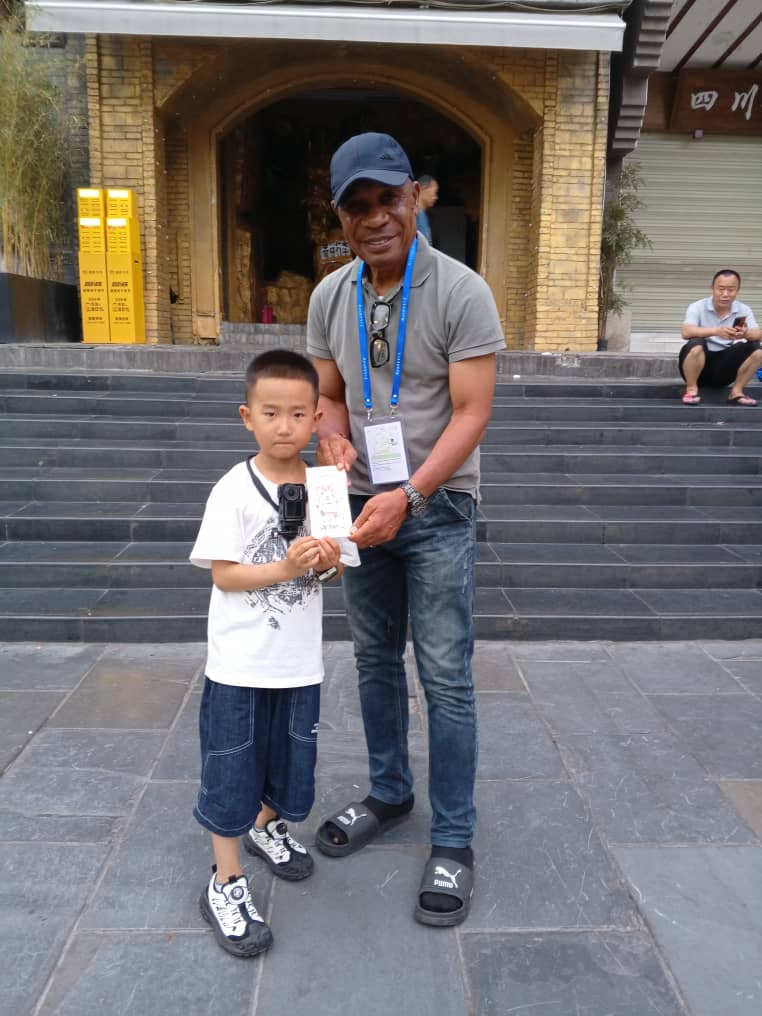
My encounter with a six-year-old boy named Eno. It was a rare encounter that has left an indelible impression on me. Kuanzhai’s Alley is Chengdu’s living room. Red lanterns, teahouse chatter, the smell of spice in the air. We were taking a walk into the Alley when a small voice stopped me. Eno was six. Bright eyes. Questions ready before his hello finished. “Where from? Your name? Do you love football?” At six, he spoke good English. He knew Cristiano Ronaldo. He asked about pandas and why only Chengdu keeps them so close. He asked about the ongoing World Cup in the USA, Canada, and Mexico. He talked like a child with maps and goals in his head, but he listened like someone older. No shyness, no demand. Just courage wrapped in courtesy.
Then came the gesture I did not expect. Eno pressed a small picture of a panda into my hand. “Wish you well,” he said, and gave it free. No blood, no prior knowing. A stranger’s hand, offering love without a sound. I felt it immediately. I had to look away for a second. Because tears rose unbidden. In that moment, Eno was not just a boy in an alley. He was the idea behind GDI made human: spreading love, uniting humanity, one small act at a time. To me, Eno is not just a little boy in an alley; he is China’s welcome, wide and deep.
That small panda picture now lives in my sitting room in Nigeria. I guard it. Some days it’s just paper and ink. Other days it’s a window back to Chengdu, to lantern light, to a boy who decided a stranger should feel welcome.
Eno taught me something the lectures circled but could not say as plainly: kindness needs no reason. It just begins. Love needs no reason to be sweet. If GDI is about building a more connected, equitable world, I saw it in miniature that afternoon. Policy, trade, and technology matter. So do pandas, football, and a child’s unguarded generosity.
I hope to reconnect with Eno someday. Until then, I’ll keep looking for that golden light in Kuanzhai’s alleys, and I’ll keep telling the story of the six-year-old who reminded a visitor from Nigeria that the soul of a city, a nation, can fit in one small hand.
…Philip Nyam participated in the just-concluded Seminar on Young Leaders under the GDI in Beijing.
By Son Tertsea, Abuja
A disturbing development in the Nigerian political space came with the judgment of a Lokoja federal court with its call on INEC to deregister the National Democratic party, NDC.
The devastating effects of this judicial pronouncement on all candidates for the 2027 general elections nominated on the platform of the Nigeria Democratic Congress (NDC) and the entire polls cannot be overemphasised.
The Lokoja Federal High Court Lokoja earlier granted the party recognition as a political party in Nigeria.
Justice Isah Dashen delivered Friday judgement in Suit No. FHC/LKJ/CS/49/2025, to set aside its December 10, 2025 judgment, which had ordered the Independent National Electoral Commission (INEC) to recognise and register the NDC.
The court upheld an application by the Peace Movement Party (PMP), which argued that it was a necessary party in the suit.
The judge further held that failure to include the PMP amounted to a denial of fair hearing and rendered the previous judgment invalid.
Justice Dashen ordered that the parties return to the position they were in before the December 10, 2025 judgment, pending the fresh determination of the substantive case.
The judge also held that some material facts were not brought before it during the earlier proceedings, a development that contributed to its decision to set aside the judgment.
The NDC and the Peter Obi Media Reach (POMR) described the court’s decision as a temporary legal hurdle.
NDC National Chairman, Sen. Moses Cleopas Zuwoghe, said the party had directed its team of lawyers to challenge the order at the Court of Appeal.
In a statement on Friday, Zuwoghe assured the public and candidates of the party in the forthcoming 2027 elections that “our party is on course,” stressing that “the NDC has not been deregistered.”
He stated that: “The public knows that by December 2025, the Nigeria Democratic Congress as an association complained of INEC’s refusal to register us as a political party, whereupon we proceeded to the Federal High Court. The Federal High Court upheld our constitutional right to freedom of association under the Constitution and compelled INEC to register us, which INEC did.
“Since then, we have started political activities, embarked on the registration of members, held congresses from ward to national levels, held conventions and concluded primaries to all offices following INEC’s timetable. We have been fully participating in all INEC activities without let or hindrance.
“NDC also fielded candidates and fully participated in the just-concluded bye-elections in Nasarawa and Enugu states.
“Candidates for the House of Assembly, House of Representatives, Senate, Governorship, Presidential, and Vice-Presidential positions have been duly nominated, and we are in the process of formally submitting them to INEC in accordance with INEC’s timetable.
“The association that filed the complaint is unknown to us. The Peace Movement Party (PMP) is not a registered political party in Nigeria. They claimed, in a motion (not even a substantive suit or appeal), that the court should set aside its earlier judgment on the purported ground that, in 2015, they had sought registration as a political party with the victory sign as their symbol and were denied.
“It is important to note that they are not an association applying for registration now under the exercise that started last year. They are also not a registered political party in Nigeria participating in the political process now, as we are.
“Furthermore, the court, having delivered a final judgment in our suit against INEC, had become functus officio. The court had also dealt with all related issues concerning associations claiming they wanted to use the same symbol and colours. The court, in its judgment, overruled INEC when those issues were raised, and there is no appeal against that judgment.
“Therefore, we are surprised that, on an application by an association claiming that it wanted to register as a political party with the victory sign in 2015, an association that is not a registered political party and is not seeking registration now to participate in the current political process, His Lordship came to the conclusion that they have locus standi, and furthermore, that he has jurisdiction to do what he did.
“Accordingly, we have been informed that His Lordship made an order setting aside the court’s earlier decision of December 2025.
“There was no order directing our deregistration. However, we are dissatisfied with the decision that has been made, and we have instructed our team of lawyers to immediately proceed to the Court of Appeal to challenge the jurisdiction and propriety of His Lordship’s order.
“We assure the general public and particularly our candidates at all levels that our party is on course. The NDC has not been deregistered, and we are challenging today’s order at the Court of Appeal as soon as possible. We have no doubt that justice will be done.”
The party condemned what it described as efforts by those who seek to shrink the democratic space and stifle opposition voices and alternatives.
“Nigerians have a right to a full range of opinions, ideas and alternatives; and political platforms and candidates should be allowed to participate in the 2027 general election process, which has already gone midway.
“It is too late for anyone to attempt to use the judiciary to derail or narrow Nigeria’s multi-party democratic space. If the said association (Peace Movement Party) were a party affected by the judgment on our initial suit, the only option open to it was to appeal the verdict, an option which it did not take. Even at that, the window open for such appeal has since closed and any such appeal by now has become statute-barred.
“To now try to upturn that verdict through the back door, via a motion, is not only unheard-of, but also illegal and an outright abuse of court process.”
The judgment is coming exactly 10 days after the Court of Appeal in Abuja ordered a stay of execution of the judgment of the Federal High Court, Abuja, ordering INEC to deregister the African Democratic Congress (ADC), Action Peoples Party (APP), Action Alliance (AA), Accord Party (AP), and Zenith Labour Party (ZLP).
The three-member panel of the appellate court led by Justice Abubakar Mohammed, accused Justice Peter Lifu of the Federal High Court in Abuja of flouting an order it made on May 22, which directed him to suspend proceedings before him.
The appellate court had held that Justice Lifu’s action amounted to an affront and judicial rascality on the hierarchy of courts.
It described the lower court’s action as “the highest form of judicial impertinence,” stressing that the Supreme Court previously held that a judge who acted in such manner “is unfit for the bench as it amounts to judicial rascality.”
Legal luminary, Femi Falana in statement entitled ‘Nigerian Judges and Lawyers Should Be Prevented From Sabotaging the 2027 Election,’ expressed concern over recent judgments delivered by judges of the Federal High Court on the powers of INEC regarding election timelines.
The senior advocate recalled that Justice Mohammed Umar of the Federal High Court invalidated INEC’s timeline for the conduct of party primaries and nomination of candidates ahead of the 2027 elections.
The court also nullified INEC’s May 10 deadline, directing political parties to submit their membership registers and databases as part of the requirements for participation in the polls.
According to him, the court held that the timeframe announced by INEC for political parties to conduct primaries and submit, withdraw, or replace candidates “is inconsistent with the provisions of the Electoral Act, 2026.”
The suit was filed by the Youth Party against INEC
He further noted that INEC had appealed the ruling and filed a motion for a stay of execution pending the Court of Appeal’s determination of the appeal.
Falana said the situation became more complicated after another judge of the Federal High Court, Justice James Omotosho, ruled in a separate suit filed by the Social Democratic Party (SDP) that INEC possesses the constitutional authority to fix timelines for political party primaries and other electoral activities ahead of the 2027 elections.
He argued that the two judgments created uncertainty within the political system.
Therefore, he urged NJC and NBA to urgently investigate the circumstances surrounding the judgments in Youth Party vs. INEC and SDP vs. INEC, warning that failure to address the issue could threaten the credibility of the 2027 elections.
He added that judges and lawyers must avoid actions capable of undermining the credibility of future elections, warning that legal disputes should not become tools for disrupting democratic processes.
He drew parallels with Nigeria’s political history, warning that failure to address the situation immediately could reopen painful memories of 1993. He warned:
“Unless the judges and lawyers involved are called to order, the 2027 election may be sabotaged by judges and lawyers.”



Mother Subjects Daughter to Abuse, Admits: “I made $300 from my 8-yr-old daughter’s pornographic video’
Spread the loveBy Nick Ibe The viral video on the social media involving an 8-year old girl whose ordeal was...

Lawyer Assaulted by Police: NBA Gboko Branch Secures N500 Million General and Exemplary Damages in Makurdi Court
Spread the loveBy Our Reporter In the pursuit of justice for a colleague, B. B. Iliamkondo, Esq., who was recently...


Alia Denounces Ayilamo Attack, Commiserated With Victims as DSS Arrests 3 Suspects
Spread the loveBy Felix Umande Governor Hyacinth Alia of Benue State has strongly condemned the deadly attack on Ayilamo Community...

Alia Condemns Ayilamo Attack, Commiserates With Victims, As DSS Arrests 3 Suspects
Spread the loveBy Felix Umande Governor Hyacinth Alia of Benue State has strongly condemned the deadly attack on Ayilamo Community...


FG, States, Be warned We Will Strike, Without Warning –ASUU
Spread the loveBy Nick Ibe, Abuja Without urgently resolving all the pending salary and welfare issues, by the Federal Government...
Protest Against Xenophobia: NASS Orders Boycott of South African Organised, Hosted Legislative activities
Spread the love–Calls on State Assemblies to join By Isa Abdul, Abuja In a bold move against South Africa’s xenophobic...

Why Education is Dear to Me – By Peter Obi
Spread the loveAfter returning to Abuja on 8th September 2026, following our visits to Benue and Plateau States, I travelled...

After Two Decades: FG Pays 2,700 ex-Nigeria Airways Staff N18bn
Spread the loveBy Son Tertsegha, Abuja Over two decades after the national carrier, Nigeria Airways, was liquidated, the Federal Government...

To Boost Sch Enrollment: Nasarawa Plans Mobile Courts To Arrest, Prosecute Parents Of Out Of School Children
Spread the loveBy Michael Lim, Jos As part of measures to tackle the growing number of out-of-school children in Nasarawa...

Akume to Religioud Leaders Make Peacebuilding Part OF National Security Ahead of 2027
Spread the loveBy Felix Umande The Secretary to the Government of the Federation, Senator Dr. George Akume, CON, on Wednesday...