
Foreign
68-year-old Briton Searches for Missing 31-Year Nigerian Husband in UK


68-year-old British woman, Dawn Ottewell, from Dewsbury, West Yorkshire, has told the UK-based newspaper, The Sun, how she is struggling to locate her Nigerian husband, Bright Emokpae, 31, whom she married in 2022.
According to reports, she wanted to divorce Emokpae, whom she accused of leaving their home and blocking her on social media.
The Sun on Monday reported that the couple, who have a 37-year age difference, met on dating apps in 2021 before marrying at a registry office in Nicosia, Cyprus, on March 22, 2022.
Ottewell said Emokpae initially told her that he was a professional in his 30s named Brian Thomas, but later disclosed that he was a fashion student in his mid-20s from Benin City, Nigeria.
She said she forgave him and eventually travelled to Cyprus in March 2022, where they met in person for the first time and got married.
“I know I was a fool, but I was in love,” Ottewell said.
“I was so lonely and depressed during the pandemic. I was out-of-work with several health issues. I was on Universal Credit and living with my daughter Kirsty, 33, who had a 14-month-old baby, but we were arguing all the time.
“When I met Bright, he made me feel special and alive.”
According to Ottewell, Emokpae later moved to Britain after obtaining a spouse visa, but their relationship deteriorated.
She alleged that he became distant and made frequent financial demands, including sending money to Nigeria. She added:
“I got all-new furniture, and he didn’t put a penny towards it. When we went out for dinner, it was usually me picking up the bill.”
The Sun reported that Emokpae denied the allegation, saying he contributed £400 towards his £900 flight from Nigeria and tax and water bills at their shared home.
The couple separated in October 2023 but reunited six months later after Ottewell received a £63,000 payout following a medical negligence claim related to a prolapse operation at an NHS hospital, according to The Sun.
Ottewell said she later regretted reconciling with him, alleging that he was interested in her money.
The relationship subsequently deteriorated again, and she said Emokpae left shortly before Christmas 2024 after finding messages she had exchanged with other men on dating apps.
Ottewell said she had not spoken to him since he blocked her on social media about eight months before The Sun’s report was published.
“He’s done a runner and is refusing to sign the divorce papers because I believe he wants to cling on to his spouse visa,” she said.
She also alleged that Emokpae could be living in Scotland, where she claimed he had started an online clothing business.
“I’m convinced he was never in love with me and just wanted a visa to move to England.
“And it’s because of his cherished spouse visa that he won’t agree to a divorce.
Ottewell said she was receiving assistance from Citizens Advice as she tried to locate him and serve him with divorce papers.
“I just want him out of my life for good.
“I also want people to know that if this can happen to me, it can happen to anyone.”
When approached by The Sun, Emokpae said he had signed the divorce papers but declined to provide evidence.


Foreign
For Rural Character, Limit Artificial Light Pollution: South African Towns Ban Streetlights, Perimeter Fences

By Malcolm Libera
A handful of small coastal towns in the Western Cape have restrictions on streetlights, security fences and other perimeter barriers.
Betty’s Bay, Pringle Bay, and Rooi-Els, situated along the Hangklip coast, fall under the jurisdiction of the Overstrand Municipality.
However, they also form part of the Kogelberg Biosphere Reserve, a UNESCO-designated area known for its biodiversity.
The villages have planning restrictions intended to preserve their rural character, limit artificial light pollution, and allow wildlife to move freely between the mountains, fynbos, and coastline.
The restrictions are set out in the Hangklip Villages Conservation Overlay Zone (HCOZ), the Overstrand Municipality Land Use Scheme, and the municipality’s Fences and Fencing By-law.
One of these provisions concerns conventional streetlights, which are not permitted in the villages unless a specific threshold of property owners supports their installation.
Under the conservation overlay provisions, streetlights may not be erected unless documented votes in favour have been obtained from 66% of registered property owners in the respective village.
The restriction is intended to preserve the area’s dark-sky environment and limit the impact of artificial lighting on nocturnal wildlife.
Animals such as caracals, owls, bats, and Cape grysbok rely on natural darkness for their behaviour, feeding and movement. Artificial lighting can interfere with these activities and affect insects, coastal birds, and marine life.
The municipality also regulates outdoor lighting on individual properties to prevent excessive light from spilling into neighbouring properties and public spaces.
Property owners are encouraged to direct external lighting downward rather than allowing it to spill over property lines.
Sensor-operated lights are also recommended as an alternative to permanent lighting because they remain off when not in use.
The regulations also specify what constitutes a public nuisance. This includes lighting with a source intensity exceeding 500 candela, illumination exceeding three lux, or an upward light ratio greater than 2.5%, measured from a street, public place or property boundary.
Electric fence restrictions
Durban, South Africa – 6 December 2020: A yellow warning placed on an electric fence to signify to others the danger of touching the fence as crime increases in the country
Security infrastructure is also subject to restrictions, especially where it could obstruct wildlife movement or create hazards for animals.
The municipality’s Fences and Fencing By-law requires prior written consent from the municipality for certain perimeter barriers.
These include electrified fences and barriers fitted with barbed wire, spikes, or other sharp protrusions.
Electrified fencing is generally only permitted above a wall at least 1.8 metres high, subject to compliance with the relevant electrical safety regulations.
Without municipal consent, fences along lateral and rear property boundaries may not exceed 1.8 metres, while fences within 4.5 metres of a street boundary may not exceed 1.2 metres.
The Overstrand Land Use Scheme also outlines parameters for boundary walls and fences, including a general maximum height of 2.1 metres, with electric fencing permitted above that height.
These restrictions are relevant in Betty’s Bay and the surrounding villages, where residential properties are situated within an environmentally sensitive landscape.
Wildlife, including tortoises, porcupines, small antelope and baboons, regularly moves through the area.
Solid walls and poorly designed security barriers can obstruct these routes, while electrified or sharp ground-level barriers can injure or kill smaller animals.
The regulations are intended to balance property security with environmental protection and ensure that residential development does not unnecessarily fragment natural habitats.
For homeowners in these areas, this means that installing conventional streetlights, building high boundary walls or adding certain security features is prohibited without municipal approval.
Businesstech

By Isa Abdul, Abuja
In Saudi Arabia, a kiss in the mosque would earn you death, as two Bangladeshi nationals, identified as Nazrul Islam Abdul Basir and Siri Akhtar, have reportedly been executed in Saudi Arabia following their conviction over the alleged immoral act inside a Mecca mosque.
Reports circulating on social media indicate that the couple had travelled to Mecca for their honeymoon. But what was to be memorable event is their lives became a suicide mission.
The gesture was wrong in a wrong place, not an expression of gratitude to Allah for their marriage, as far as the Saudis are concerned.
Reports claim the couple’s bodies had been returned to Bangladesh in two coffins for burial.
Some online reports claim the couple were newlyweds executed over a kiss (such as a forehead kiss or a kiss inside the mosque).
However, the Saudi government’s official statement did not detail the exact nature of the act, and conflicting reports—including statements from family members and media checks—disputed whether they were newlyweds or what specific physical contact occurred.
But reports indicate the Bangladesh Consulate General in Jeddah stated they received no advance notice or prior notification from Saudi authorities regarding the executions and have formally requested clarification and acknowledgement.

By Son Tertsea, Abuja
A Catholic priest was crushed to death by a wooden crucifix that pressed him against the pulpit as it fell from the wall while celebrating Mass in the Ecuadorian city of Guayaquil on Saturday.
According to reports, shouts of “Father, Father! Call an ambulance!” people at Our Lady of Perpetual Help church could be heard shouting just before a livestreamed broadcast cuts out.
The graphic footage of the accident went viral Sunday on social media and was widely carried by news outlets.
The Archdiocese of Guayaquil mourned the death of the priest, Patricio Sanchez, in a statement and expressed its “solidarity, affection and love” for his family and friends.


Failure to Secure NNPCL GMD Job: EFCC Arraigns Woman Over N1.1 bn Fraud
Spread the loveBy Isa Abdul, Abuja One Halimat Adenike Tejuosho was Wednesday arraigned before a High Court of the Federal...
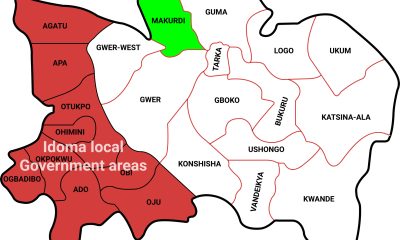

Let’s Honor All Pioneer Paramount Rulers Across Tiv and Idoma Lands.
Spread the loveBy Peters Ichull Today, the Tiv nation and the entire Benue family pause in solemn reflection to mark...


NKST Synod Says: “Alia Is A Talk-And-Do Governor”, Deserves Re-election in 2027
Spread the loveBy Felix Umande The NKST Synod has declared its support for the re-election of Benue State Governor, Rev....


SGF Akume Charges FRSC: “Nigerians Must Be Assured Of Safe, Crash-free Season”
Spread the loveBy Felix Umande The Secretary to the Government of the Federation, Senator George Akume (CON), has charged the...


Court Blocks Atiku’s Fresh Evidence Bid Against Tinubu Ahead Of 2027
Spread the loveBy Felix Umande The Federal High Court, Abuja Division, has dismissed former Vice President Atiku Abubakar’s bid to...


All 36 States Aporove State Police, Senate Transmits Bill to Tinubu For Assent
Spread the loveBy Felix Umande The Senate has resolved to transmit the Constitution of the Federal Republic of Nigeria (Sixth...


Death of Four Students: UNN to Introduce Routine Drug Tests
Spread the loveBy Lazarus Oko The University of Nigeria, Nsukka (UNN), following the tragic death of four students during a...


FAAC: FG, States, LGs Share N2.4trn in October
Spread the loveBy Son Tertsea, Abuja The three tiers of government, federal, states and local governments, have shared the Federation...


Gun can Kill Terrorists, only Education can Kill Terrorism – Buratai
Spread the loveThe former Chief of Army Staff, retired Lt.-Gen. Tukur Buratai has called for inclusive education and wider access...


Tinubu Approves University Of Public Relations And Leadership In Nasarawa
Spread the loveBy Felix Umande President Bola Ahmed Tinubu has formally approved the establishment of the University of Public Relations...