
General News
Tinubu Approves N3.9 Trillion For 27 Road Projects Across 15 States, Including Benue AND Plateau

Federal Executive Council re-awards Niger dual carriageway to Dangote for N1.8 trillion; Umahi lists major interventions nationwide
By Felix Umande
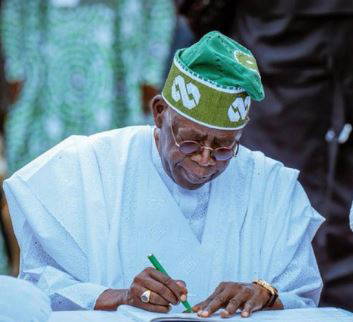
President Bola Ahmed Tinubu has approved 27 road projects worth over N3.9 trillion across 15 states, as the Federal Government intensifies efforts to improve road infrastructure nationwide.
Minister of Works, David Umahi, disclosed the approvals on Monday while briefing journalists after the Federal Executive Council, FEC, meeting at the Presidential Villa, Abuja.
According to Umahi, the approved projects will cut across Adamawa, Benue, Cross River, Ebonyi, Ekiti, Kogi, Kwara, Lagos, Niger, Ondo, Osun, Oyo, Plateau, Taraba and Yobe states.
The council approved the re-award of the 409-kilometre dual carriageway project in Niger State under the tax credit scheme to businessman Aliko Dangote at a cost of #1.8 trillion.
Umahi said other key projects approved include: N276 billion for the dualisation of the Ilorin-Ogbomoso Road; N265 billion for the reconstruction of the Iseyin-Eruwa-Agbesi Road linking Oyo and Kwara states; N217 billion for the dualisation of the old alignment from Ijaye through the Federal Government College to Ilorin Road, with a spur to Akinmorin; N116 billion for the 21-kilometre Abakaliki-Afikpo Road in Ebonyi State; N110 billion for the Ogbomoso-Oko-Illupu Road in Oyo and Osun states; N104 billion for the rehabilitation of Sections One and Two of the Ilorin-Omorin-Ebe-Kabba-Obajana Road in Kwara and Kogi states; N98 billion for the construction of the 30-kilometre Idi-Araba-Ayede-Olodo Road in Oyo State; N92 billion for the rehabilitation of the Baban-Lamba-Sharan Phase Two Road in Plateau State.
The minister added that the council approved N86 billion each for the reconstruction of the Enugu-Abakaliki Road with a flyover, and the Adikpo-Ajayi-Tese-Akpa-Otukpo Road traversing Benue and Cross River states.
Other approvals include N83 billion for the Jimeta-Mayo Belwa Road in Adamawa; N82 billion for the rehabilitation of Igbeti Road in Oyo; N74 billion for the Igbeti-Soro-Kishi Road in Oyo; N71 billion for the 52-kilometre Dabban-Makina Road in Niger and N62.99 billion for the Tungo-Karamti Road with five bridges connecting Adamawa and Taraba.
Additional projects are N58 billion for Yola-Hong-Mubi Road Phase Two; #46 billion for Amasiri-Okporojo Road; N34 billion for the 18-kilometre Ikere-Ekiti-Ijare Road linking Ekiti and Ondo; N26 billion for a new flyover on the Trans-Sahara Road; N24.7 billion for the Kabba-Ifaki-Ado Ekiti Road linking Kogi and Ekiti and N21 billion for a flyover at Oko-Olowo Junction in Kwara.
Further approvals cover N15.7 billion for the Pacific Road linking Igbe Laara to Ikorodu in Lagos; N15.5 billion for the 13-kilometre Badeku-Jaiye Road in Oyo; N15.246 billion for Phase Two of the Yola-Fufore-Gurin Road in Adamawa and N15 billion as augmentation for the 32.2-kilometre Gashua Road project in Yobe.
Umahi said the council also approved the full business case for the operation and maintenance concession of the Lagos-Ibadan Expressway and directed the commencement of reconstruction of failed sections along the Ibadan axis using concrete pavement.
He further announced that the first 118-kilometre section of the Abuja-Kaduna-Kano Highway, valued at N137 billion, has been completed.
The approvals bring Benue and Plateau among the states set to benefit from the Federal Government’s renewed push to expand and rehabilitate critical road networks across the country.



By Isa Abdul
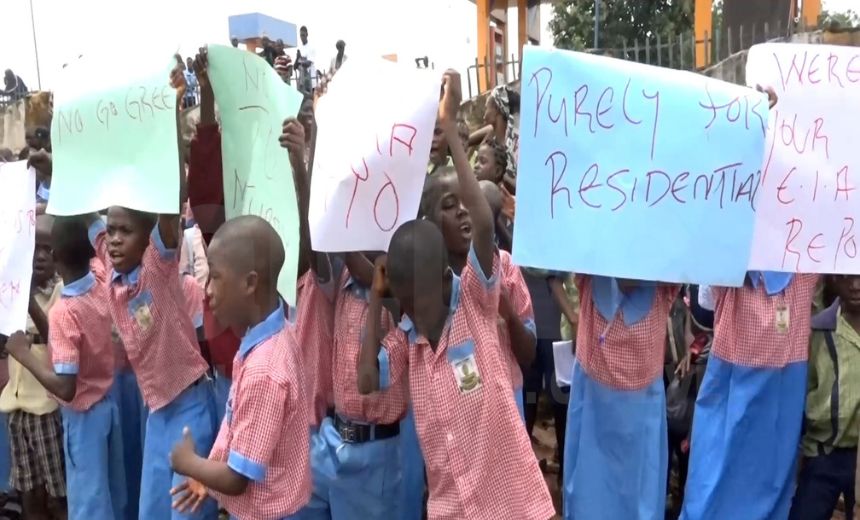
The construction of an alleged mortuary close to public school and residential buildings has been protested against by the residents of Agbeji Community in Dekina Local Government Area of Kogi State.
The protesters who carried placards on Tuesday cite health and environmental concerns, even as the landowner insists he has the right to develop the property.
One of the protesters, who spoke on camera said they are not against someone’s business but their worry is the location of the mortuary near residential buildings and a public school.
But the landowner who identified himself as Alh. Rilwan Okobomude, disagrees, insisting the property is his and that he has the right to develop it, while pledging to comply with relevant regulations.
In an interview with News Central, monitored in Abuja, the land owner talked about building the mortuary for the hospital.
But it is not clear why he’s building a mortuary before the hospital.
General News
Benue Govt Gives 2-Week Ultimatum To Owners Of Illegal Billboards, Threatens Mass Removal
By Felix Umande
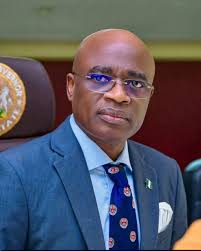
The Benue State Government has decried the arbitrary erection of billboards across the state by individuals, groups and political parties without approval, warning that all unauthorised structures will be pulled down after a two-week grace period.
In a joint statement issued on Tuesday, October 6, 2026, by the Benue State Signage and Advertisement Agency, the Benue State Internal Revenue Service, BIRS, and the Urban Development Board, the government said the billboards were erected without permit, without clearance and without payment of prescribed fees.
The agencies said the practice breaches the law, deprives the state of legitimate revenue, endangers public safety and undermines orderly urban development.
The statement, signed by the Commissioner for Information and Orientation, Hon. Chief Solomon Iorpev, however, said government was prepared to assume that many offenders acted out of ignorance rather than deliberate defiance.
Consequently, owners and operators of unauthorised billboards have been given two weeks, beginning Tuesday, October 6, 2026, to regularise their structures.
Within the window, they are required to approach the Benue State Signage and Advertisement Agency to begin the permit process, obtain clearance from the Urban Development Board, and pay all required fees.
The government warned that enforcement will commence on Tuesday, October 20, 2026, with no further notice.
“Enforcement teams are expected to begin the removal of every billboard that has not been regularised from the set date. Billboards taken down will be at the owners’ cost. Anyone who ignores this window should expect no sympathy and no exception, regardless of status, affiliation or political party,” the statement said.
It described the grace period as a sign of government’s goodwill and preference for compliance over confrontation, urging all concerned to use the window.
For further clarification, the government advised the public to contact 09034345007.
–Tells Editors: “remain primary filter against information disorder.”
By Son Tertsea, Abuja
The Independent National Electoral Commission (INEC) has set in motion a financial monitoring mechanism, in conjunction with anti-graft and financial intelligence agencies, to fish out those embarking on illegal campaign spending.
This was one of the INEC Chairman, Prof. Joash Amupitan’s, disclosures on Monday in Abuja while delivering a keynote at a strategic workshop with media executives organised by the Nigerian Guild of Editors (NGE) in collaboration with the commission.
INEC chairman also disclosed that the number of registered voters has risen to more than 103 million.
In addition, INEC said, it has acquired 57,000 new Bimodal Voter Accreditation System (BVAS) machines as part of measures to strengthen the technological infrastructure for the 2027 elections.
Its target, according to the body, was to commence voting simultaneously across all polling units nationwide during the 2027 elections.
INEC’s collaboration with the Economic and Financial Crimes Commission (EFCC), Independent Corrupt Practices and Other Related Offences Commission (ICPC) and the Nigerian Financial Intelligence Unit (NFIU), he said, was to monitor campaign financing and identify suspicious expenditure with s view to preventing money from undermining the credibility of the elections.
In Amupitan’s view, the teams will track illegal campaign spending, strengthen surveillance around polling units to detect attempts to influence voters through financial inducements.
He warned political actors that violators of the Electoral Act would attract arrest and prosecution, adding that elections must be decided by the conviction of the voter, not the depth of a candidate’s pocket.
The chairman disclosed that the three-phase National Register of Voters had produced 10,772,421 new voters, with 2,611,266 in the first phase, 4,121,835 in the second phase and 3,867,997 in the third phase, respectively. But the fugure is subject to final verification, completing eight of the 14 major statutory activities contained in its timetable for the 2027 elections.
The electoral umpire added that the final Automated Biometric Identification System (ABIS) cleanup was complete, and the preliminary register was displayed for claims and objections. In his words:
“In line with Section 10 of the Electoral Act 2026, the first phase of the CVR commenced on August 25, 2025 and ended on December 10, 2025, registering 2,611,266 voters; Phase II commenced on January 5, 2026, and ended on April 17, 2026, registering 4,121 ,835 voters; and Phase Ill commenced on May 11, 2026 and ended on July 26, 2026, registering 3,867,997 voters. The total new registration stands at 10,772,421, subject to the ABIS verification being concluded.”
Amupitan revealed that the commission had drawn lessons from recent off-cycle elections and would improve its logistics, personnel and technology ahead of the 2027 polls.
The commission further warned political parties, candidates and campaign managers against violence, intimidation and hate speech and other vices ahead of the 2027 general elections.
The commission, through the Inter-Agency Consultative Committee on Election Security (ICCES), he said, had activated an early-warning framework to monitor political violence, thuggery and dangerous campaign rhetoric.
Amupitan called editors, the “bridge in an era of information chaos”, to work with INEC to build a public space of verified information, civic responsibility and institutional trust. In his words:
“When newsrooms prioritise factual accuracy over sensational headlines, when reports contextualise field logistics rather than default to inflammatory speculation, and when information is verified before publication, you perform a sacred public service. You act as the primary filter protecting our democracy against information disorder.”
In his submission at the event, President of the Nigerian Guild of Editors (NGE), Eze Anaba, canvassed for a credible and transparent electoral process that would give voters, rather than the courts, the outcome of elections.
He said: “Elections were not merely about casting ballots but about building citizens’ confidence that their votes would count and that institutions responsible for conducting elections would act fairly and professionally.”
To Akingbulu, verification was a two-way process, arguing that newsrooms could not properly verify information that institutions failed to disclose.
Warning against deepfakes, fabricated campaign materials and other forms of manipulated content, saying such developments could undermine public confidence in the electoral process.
The Executive Director of the International Press Centre (IPI), Lanre Arogundade, stressed the importance of timely and transparent communication from INEC.


How FG’s Docility and FIFA’s Compromise on Mpasi Conspired Against Nigeria’s 2026 W’Cup Qualifier– Report
Spread the loveThe apex world soccer’s governing body, FIFA, knew that the Democratic Republic of Congo fielded an ineligible player...

Kogi Community Protests Building of Mortuary in Residential Area.
Spread the loveBy Isa Abdul The construction of an alleged mortuary close to public school and residential buildings has been...

100 Days To 2027 Polls: INEC Vows Neutrality, Says BVAS, Ballots Ready
Spread the loveBy Felix Umande The Independent National Electoral Commission, INEC, has assured Nigerians and the international community of its...


THE LAST TANGO: Tears, Tributes and A Final Goal As Messi Bows Out After 21 Years
Spread the loveBy Felix Umande Emotions ran high at the Estadio Monumental on Tuesday night as Lionel Messi signed off...


Church’s Duty to Empower Individuals, Create Opportunities and Improve Family’s Economic Well-being
Spread the loveBy Seyi Balogun, Lagos The need for the Church’s commitment to empowering its members through employment opportunities, entrepreneurship...
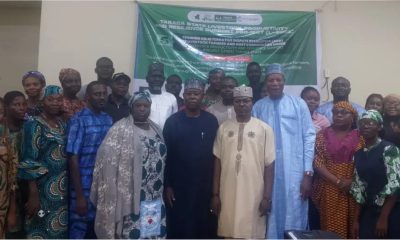

Taraba Explores ADR for Sustainable Peace Between Crop, Livestock Farmers
Spread the loveBy Michael Lim Conflict prevention between livestock farmers and host communities in Taraba State through the promotion of...


Financial Inclusion: Kwara Buys Dangote Refinery Shares For Female Teachers
Spread the loveBy Michael Lim Kwara State Government has announced plans to buy shares in the Dangote Refinery Initial Public...

Benue Govt Gives 2-Week Ultimatum To Owners Of Illegal Billboards, Threatens Mass Removal
Spread the loveBy Felix Umande The Benue State Government has decried the arbitrary erection of billboards across the state by...


INEC Tracking Illegal Campaign Spending
Spread the love–Tells Editors: “remain primary filter against information disorder.” By Son Tertsea, Abuja The Independent National Electoral Commission (INEC)...

Importers, Petroleum Marketers Kick Against Dangote’s Restriction of Petrol Sales
Spread the loveBy Seyi Balogun Major marketers have kicked against Dangote Petroleum Refinery’s non sale of Premium Motor Spirit (petrol)...