
Uncategorized
Diezani Alison-Madueke, Ex-Nigeria petroleum minister discharged in UK bribery trial


–My nightmare now over, ex-minister
By Isa Abdul
Former Nigerian oil minister, Diezani Alison-Madueke, has finally been cleared of all five charges preferred against her by a London court of taking bribes from wealthy oil executives in the form of luxury home stays and lavish spending sprees in the UK.
The 65-year old ex-oil minister was found not guilty after a trial at London’s Southwark Crown Court that lasted over a decade based on charges of accepting bribes and a charge of conspiracy to commit bribery.
Alison-Madueke was Nigeria’s petroleum minister between 2010 and 2015 under President Goodluck Jonathan government and the first female president of the oil exporters group OPEC.
The verdict is seen in some quarters as a blow for the UK’s National Crime Agency (NCA), which had been investigating one of Africa’s most prominent political figures for 13 years.
From the start of the trial in January, defence lawyers questioned the fairness of the prosecution’s case, suggesting vital documents showing Alison-Madueke’s innocence had gone missing in Nigeria.
They also said the long delay in bringing the case to court was unjust and a sign of Britain’s “broken criminal justice system”.
Also cleared by the jury were Alison-Madueke’s older brother Doye Agama, 69, an archbishop at a Pentecostal church in Manchester, who was acquitted of conspiracy to commit bribery.
Oil industry executive Olatimbo Ayinde, 54, too was found not guilty of bribery and bribery of a foreign public official.
She had faced prosecution despite being an informant in an anti-corruption probe by the Nigerian authorities.
‘Madam due process’
Alison-Madueke portrayed herself in court as a role model for women, a tireless fighter against corruption, and someone who was such a stickler for the rules she was nicknamed “Madam due process”.
She became the first female member on the Nigerian board of oil and gas giant Shell in 2006, and four years later was appointed oil minister, the country’s second most senior politician. She became president of Opec in 2014.
“In a very patriarchal society, to have a woman sitting at the helm was a major no-no,” she told the court, suggesting this had made her a target for unnamed male opponents.
Prosecutor Alexandra Healy KC said the former minister improperly allowed powerful men with lucrative government contracts in the oil business to bankroll her extravagant lifestyle.
Six of them were named on the indictment, although none were charged.
But the prosecution failed to provide evidence she awarded contracts to any of the oil tycoons named because of bribes.
“At no time did I ask, take, or seek a bribe or bribes of any sort,” Alison-Madueke told the court, saying many of the luxury items purchased were not for her, and that she had been with the oil men to offer advice on interior design in their own properties.
Alison-Madueke told the court that Nigerian ministers were not allowed to hold foreign bank accounts when on service overseas, and her department’s office in London was in such disarray that she relied on wealthy businessmen funding her living expenses.
She said they were always reimbursed in Nigeria and evidence proving this had been seized from her home in Abuja but never produced by the authorities there.
Former Nigerian president Goodluck Jonathan, who had appointed Alison-Madueke, did not appear as a witness. But he provided a statement in which he said third parties would often pay for transport, accommodation and other items for ministers on official overseas business.
Questions raised by the case
Diezani Alison-Madueke said the verdict means her “nightmare is over”
There were a number of unanswered questions that seem to have fatally undermined the prosecution.
Defence barrister Jonathan Laidlaw KC questioned why the Nigerian government had not sought to prosecute Alison-Madueke.
He said Alison-Madueke had “effectively been kept prisoner in this country for almost 11 years… unable to work, unable to travel” while the NCA had “done nothing to bring about the extradition” of the six oil men said to have paid bribes to her.
The jury was not told why they had not been charged.
The defence claimed the investigation had been compromised from the start because the NCA was denied access to the search of Alison-Madueke’s Abuja home in 2015.
They relied on work done on their behalf by Nigeria’s Economic and Financial Crimes Commission (EFCC).
But while the prosecution told the jury to trust how the EFCC had gathered evidence against Alison-Madueke, at the same time it advised them to disregard the commission’s evidence in relation to a co-defendant in the trial.
The defence case of Olatimbo Ayinde, the oil industry executive who was also found not guilty by the jury, was that she had been working as an informant for the Nigerian authorities to expose corruption.
Ayinde, a Nigerian businesswoman with British citizenship, said she had been encouraged by the west African country’s security services to “play along” with those in government who were asking her for bribes.
An EFCC investigator, who had travelled to London from Nigeria, told the court Ayinde had given “vital information that assisted the investigation”.
“Miss Ayinde’s plan was to help law enforcement and now she’s there in the dock,” said her barrister Jonathan Lennon KC who had sought unsuccessfully to have his client’s case thrown out of court.
In a statement after the verdict, Alison-Madueke said her “nightmare is over”.
She said: “For 11 long, gruelling years this case has hung over my head and has tormented me and my family. But today, the past decade of relentless and unjust vilification, condemnation and scrutiny has finally come to an end.”
Uncategorized
NDLEA intercepts N3.4bn Loud, opioids, arrests fake police officer, mechanic-drug dealer
By Nick Ibe
Operatives of the National Drug Law Enforcement Agency (NDLEA) have intercepted over 1.3 million pills of tramadol and other opioids as well as 6,000 kilograms of potent strains of cannabis with a combined street value of more than N3.4 billion in a string of major operational breakthroughs across Lagos, Edo, Niger, Delta, Ondo, Gombe, Imo and FCT.
According to Femi Babafemi, Director, Media and Advocacy, NDLEA Headquarters, Abuja on Sunday, 20th September 2026, one of the line up of successful operations was the interception of 1,200 parcels of Canadian Loud, a synthetic strain of cannabis with a gross weight of 603.75 kilograms, valued at One Billion Eight Hundred and Eleven Million Two Hundred and Fifty Thousand Naira (N1,811,250,000).
Recorded success also, according to the NDLEA spokesman, was the arrest of a trafficker who impersonates as a senior police officer to evade checkpoints while ferrying drugs across state lines.
The 49-year-old fake police officer, Innocent Ekpe, was arrested on Wednesday 16th September 2026 by NDLEA operatives along the Benin-Onitsha expressway in Asaba, Delta state with 292.48 kilograms of skunk hidden in his silver Toyota Sienna bus. Investigation established that Ekpe had long paraded himself as Godwin Emeka, a Deputy Superintendent of Police, using a forged ID card to escape scrutiny at checkpoints while transporting illicit consignments. An accomplice, 39-year-old Nduka Joseph, was arrested along with him.
In Edo State, NDLEA operatives acting on intelligence stormed a location on Agbor Road, Benin City, where they arrested 45-year-old Matthew Ossai, who used his auto-repair workshop as a front for storing illicit drugs. Officers recovered 48 kilograms of Canadian Loud and 152 grams of methamphetamine, along with a metal box used to store the illicit substances.
At the Tin-Can Island Port in Lagos, a 40-foot container shipped from Montreal, Canada, and arrived on 12th September was placed under intensive monitoring by NDLEA operatives based on processed intelligence. The shipment was eventually subjected to a full joint physical examination with Customs and other security agencies on Wednesday 16th September. The search uncovered 1,200 parcels of Canadian Loud weighing 603.75 kilograms, concealed inside 31 black jumbo bags loaded within two Toyota Sienna vehicles in the container.
In Niger State, NDLEA operatives on patrol along the Abuja-Kaduna expressway at Chachi, Tafa LGA, on Tuesday 15th September arrested three young suspects: Bashir Usman (20), Abubakar Nuhu (18) and Abdulrahman Abdulwahab (18) with two locally fabricated AK-47 rifles and a magazine, a locally made pistol with magazine, and nine rounds of 9mm ammunition concealed in a black travel bag.
Two suspects: Aminu Isyaku (23) and Jamilu Habibu (25) were on Friday 18th September arrested by NDLEA officers along Abaji-Abuja highway. Over 1.1 million assorted tramadol tablets/capsules, codeine syrup, methamphetamine and Exol tablets concealed in eight sacks en route from Onitsha, Anambra state to Mararaba, Nasarawa state, were recovered from them.
In Lagos, a suspect Onyeka Ofor was arrested on Friday 18th September at his residence in Aguda, Surulere with 48,900 pills of tramadol 225mg , while seven cartons of cannabis sativa weighing 59kg were intercepted at a logistics company with a suspect Luke Ugokwe taken into custody. In another operation in Lagos, Ibrahim Hudu (43) was arrested at Apongbo with 998.38kg of nitrous oxide gas on Thursday 17th September.
A total of 154,480 capsules of tramadol were recovered from two suspects: Sabi’u Umar (27) and Hassana Muhammad (19) who were arrested at Barunde area and Gombe main market respectively in Gombe state on Friday 18th September.
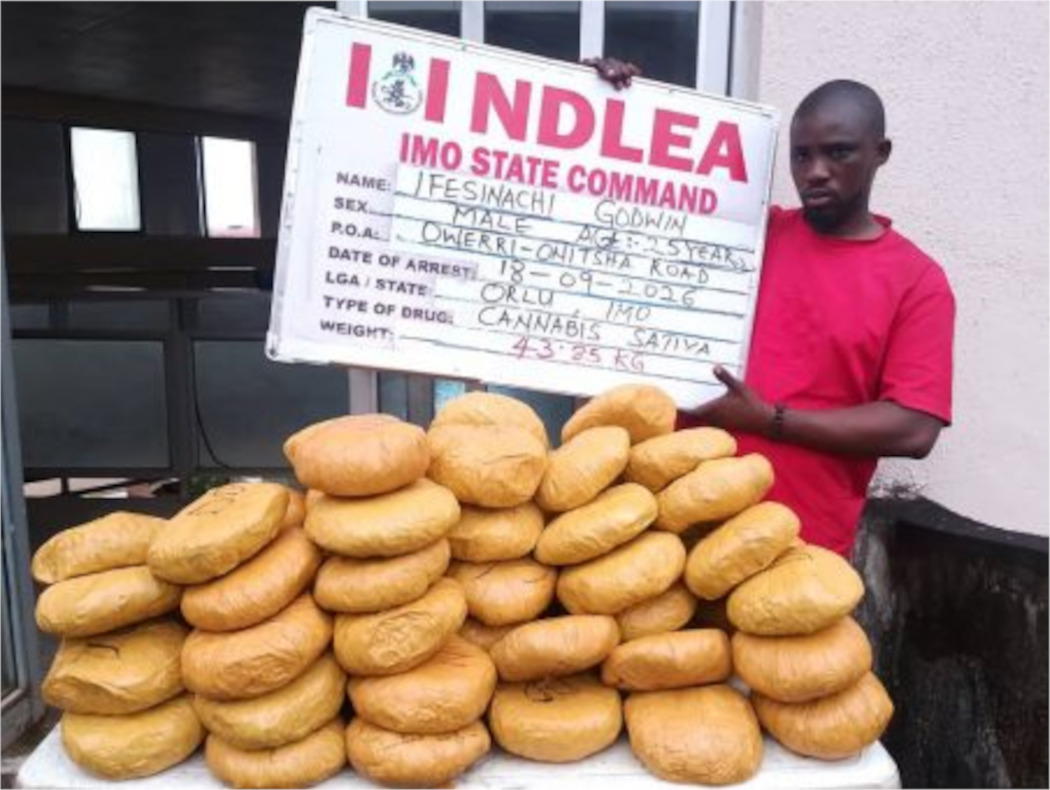
A suspect Ifesinachi Godwin (25) was arrested along the Owerri-Onitsha road, Imo state with 43.85kg of skunk on Friday 18th September, while four suspects: Blessing Effiong, Saviour Peter, David Friday Sunday and Ability Peter Sunday, were nabbed during raid and destruction of 5,000 kilograms of skunk on a two-hectare cannabis farm in Ita-Ogbolu forest, Ondo state on Tuesday 15th September. No less than 48kg of dry and fresh cannabis was recovered from the location for the prosecution of the suspects.
With the same vigour, Commands and formations of the Agency across the country continued their War Against Drug Abuse (WADA) sensitization activities to schools, worship centres, work places and communities among others in the past week. These include: WADA enlightenment lecture to students and staff of St. Ferdinand School, Ogbomoso, Oyo; Unizik Secondary School, Awka, Anambra; Scholars Nursery and Primary School, Epe, Lagos, and Government Technical Training School, Jalingo, Taraba state, while the Delta Ports Command of NDLEA paid a WADA advocacy visit to His Royal Majesty, King Couple Mackson Oromoni Mobene III, Pere Ama-Okosu of Ogbe-Ijoh Warri Kingdom, Delta state, among others.
While commending the officers and men of Lagos, Tincan, Edo, Niger, Delta, Ondo, Gombe, Imo and FCT Commands for their professionalism and intelligence-driven approach to the various successful operations, Chairman/Chief Executive Officer of NDLEA, Brig. Gen. Mohamed Buba Marwa (rtd) enjoined them and their colleagues across the country to continue with the current balanced approach to the drug control efforts of the Agency.
General News
Sharran Srivatsaa: Faced 39 Rejections, Dropped out of Stanford … led a company valued $1.2 billion

At 17, Sharran Srivatsaa arrived in the US from India on a tennis scholarship, alone and uncertain about what came next. The path that followed was anything but linear.
His story challenges the idea that success follows a straight line or a fixed timetable.
Sharran Srivatsaa’s journey: from tennis courts to a $1.2 billion valuation
Srivatsaa’s early years in the US were shaped by discipline and rejection. Tennis helped fund his education and instilled resilience. Finance did not come easily.
He has spoken publicly about being turned down repeatedly before eventually securing roles at major investment banks, including Goldman Sachs and Credit Suisse. Those early setbacks, he says, taught him persistence rather than entitlement.
Despite earning admission to Stanford, Srivatsaa decided to leave academia and build a company instead. The move was unconventional and carried significant risk. It also set the tone for a career defined by calculated leaps rather than safe progression. His early ventures provided hands-on operating experience, including a successful exit in his early twenties.
He later made his biggest impact in real estate. As CEO of Teles Properties, he helped grow the firm’s annual sales volume from roughly $300 million to about $3.4 billion over a five-year period. The brokerage was eventually acquired by Douglas Elliman, marking one of the most notable growth stories in the US residential real estate sector.
His next chapter came at The Real Brokerage, commonly known as Real. As President, Srivatsaa played a central role in the company’s rapid expansion. During his tenure, the agent network grew sharply and the publicly listed firm reached a market valuation of around $1.2 billion at its peak. The period cemented his reputation as a scale-focused operator rather than a one-time founder.
In 2025, Srivatsaa joined Acquisition.com, the firm founded by Alex Hormozi and Leila Hormozi. As President and Managing Partner, he now works closely with founders running eight- and nine-figure businesses. His focus is less on ideation and more on systems, leadership, and repeatable growth.
“I’m in my forties and still figuring things out,” he has said, adding, “That’s not failure. That’s progress.”
Why his story resonates now
Srivatsaa frequently speaks to younger professionals who feel behind by their mid-twenties. His message is direct. Careers are rarely linear. First paths are not final paths. Early failures do not define long-term outcomes.
“The only real mistake,” he often argues, “is settling too soon.”
In an era obsessed with early success, Sharran Srivatsaa’s journey offers a quieter truth: Reinvention is not a weakness. It is a skill.
Uncategorized
Alago Be Prepared: The Fulani You Use Against Tiv Today, Surely, Will Soon Be Your Albatross

By Engr Fabian Aboh Ortindi
I have come across certain comments in the ongoing discussion bothering on the tenacity and lordship over the entity called Kadarko. These comments are disturbing and seem to be a total deviation from the subject of discussion.
When you engage some of my Alago neighbors intellectually, you get nothing from them but hatred, revenge, and bitterness.
They hate the Tiv people of Nasarawa State because they are desperate for vengeance. Sometimes, out of bitterness, they speak as though they are speaking for the Idoma people of Benue State. You hear statements like:
“If you want to be treated fairly, ask your brothers in Benue State to make the Idoma people governor of the state.”
This does not sound logical. The Idoma people of Benue are there fighting their own cause. They are more than capable of doing so. Why would anyone want to take revenge on their behalf in another state?
You also hear statements like:
“Your people have driven all the Alago people out of Amele, in Benue state, so you cannot enjoy anything in Nasarawa State.”
If you are not cowards, and Amele truly belongs to you, as you claim, there would be no need to run away. You would stay and defend it. The way the Tiv are refusing to leave Nasarawa state.
The Tiv people of Nasarawa
state belong here and God has a reason for keeping them in a state different from where their kins dominate in Benue. There is nowhere they can run to. So you will be wasting your time expecting them to return to Benue simply because you ran away from your fight in Amele. They will stay and fight back.
The hatred and bitterness in them has pushed them into employing their last and only source of strength, which seems to be the employment of the services of Fulani bandits to terrorise the Tiv people and send them out of their homes and farms. But you know that the fulanis do not fight for free.
The question is: How many of the lands they have helped you grab have actually been given to you? They are also interested in the land. Very soon, they will be interested in the leadership position of the chiefdom. And you know what? The Tiv will not be there to fight on your side. War is expensive and expansive. You may not continue to have the finances and energy to prosecute this evil agenda.
Bitterness and jealousy only become a heavy burden to those who carry them. The truth is : Tiv will not leave Nasarawa state or Kadarko, and violence cannot solve this. So if you like, keep being bitter and jealous. Keep hating. It is your cross to carry.
There is no possibility of the Tiv leaving Nasarawa State for you. And it is impossible to kill all the Tiv people. So you can see that your dream will never come to fruition.
Let us choose a better path: peace, justice, and fairness for all. All these are priceless as compared to hatred, bitterness, violence and vengeance.


75% of Pilgrimage Funds Stolen, EFCC Boss Alleges
Spread the loveBy Nick Ibe, Abuja About 75 per cent of funds released by the Federal Government for Christian and...

Plateau Women Protest, Block Highway over Killing of Three Vigilantes
Spread the loveBy Michael Lim, Jos The killing Friday of three vigilantes, including the community youth leader, during a night...


NNPC Ltd Welcomes $800m Ima Gas Final Investment Decision
Spread the loveBy Philip Nyam The Nigerian National Petroleum Company Limited (NNPC Ltd) has welcomed the $800 million Final Investment...

The UN Hypocritic, Irresponsible Walkout Of Shame: And Nigeria’s Terrorism at Home
Spread the loveBy H. E. Mejeh Yesterday in New York, Nigerian delegates staged a well-rehearsed walkout from the United Nations...

Shehu Sani: El-Rufai Never Did Enough to Stop Southern Kaduna Killings
Spread the love–He is paying price for misgovernance, irresponsibility By Isa Abdul, Abuja El-Rufai had no real commitment to stopping...


October AGLOFEST: To Converge Investors, Businesses, Cultural institutions, Creative Industry
Spread the loveBy Nick Ibe, Abuja October 2026 has been chosen by the Federal Government to launch the African Global...


US Sells ex-Gambian Dictator Jammeh’s $3.5m Mansion, Shares $2.5m to Victims
Spread the loveBy Son Tertsea The United States has returned about $2.5 million to The Gambia from the sale of...


Nasarawa Police Foil Murder Attempt, Net 4 Kidnappers, 2 Cultists
Spread the loveMichael Lim Four suspected kidnappers who allegedly plotted to kill their victim after collecting ransom have been arrested...


Bill Gates Warns AI Is ‘Powerful’ Enough To Destroy Humanity
Spread the love–There “absolutely” needs to be legislation regulating AI and law enforcement By Son Tertsea, Abuja Billionaire Bill Gates...
EFCC Chair: “I receive over 20,000 Corruption Petitions Yearly in Respect to Public Corruption
Spread the loveBy Son Tertsea, Abuja Fresh concerns have been raised over the scale of corruption in the public sector...