
Science & Technologies
Scientists test underwater solar panels that work 10 meters beneath the waves — breakthrough perovskite tech could support self-powered marine drones

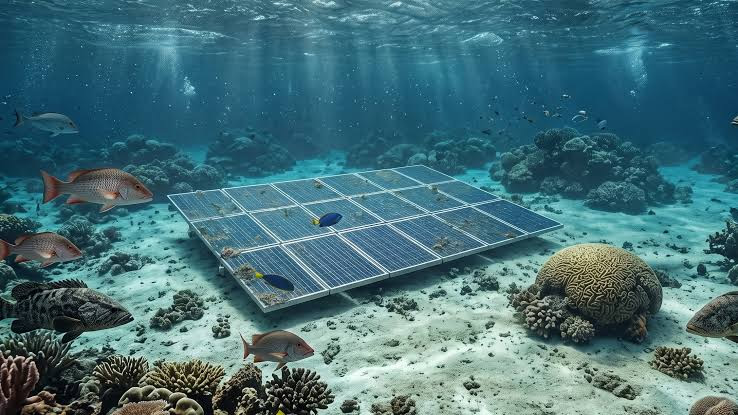
Scientists have developed solar panels that can work up to 10 meters underwater
The panels can capture up to 324 mWh of energy at that depth
Each device is expected to last up to five and a half years at a time
A lot of devices are deployed underwater for research and exploration purposes, but powering them all can prove to be difficult, especially if they’re under the waves for a considerable period of time. A new scientific paper, however, has shown that solar panels can be successfully used at depths of up to 10 meters, potentially presenting a new way to keep underwater tech powered up and ready for action.
The paper was published in the Joule periodical and accompanied by a press release explaining its advances. The research was conducted by a team of scientists from Yunnan University in China, who said that a series of solar cells placed 32 feet (10 meters) below the water’s surface in the South China Sea were able to collect enough energy to power up a set of lithium-ion batteries in two hours.
The cells were made from lead halide perovskite with a polymer called polyhexamethylene guanidine hydrochloride added into the mix. This additive helped to enhance the effectiveness of the panels.
According to Wen-Hua Zhang of Yunnan University, “Very few studies have been reported on underwater solar cells, and all of them are focused on very shallow water depths of only two meters or less, a scenario far from catering for requirements of practical application.”
An underwater solar panel being tested
“This work presents the first functional validation of submerged solar cells practically operating at a water depth of up to about 10 meters, greatly broadening their application scope,” Zhang added. The researchers stated that each cell could be deployed for around five and a half years at a time.
Balcony solar panel
New solar panel design could increase daily PV energy production by 20%
Danish startup raises funds to build underwater CCTV-like tech to track drones and more
IFA 2026 plug-in solar
The 5 best plug-in solar gadgets we saw at IFA 2026, from Anker to EcoFlow
The panels captured 1,416 milliwatt-hours (mWh) of electricity at a depth of two meters. This decreased to 752 mWh at six meters and 324 mWh at ten meters. During separate lab testing, the solar panels had a power conversion efficiency of just under 35%.
Paving the way
Underwater datacenter
Solar panels could one day be used to power ‘self-sustained marine energy systems and autonomous underwater devices,’ researchers believe.
The idea behind this research is that underwater solar panels could be used to power devices such as sensors, cameras, communications systems, and more.
Get daily insight, inspiration and deals in your inbox
Your Email Address
Contact me with news and offers from other Future brands
Receive email from us on behalf of our trusted partners or sponsors
By submitting your information you agree to the Terms & Conditions and Privacy Policy and are aged 16 or over.
Many of these objects are stationary for much of the time, so nearby solar cells could help keep them topped up and working without necessarily requiring extensive human intervention.
One question that remains unanswered is how exactly solar panels like this would interact with their environment. For example, it’s likely that they would accumulate biomatter that could hinder their operation, potentially requiring regular cleaning in order to remain fully functional. After all, the sunlight that will power these cells could also promote the growth of plants and animals — a process known as biofouling.
Still, the research seems to have potential. As the authors noted, “This work paves the way for the practical deployment of perovskite photovoltaics in underwater environments, offering a promising route toward self-sustained marine energy systems and autonomous underwater devices.”
TechRadar




Science & Technologies
2nd World Humanoid Robot Games Take Off in Beijing: Chinese Robot Breaks Usain Bolt’s World Record
By Son Tertsegha
As the second edition of World Humanoid Robot Games kicked off at the National Speed Skating Oval for the 2022 Winter Olympics, in Beijing, a Chinese robot named Lightning has run the 100m in 9.32 seconds, beating the human world record, held by the Jamaican, Usain bolt, in 2009.
The humanoid, developed by the Chinese smartphone manufacturer Honor, reached a peak speed of 14.5 metres per second during a test event for the second World Humanoid Robot Games. The performance surpassed the 9.58sec men’s 100m world record set by Usain Bolt 17 years ago at the World Athletics Championships in Berlin.
China is in the lead of promoting humanoid robots as an emerging industry, with policymakers and companies believing that these advances in AI and hardware will accelerate their deployment in manufacturing, logistics and consumer applications.
Lightning also won the Beijing half marathon in April in 50 minutes and 26 seconds, faster than the men’s world record. The robot stood 169cm tall and had 95cm-long legs at the half marathon.
Researchers have since lengthened its legs by 10cm for these Games.
More than 2,000 humanoid robots are participating in the second edition of the five-day games, with the spectacle intended to demonstrate China’s rapid progress in advanced robotics as the technology race with the US heats up.
This edition has 51 events and more than 1,000 competitions taking place including running, table tennis and football.
The games opened the same week as Beijing held the 2026 World Robot Conference, where companies showcased around 3,000 products, including humanoid robots. China makes the majority of the world’s humanoid robots.
In what’s believed to be targeting China, last month, the US Federal Communications Commission announced a ban on imports of new foreign-made humanoid robots. The Pentagon recently also added Unitree, one of China’s leading humanoid robot makers, to its list of companies that it deemed have ties with the Chinese military. Beijing has hit back at the accusations.
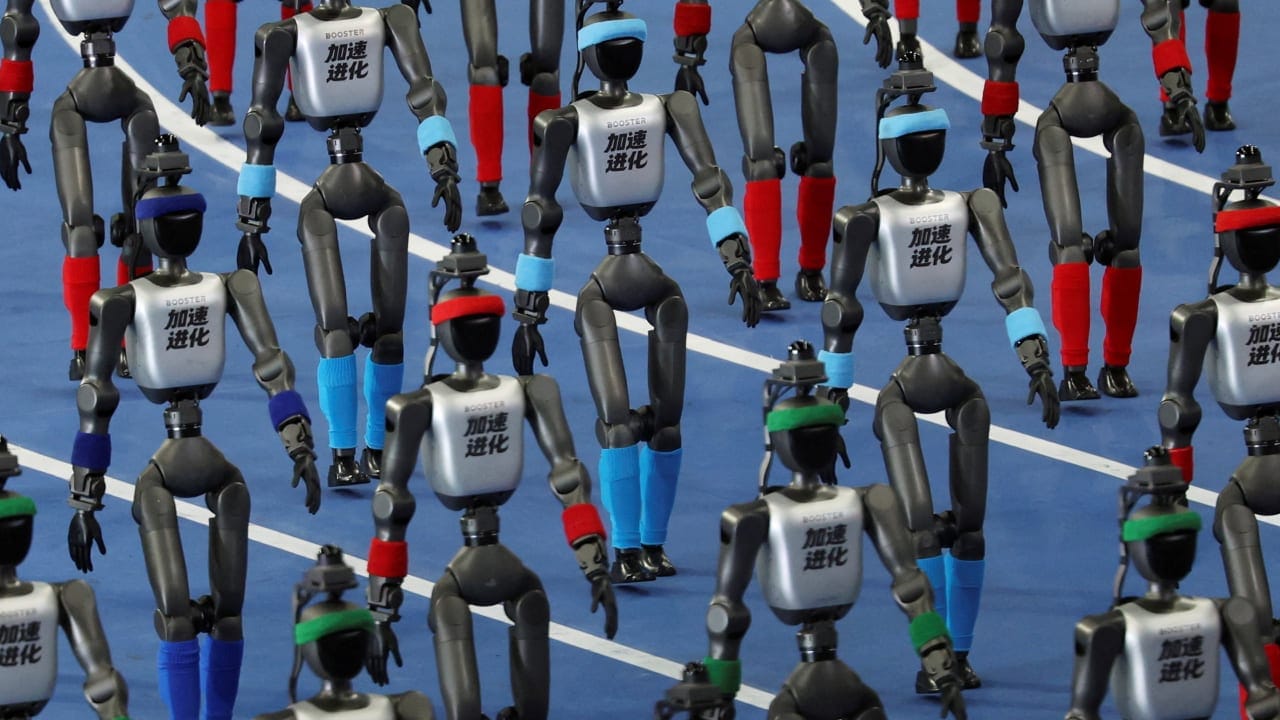
At Saturday’s opening of the robot games, the organisers and robot makers said that Chinese humanoid robots defeated human world records, as hundreds of humanoid robots marched in formation on to the field in a massive display of synchronised coordination.
In a standing high jump, a humanoid robot was able to reach 2.88m, well above the 0.95m best result by a humanoid in last year’s first edition of the games.
It equally surpassed the human high jump record of 2.45m set by Cuba’s Javier Sotomayor in 1993. Both robots were from Beijing-based X-Humanoid.
Experts say humanoid robots are still mostly used for demonstrations, performances and research – at least for now – and it will take time to achieve mass real-world deployment. Some spectators at the robot games said they were excited about the humanoid robots’ quickly improving abilities.
Press reports indicate that humanoid robots are “evolving rapidly”, said Li Yanfeng, an education worker and a Beijing resident. “At first, I wasn’t very accepting of artificial intelligence. I was even a bit resistant to it, because of the possibility that it might replace or displace humans,” she said. “But now that I see this development is unstoppable, I decided to come and take a look.”
Yang Shangzheng, another spectator, said: “These sports are perfectly normal for humans, but now robots can do them. I find it amazing.” Liu Tao, who was watching the games with his son, said he was hoping to see “the best robots China currently has to offer”.
This year’s robot games – which the organisers say has 16 countries participating, among them Germany, Japan and the US – also includes other events such as weightlifting and tug of war.
Science & Technologies
Young Nigerian Drone Makers Richer $52 Million: Plan Ghana Factory Africa’s Largest

By Son Tertsegha, Abuja
Nigerian defence-technology startup Terra Industries has raised another $18 million, taking its seed funding to $52 million amid preparation to open a drone factory in Ghana and launch its first international office in London.
Nathan Nwachuku, 22, and Maxwell Maduka, 24 are founders of the Abuja-based startup Terra Industries.
Its 34,000-square-foot Pax-2 factory in Ghana is scheduled to open in the fourth quarter and is expected to produce up to 50,000 aerial systems a year by 2028.
The funding gives the Nigerian company more capital to manufacture in Africa while expanding its sales and operations beyond the continent.
The company said the latest funding will support manufacturing, engineering, operations and business-development teams, as well as deployments across Africa and other markets in the Global South.
Terra’s Pax-2 factory in Ghana is scheduled to open in the fourth quarter. The 34,000-square-foot facility is expected to become Africa’s largest drone factory once operational, according to the company.
It is a significant next step after Terra’s funding reached $34 million in February, when the startup said it was scaling production of drones, surveillance towers and unmanned ground vehicles.
The Ghana facility is a more defined version of the company’s earlier plan to expand its manufacturing base beyond Nigeria. It will follow Terra’s 15,000-square-foot flagship factory in Abuja.
Terra says its systems are already used to help protect power plants, mines and other critical infrastructure assets valued at about $11 billion across multiple African countries.
The latest raise also comes as African governments and infrastructure operators look for locally built alternatives in a sector where the continent still receives a small share of global defence-technology funding.
From Abuja to Accra and London
Terra was founded in 2024 by Nathan Nwachuku and Maxwell Maduka. It develops autonomous aerial, land and maritime systems, including drones, interceptor drones, surveillance towers and unmanned ground vehicles.
Terra’s additional capital was provided by existing investors 8VC, Silent Ventures, Nova Global, Belief Capital and SV Angel. Norleo Space Investments and Grant Gordon also joined the round, Terra said in its funding announcement.
The company will open an office in London while keeping manufacturing in Africa. It plans further expansion across the Gulf, South America and South Asia.
The factory timetable
Pax-2 is expected to produce up to 50,000 systems a year by 2028. That figure is a company target, not current output.
The new factory is designed to produce Terra’s aerial-systems portfolio. Its planned capacity is more than three times the size of the company’s existing Abuja factory by floor area.
The project gives Ghana a direct role in the company’s next production phase, while Nigeria remains home to its original factory and founding team.
The funding does not mean the factory is already operational. Terra has said Pax-2 is due to open in the fourth quarter, and the planned annual capacity is tied to its 2028 target.

–NAE President, Prof Bello
By Nick Ibe, Abuja
The proposed mandatory one-year Engineering Residency Programme by the Council for the Regulation of Engineering in Nigeria (COREN) has been welcomed because it will enhance skill competence and make engineers more attractive as well as employable. This is the view of the Nigerian Academy of Engineering, NAE.
This was disclosed by President of the Academy, Prof. Rahamon Bello, while speaking to journalists ahead of its apex event, which includes investiture of past Chief Executive Officer of the Nigerian Communications Commission (NCC), Prof. Umar Danbatta, as the 14th President of the NAE, its 2026 NAE yearly lecture, presentation of Lifetime Achievement Awards to 10 fellows and induction of 12 new honorary fellows, to be held in Lagos.
The proposed Engineering Residency Programme (ERP), when operational in Nigeria, will be a mandatory, one-year post-graduation training initiative to be anchored by COREN, designed for fresh engineering graduates to build practical, industry-aligned skills and complete professional requirements before proceeding to the National Youth Service Corps (NYSC).
He said the residency programme, which has received the blessings of NAE, National Universities Commission (NUC) and other stakeholders, is the right way to deepen the competence of budding engineers in the country.
Bello explained further that the new curriculum the NUC had just come up with has allowed universities to engage external industry stakeholders to add value to the theoretical aspects of what engineering students are learning. In his words:
“I think the new curriculum will formalise internships for engineers. It hasn’t come up yet, but I believe that’s the way we have to go. So, as doctors go on internship, pharmacists go on internship, engineers will not be left out,” he said.
Bello, who is also the former Vice Chancellor of the University of Lagos, said the Academy has officially submitted critical advocacy papers to the Federal Government, offering actionable engineering solutions to deep-seated national crises. According to him, the NAE has also been active in fulfilling its mandate as a think-tank for the engineering sector by organising strategic policy dialogues on engineering solutions for energy, efficient and profitable operation of the nation’s refineries, transportation, wastewater management, environmental stability and climate change, among others.

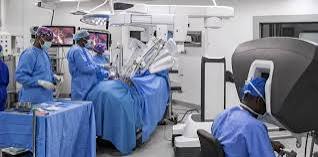

Foreign Medical Tourism to Drop as Nigeria Records First Tele-robotic Surgery Success in West Africa
Spread the loveBy Son Tertsea Nigeria’s first tele-robotic surgery on September 20, 2026 at the Redeemer’s Health Village (RHV), in...


Experts Warn Against “informalization of formal employment”
Spread the loveBy Isa Abdul Economic crunch is gradually reshaping the Nigerian economic landscape, particularly the formal employment system. According...


NBTI Receives, Presents Nigeria’s 7 Shining Stars in Lahore, Pakistan to Science and Tech Minister
Spread the loveBy Seyi Balogun Seven Nigerian entrepreneurs who proudly represented the nation and distinguished themselves at the SEE Pakistan...


Reduce Food Waste, Mrs Tinubu urges Nigerian Households, Communities
Spread the loveBy Nick Ibe A call to reduce food waste and adopt sustainable practices to protect the environment has...


The Civil Service for Federal and State is the Same, the Salary Structure Should also be Same –Jonathan
Spread the loveBy Seyi Balogun The harmonisation of structures and salary scales across Nigeria’s federal and state civil services has...


Miva University Appoints Cross River-Born EFCC Officer Professor of Practice
Spread the loveDr David Olom Nkpe, Assistant Commander of the Economic and Financial Crimes Commission (EFCC), has been appointed as...


NDLEA intercepts N3.4bn Loud, opioids, arrests fake police officer, mechanic-drug dealer
Spread the loveBy Nick Ibe Operatives of the National Drug Law Enforcement Agency (NDLEA) have intercepted over 1.3 million pills...


As Howard Buffett Takes over from his Billionaire Father Warren: What’s the Future of Berkshire Buy-and-Hold Policy?.
Spread the loveWhen Warren Buffett stepped down as chairman of Berkshire Hathaway on Friday, the job passed to his 71-year-old...


Sacrificial Courage: Driver Moves Burning Truck From Fuel Station, Saves Lives, Property in Osun State
Spread the loveBy Felix Umande Courage has a new name in Osun State — Alagbe Hezekiah, a38-year-old tanker driver and...


APC Campaign Says Atiku Unfit For Presidency Over Alleged $500,000 Mambilla Bribe
Spread the loveBy Felix Umande The All Progressives Congress Presidential Campaign Council has described African Democratic Congress (ADC) candidate Atiku...