
Foreign
The World’s Third-smallest Nation Changes its Name from Nauru to Naoero

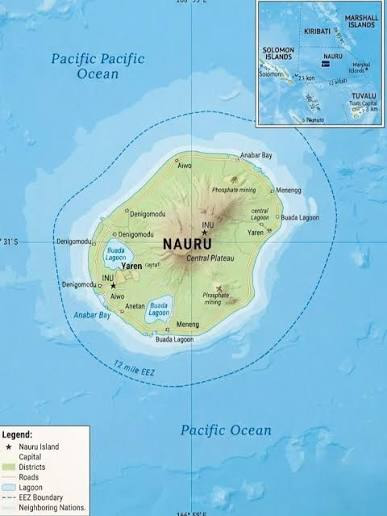
–Its international code shifts from NRU to NRO
The world’s third-smallest nation has changed its name from Nauru to Naoero; its international code shifts from NRU to NRO
The Pacific island nation of Nauru has officially changed its name to the Republic of Naoero, a move its president says better reflects the country’s language, identity and heritage.
The shift also changes the country’s international code from NRU to NRO, while its people will now be referred to as dei-Naoero, as per reports.
The name is not new to the island itself. In the national language, the country has long been known as Naoero; the international version, “Nauru,” became common largely because foreign speakers struggled with the pronunciation.
The government says the updated name corrects that historical mismatch and restores a traditional identity that was never truly lost.
Why the name changed
President David Adeang first proposed the change in January, saying it would “more faithfully honor” the nation’s heritage, language and identity. Parliament later backed a constitutional amendment in two rounds of voting, and the government then said a public referendum would not be necessary after further discussion.
In the government’s view, the word Naoero already lives in the country’s culture and official symbols. Officials said it appears on the national coat of arms, is used in the community, and is allowed by the constitution, making a referendum unnecessary for what they described as a reclaiming of the nation’s true name.
What changes now
The most visible change is the country’s formal designation: the Republic of Naoero. Along with that, its ISO-style international code is shifting from NRU to NRO, and government aircraft and ships will also be renamed to match the new identity.
The government has already begun asking other countries and international institutions to recognize the change. The United Nations website now lists the country under its new name, and diplomatic websites in Australia, New Zealand, the United States and China have also begun using Naoero.
A small nation with a big history
Naoero is one of the world’s smallest countries by population, with about 12,000 residents. The tiny coral limestone atoll has had a complicated past: it was colonized by Germany, later administered by Australia, and became an independent republic in 1968.
Its modern history has been shaped by phosphate mining, which once brought major wealth but eventually collapsed and pushed the country close to economic ruin in the 1990s. Today, climate change has become its biggest existential challenge, as rising sea levels threaten the low-lying island.
That pressure has prompted the government to seek overseas investment, including through a paid citizenship program designed to help fund relocation efforts for people and infrastructure away from the encroaching ocean.
Part of a wider trend
Naoero’s move fits a broader pattern of countries redefining themselves by restoring native names or dropping colonial-era labels. Eswatini, for example, reverted from Swaziland in 2018, while Turkey asked the United Nations in 2022 to officially use Türkiye, the name long used domestically.
For many countries, these changes are about more than spelling. They are a way to signal sovereignty, cultural pride and a break from names imposed or simplified by outsiders. In Naoero’s case, officials say the change is a symbolic but meaningful step toward renewed national pride.
Why it matters
For a nation this small, a name change can carry outsized significance. It affects how the country is represented on maps, in diplomacy, in shipping, and in global databases, but it also sends a message about identity and self-definition.
The government says the old name became familiar internationally out of convenience, not choice. Reclaiming Naoero, then, is being framed not as a rebrand but as a return to what the nation has always called itself.
(With inputs from AP)

By Isa Abdul, Abuja
In Saudi Arabia, a kiss in the mosque would earn you death, as two Bangladeshi nationals, identified as Nazrul Islam Abdul Basir and Siri Akhtar, have reportedly been executed in Saudi Arabia following their conviction over the alleged immoral act inside a Mecca mosque.
Reports circulating on social media indicate that the couple had travelled to Mecca for their honeymoon. But what was to be memorable event is their lives became a suicide mission.
The gesture was wrong in a wrong place, not an expression of gratitude to Allah for their marriage, as far as the Saudis are concerned.
Reports claim the couple’s bodies had been returned to Bangladesh in two coffins for burial.
Some online reports claim the couple were newlyweds executed over a kiss (such as a forehead kiss or a kiss inside the mosque).
However, the Saudi government’s official statement did not detail the exact nature of the act, and conflicting reports—including statements from family members and media checks—disputed whether they were newlyweds or what specific physical contact occurred.
But reports indicate the Bangladesh Consulate General in Jeddah stated they received no advance notice or prior notification from Saudi authorities regarding the executions and have formally requested clarification and acknowledgement.

By Son Tertsea, Abuja
A Catholic priest was crushed to death by a wooden crucifix that pressed him against the pulpit as it fell from the wall while celebrating Mass in the Ecuadorian city of Guayaquil on Saturday.
According to reports, shouts of “Father, Father! Call an ambulance!” people at Our Lady of Perpetual Help church could be heard shouting just before a livestreamed broadcast cuts out.
The graphic footage of the accident went viral Sunday on social media and was widely carried by news outlets.
The Archdiocese of Guayaquil mourned the death of the priest, Patricio Sanchez, in a statement and expressed its “solidarity, affection and love” for his family and friends.

Colombian police say the arrested Israeli suspect is wanted by authorities in the United Arab Emirates for fraud, money laundering, forgery, and the use of falsified private documents
Mikhael Mezrahi, the Israeli national, has been detained following an Interpol Red Notice issued against him. The 61-year-old Israeli national known by the nickname “El Banquero” (The Banker) was arrested at El Dorado International Airport in Bogotá, Colombia, in a joint operation by Colombian police and Interpol, authorities said.
Following his arrest, he was transferred to Colombia’s Attorney General’s Office as extradition proceedings advanced. Investigators allege that Mezrahi was connected to an international network responsible for defrauding a bank identified as Khartoum in Dubai of approximately $16.7 million using fraudulent financial documents
The suspect reportedly carried four passports while traveling to Venezuela.
Colombian media reported that the suspect, identified in some reports by his full name, Mikhael Jaime Shamis Mezrahi, arrived in Bogotá on a flight from Madrid and was preparing to board a connecting flight to Venezuela.
According to the reports, he was carrying four passports issued by different countries. In addition to Israeli and Mexican citizenship, he reportedly also holds Canadian and Lebanese citizenship.
Alleged fraud network linked to international businesses and money transfers.
According to the reports, Mezrahi’s extensive business activities include securities companies in the United Kingdom and real estate and tourism projects in Canada and Mexico.
He was also reportedly the subject of previous investigations in Canada related to drug trafficking. Investigators allege that proceeds from the fraud were transferred, in part, to a company he owned called WYB AG General Trading.
Colombian police hail arrest as international law enforcement success
Col. Alver Vicente Alfonso Sanabria, director of the Interpol investigation unit within Colombia’s National Police, described the arrest as a significant achievement in international law enforcement cooperation.
“Mezrahi’s arrest is a significant result of the international police cooperation mechanisms led by Interpol’s National Central Bureau in Colombia,” Sanabria said.
“It demonstrates the country’s commitment to combating transnational organized crime,” he added.



PERSPECTIVE: Tiv Leaders Must Hear This: While Akwa Ibom Asked For A Future, Tiv Leaders Fight Over A Man
Spread the loveBy Edward Tion I watched the presidential campaign in Akwa Ibom today with a bleeding heart. Not because...


Pursue Unity, Peace, Play Active Role in Nigerian Politics, Deputy Speaker, Kalu Urges Igbo Elites, Leaders
Spread the loveBy Saint Mugaga Deputy Speaker of the House of Representatives, Rt. Hon. Benjamin Kalu has called on Igbo...


2027: Amupitan Seeks Royal Support, Partnership to Discharge Mandate Peacefully, Effectively
Spread the loveBy Isa Abdul The National Chairman of the Independent National Electoral Commission (INEC), Professor Joash Amupitan, has said...


Place 7-Year Ban On Establishment Of New Tertiary Institutions– Edu Minister Begs NASS
Spread the loveBy Son Tertsea, Abuja The Federal government has appealed to the National Assembly to halt the passage of...


Gov Sule to Security Agencies: Fish Out Sponsors of VP Shettima’s Attackers in Lafia
Spread the loveSDP: attackers APC members against Wadada’s candidacy By Isa Abdul, Abuja Prominent personalities in the state planned and...


Wike’s Entry, Allocation of UniAbuja Land a Breach of Court Order– ASUU
Spread the loveBy Nick Ibe, Abuja The Federal Capital Territory Administration’s (FCTA) allocation of some hectares of land belonging to...


Alleged 4 Herbal Concoction Consumers Die in Benue
Spread the loveBy Vincent Tyosuugh After consuming a suspected poisonous herbal concoction allegedly sold to residents of Oju Local Government...


BENUE APC Split Deepens As SGF, Stakeholders Shun Alia Campaign Flag-off, Disown Campaign List
Spread the loveBy Felix Umande The crisis rocking the Benue State chapter of the All Progressives Congress (APC) deepened on...


Defence Minister Invites Cybersecurity, Drone, DefenceTech Experts for Collaboration with DICN
Spread the loveBy Nick Ibe, Abuja Minister of Defence, General Christopher Musa (rtd) has called on Nigerians with expertise in...


Wike’s Rainbow Coalition Faces Storm Over Alleged Split Voting: VP Shettima, SDP, Ondo APC Reject Coalition
Spread the loveBy Son Tertsea, Abuja Nyesom Wike’s Rainbow Coalition has been identified as a split voting device according to...