
Business and Economy
Alternative Bank: Nigeria’s Growth, Devt Tied to Access to Finance for All


By Seyi Balogun
Sustainable development can only be achieved when more individuals and businesses have access to financial opportunities, says Alternative Bank, adding that inclusive finance is critical to Nigeria’s long-term economic growth.
The bank’s statement was issued on Thursday following two awards it received in recognising of its contributions to sustainable development, financial inclusion and humanitarian partnerships.
The bank received the Champion of Sustainable Development Award at the Africa Social Impact Summit 2026 Impact Capital Dinner in Lagos.
According to the statement, it also received the Distinguished Humanitarian Partnership Award from the National Association of Nigerian Visually Impaired Students, University of Lagos Chapter, during the association’s 20th anniversary celebration.
Though presented by different organisations, they reflected a shared recognition that sustainable development goes beyond providing capital and requires broader participation in economic activities, including groups often excluded by conventional financial systems.
The Executive Director, Commercial and Institutional Banking, Lagos and South-West, Korede Demola-Adeniyi, while highlighting the import of the recognition said:
“Finance delivers its greatest value when it expands opportunity. Sustainable growth is achieved by supporting businesses, strengthening communities and ensuring more people have access to the tools they need to succeed. Anything less leaves the job unfinished.”
The statement noted that the Champion of Sustainable Development Award was presented during the Africa Social Impact Summit Impact Capital Dinner, organised by the Sterling One Foundation in partnership with the United Nations Population Fund and supported by the MacArthur Foundation.
It added that the summit brought together business leaders, policymakers, development partners and investors to discuss practical strategies for financing Africa’s development priorities.
The bank said the award acknowledged its efforts to promote responsible finance while supporting initiatives that expand economic opportunities and strengthen communities.
The statement further explained that the Distinguished Humanitarian Partnership Award recognised the bank’s collaboration with organisations advancing disability inclusion, educational access and community development.
The Head of Corporate Social Investment at The Alternative Bank, Solomon Okonkwo, said lasting partnerships were necessary to eliminate barriers that prevent people from participating fully in society and the economy.
“Inclusion becomes meaningful when people can learn, work and contribute without unnecessary barriers. We remain committed to partnerships that expand access and create opportunities for individuals and communities to thrive,” he said
By Nick Ibe, Abuja
To access consumer loans using basic mobile phones is all that is needed without requiring internet connectivity or smartphones with the introduction of the Federal Government’s USSD-based credit service designed for Nigerians .
Known as SPARK, the service was unveiled by the Nigerian Consumer Credit Corporation (CREDICORP), to expand access to credit, particularly for first-time borrowers with limited or no formal credit history.
Interested Nigerians have been advised to watch for the service’s wider rollout with 347333# unveiled as the USSD code for accessing SPARK. But the service may not yet be fully operational nationwide.
However, CREDICORP said the product was expected to be widely available before the end of 2026.
The initiative is designed to help borrowers establish repayment records that could improve their credit profiles and create opportunities to access further financial services.
CREDICORP’s broader consumer credit programmes cover five thematic areas aimed at improving access to essential goods, household equipment and productive assets.
They include, Mobility: Compressed natural gas (CNG) and electric vehicles, Digital devices: Laptops, smartphones and tablets, Energy solutions: Generators and solar panels, Home improvement: Furniture, household appliances and building materials, and Life essentials: Healthcare, apparel, food and beverages.
These categories outline CREDICORP’s broader consumer credit priorities. However, not all the listed goods and services can currently be financed through SPARK specifically.
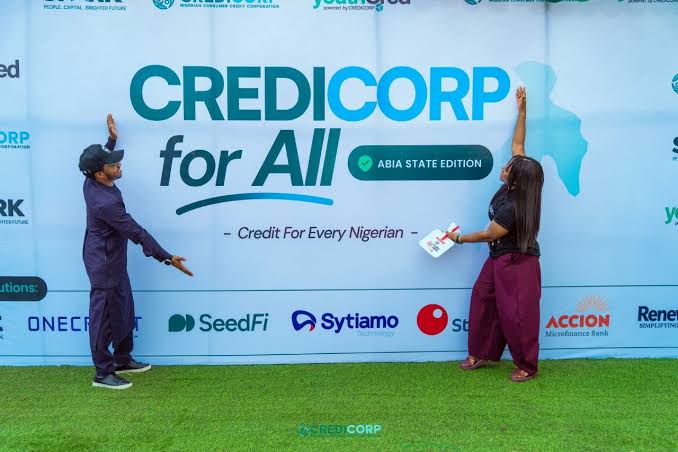
The FG introduced SPARK in Aba, Abia State, where the corporation highlighted consumer credit opportunities for more than 1,000 residents.
The event brought together beneficiaries, participating financial institutions, local vendors and government representatives to demonstrate how consumer credit could support livelihoods and economic activities.
Activities included credit-access demonstrations for market women and traders, presentations on the YouthCred initiative for young Nigerians, and the showcasing of credit-backed tricycles for transport operators.
The event also featured locally assembled tricycles made available through CREDICORP’s Securing Consumer Access for Local Enterprises initiative, known as S.C.A.L.E.
CREDICORP Managing Director and Chief Executive Officer, Uzoma Nwagba, said the initiative was intended to extend consumer credit beyond traditional financial institutions. In his words:
”Consumer credit should not be a privilege reserved for a few. It should be an opportunity available to every working Nigerian
“Today in Aba, Abia State, in Nigeria’s South East, we are demonstrating what that means in practical terms: credit for market women, a financial head start for young people, productive assets for transport operators, and with SPARK, a simple way for Nigerians to begin building their credit histories. This is how we make credit work for the people.”
Chinenye Mba-Uzoukwu, chief principal to Abia State Governor Alex Otti, said the state government was creating an environment in which businesses could grow and responsible consumer credit could reach more residents. Mba-Uzoukwu said, while representing the governor at the event:
“Under Governor Alex Otti’s leadership, Abia State is putting the conditions in place for businesses to grow, investments to flourish and responsible credit to reach more of our people.
“By strengthening the enabling environment for enterprise, we are making it easier for initiatives such as CREDICORP to support traders, young people and hardworking families across the state.”
Similarly, Armstrong Ume Takang, Managing Director of the Ministry of Finance Incorporated and a CREDICORP board member, said the showcase demonstrated how government policies could translate into economic opportunities.
“Through CREDICORP, we are seeing how well-structured public investment can stimulate enterprise, support local manufacturers and deliver measurable economic impact directly to citizens,” Takang said.
CREDICORP said it had facilitated more than ₦53.5bn in consumer credit for over 351,000 Nigerians since commencing operations, with women accounting for approximately 59 per cent of beneficiaries.
What Nigerians should know
SPARK is a credit service, not a grant. Borrowers who obtain loans will be expected to repay them according to the agreed terms.
The corporation has not provided comprehensive public details of SPARK’s loan limits, interest rates, repayment periods or full eligibility requirements in the reports announcing the product.
Prospective SPARK beneficiaries should also avoid unofficial websites, agents or individuals demanding upfront payments in exchange for guaranteed loan approval.
Business and Economy
JPMorgan Alters Banking in Nigeria, Gets CBN Approval, As Esther Alade Joins Merchant Bank

By Seyi Balogun, Lagos
The Central Bank of Nigeria (CBN) has approved plans by global financial services giant JPMorgan to establish a merchant bank in Nigeria, opening a new chapter in the lender’s presence in the country’s financial sector.
The proposed institution, to be known as JPMorgan Merchant Bank Nigeria Limited, has received, according to Legit.ng, approval-in-principle from the apex bank.
The American banking giant JPMorgan Chase has taken another step by appointing former Central Bank of Nigeria (CBN) acting governor, Sarah Omotunde Alade, as an independent non-executive director of JPMorgan Merchant Bank Nigeria Limited. The appointment brings one of Nigeria’s most experienced monetary policy expert’s into the governance structure of the proposed bank as the US financial institution seeks to strengthen its presence in Africa’s largest economy.
Alade, who spent 24 years at the CBN, brings extensive experience in economic management, banking operations, financial markets and public finance.
Her appointment comes amid expectations that JPMorgan’s expansion could create fresh opportunities for Nigerian businesses seeking international financing, investment advisory services and access to global capital.
Alade served as acting governor of the CBN in 2014 following the suspension of then governor Sanusi Lamido Sanusi. She assumed the position on February 20, 2014, overseeing the apex bank during a sensitive period for Nigeria’s monetary policy and financial markets. Before that appointment, she had served as deputy governor in charge of Economic Policy since March 26, 2007. Her responsibilities included monetary policy, economic research, statistics, trade and exchange, and financial markets.
As an independent non-executive director at JPMorgan Merchant Bank Nigeria, Alade will provide strategic guidance and board-level oversight rather than manage daily banking operations.
From university lecturer to CBN leadership Alade began her professional career in 1977 at the Ministry of Finance and Economic Development in Ilorin, Kwara State. She subsequently joined the University of Ilorin as a lecturer before moving to the CBN in 1993 as an assistant director in the Research Department. At the apex bank, she headed several departments responsible for government finance and fiscal analysis. In 2004, she became director of Banking Operations, later chairing the board of the Nigeria Inter-Bank Settlement System (NIBSS).
She also served as secretary of the National Payments System Committee, contributing to the development of Nigeria’s financial infrastructure.
Alade retired from the CBN in March 2017 after more than two decades of service. Buhari appoints Alade economic adviser Her retirement did not mark the end of her involvement in national economic policymaking. In November 2019, former President Muhammadu Buhari appointed her Special Adviser on Finance and the Economy.
Nigerian bank expands, set to begin full commercial operations in November
Alade holds an Economics degree from the University of Ife, now Obafemi Awolowo University, a master’s degree from the University of Melbourne and a PhD from the University of Ilorin.
What JPMorgan’s expansion means for Nigeria
JPMorgan’s planned merchant banking operations could strengthen competition in Nigeria’s corporate and investment banking sector. Unlike conventional retail banks, merchant banks primarily serve businesses, institutional investors and large organisations through specialised financial services.
These include capital raising, corporate finance, investment advisory and structured financing. The proposed institution could also provide Nigerian companies with stronger connections to international capital markets. However, the range of services JPMorgan Merchant Bank Nigeria can offer will depend on its regulatory approvals and licensing conditions.
Alade’s appointment signals the institution’s intention to draw on experienced Nigerian financial leadership as it develops its local operations.

By Nick Ibe, Abuja
Legal and business leaders have revealed situations that discourage long term investments in Nigeria. Consequently, they warn that investors may continue to shun long-term investments in Nigeria if courts fail to enforce contracts consistently, if commercial disputes drag on for years, and if government policies undermine existing business agreements, according to the Punch..
The country’s ability to attract and retain capital depended not only on the potential for profit but also on whether investors could protect their assets, obtain fair decisions in commercial disputes and recover their investments when necessary.
Putting this in focus was the Managing Partner of Candide-Johnson Law, Charles Adeyemi Candide-Johnson, SAN, who said that capital was attracted by safety rather than merely the promise of profit. In his words:
“Actually, capital goes where it is safe.”
The warning formed part of discussions at the third annual Multi-Door Courthouses and Alternative Dispute Resolution Stakeholders Summit 2026, held at the MUSON Centre, Onikan, Lagos, on October 19 and 20.
The summit had the theme, ‘Investor Confidence and ADR: Strengthening Nigeria’s Investment Climate’.
Anther speaker, Bode Olanipekun, SAN and the President and Chairman, Council of the Nigerian-British Chamber of Commerce, Abimbola Olashore, identified weak contract enforcement, questionable ex parte orders, inconsistent government policies and unpredictable dispute resolution as obstacles to investment.
The Chief Executive Officer of the American Business Council Nigeria, Mrs Margaret Olele, also warned that regulatory inconsistencies and breaches of contractual commitments could force companies to reconsider their operations or leave the country.
Olanipekun, Managing Partner of Wole Olanipekun & Co, said investors were concerned not only about the returns they could earn but also about the possibility of losing their capital in prolonged commercial disputes.
He described the two concerns as “return on investment” and “return off investment”, explaining that businesses want their investments to grow while ensuring that their money was not lost.
“Everybody has heard of ROI, return on investment. At the back of our minds, I want us to use two forms of ROI this morning: ROI as return on investment and ROI as return off investment.”
He added, “As an investor, I don’t want my investment to diminish; I want my investment to grow. That’s return on investment.
“Now, there’s return off investment. As an investor, I don’t want to lose my investment. I don’t want my money to get lost.”
To illustrate the consequences of prolonged litigation and the misuse of ex parte orders, Olanipekun cited a commercial dispute in which one company allegedly obtained court orders after another judge had declined to grant similar reliefs without first hearing the opposing party.
According to him, Company A approached a court on October 27, 2015, seeking orders against Company B, but the application was refused.
He said Company A subsequently filed the same case before another judge and obtained the orders on December 4, 2015.
Company B challenged the orders, which the Court of Appeal discharged on March 30, 2016. The Supreme Court subsequently affirmed their impropriety on July 13, 2018, Olanipekun said.
He added that the Court of Appeal later held that the second suit amounted to an abuse of court process and dismissed it.
Company B subsequently sought damages over the losses allegedly caused by the orders, with the High Court awarding more than N71bn on July 18, 2023. Olanipekun said an appeal against the damages award was pending.
Questioning the consequences for the company, he said, “What really will be the status of Company B today, 10 years after, if it has not recovered a dime from that loss which the court had found that it did suffer?”
He urged business leaders to consider whether commercial disputes would be better handled by independent arbitrators with the necessary industry knowledge and the ability to deliver final decisions efficiently.
“People of commerce would prefer commercially skilled and knowledgeable independent arbiters who understand their businesses to resolve their disputes,” he said.
“The more a jurisdiction can provide this quality of arbiters, the more confident investors would be to commit capital to such destinations.”
Olanipekun also cited a 2023 dispute involving Seplat Energy, in which three shareholders holding a combined 162 shares reportedly obtained ex parte orders restraining the company’s chief executive officer, executive management and board members from acting in their official capacities.
He said their combined holdings represented less than 0.002 per cent of the company’s issued shares.
According to him, the Court of Appeal suspended the orders on May 15, 2023, four days after they were granted, while the shareholders filed a notice of discontinuance on May 22.
He argued that the case demonstrated how court orders obtained without hearing the opposing party could affect corporate governance and business operations, potentially damaging investor confidence.
Candide-Johnson in his submission said the judiciary needed to provide a predictable commercial justice system in which contractual agreements were enforced according to their terms, subject to applicable laws and legitimate legal exceptions.
He argued that parties included choice-of-law and dispute-resolution clauses in commercial agreements because they anticipated the possibility of disputes and wanted to know how those disagreements would be resolved.
“If they can say with certainty that if my disputes come to these courts, the contracts will be enforced as we intend it, without influences outside of precedent, they will be confident to invest,” he said.
The lawyer, who also works as an arbitrator, said courts should understand the commercial expectations of contracting parties and avoid undermining agreements without sufficient legal justification.
“To be honest, there’s no reason why a contract should not be enforced as it appears in the fine print, except there’s some extenuating factors of illegalities and all of that,” he said.
He acknowledged that investors may not expect to win every dispute but would want assurances that the process would be fair and free from undue influence.
“Nobody expects to go to court and win all the time. In fact, it would raise certain questions if some particular persons win all the time.
“What people expect is an experience that they can say is fair and not influenced by considerations of relationships.”
Candide-Johnson urged Lagos State to lead efforts to establish a credible model of commercial justice, citing its economic importance and the implications of its institutions for Nigeria’s reputation.
“Lagos State is big enough to be a country by itself. The economy of Lagos State is larger than the economy of Côte d’Ivoire, Senegal, and Kenya combined,” he said.
He pointed to the English legal system as an example of how consistency and predictability could strengthen confidence in commercial transactions, noting that its development under Lord Mansfield was intended to provide merchants with rules they could understand and trust.
He also warned against treating the existence of laws and constitutional provisions as sufficient guarantees of justice, arguing that their effectiveness depended on the commitment of those responsible for enforcing them.
Candide-Johnson said mediation and other alternative dispute resolution mechanisms should complement the courts, allowing less complex disputes to be resolved without adding to judicial backlogs.
“Sometimes it’s just pride and anger that creates disputes,” he said, adding that some disagreements could be settled through conversation and mediation.
He said integrating ADR into the justice system, under appropriate judicial supervision, would reduce pressure on the courts and allow judges to concentrate on more complex cases.
Also, Olashore said weak contract enforcement and policy inconsistency were discouraging investors from committing long-term capital to Nigeria.
He argued that investors wanted to know not only whether a project would generate profits but also whether they could access those returns and recover their capital.
“In truth, the capital will go to where it is welcomed and where it is treated well,” he said.
Explaining the priorities of investors, Olashore said foreign investors wanted assurances that they could repatriate their earnings, while local investors needed confidence that projected profits would translate into money available in their bank accounts.
“For a foreign investor, how do I repatriate? If you are local, how do I assure that this projected profit will end up as cash in the bank?” he asked.
He illustrated the effect of Nigeria’s reputation for weak contract enforcement with an experience involving efforts to persuade an American airline to establish direct flights between Lagos and the United States.
Olashore said the commercial prospects for the proposed route were attractive, but concerns about the enforcement of aircraft leasing agreements in Nigeria undermined the proposal.
According to him, the airline’s chief executive, who had previously worked at Boeing, was concerned about the difficulties aircraft owners could face recovering their planes from operators who allegedly failed to meet their lease obligations.
Olashore said the executive had consequently formed a negative opinion about doing business in Nigeria.
“He said he had made up his mind that, as far as he was concerned, Nigeria was not a place where you could do business because they were not sure about enforceability,” he said.
Olashore said the experience showed how uncertainty about enforcing contractual rights could outweigh an otherwise attractive business opportunity.
“The issue about people investing is that when I cannot price the risk, I would rather not invest,” he said.
He maintained that investors could calculate some risks, including the time required to resolve disputes, but uncertainty about whether their rights would ultimately be protected was more difficult to accommodate.
“I tell people, it is not about the length of time. Again, I can price that. If there is a dispute that takes 20 years, let me put that into my calculation and do my risk analysis,” he said.
“When there is uncertainty even at the end of the 20 years, I will not invest,” he added.
Olashore said Nigeria needed long-term financing for projects and businesses but would struggle to attract such capital if investors continued to distrust its institutions.
“When I see all the comments asking how come we have only short-term money coming in, that is because people don’t trust us. That is why they invest for the short term,” he said.
He urged the government to protect property rights, ensure accountability and maintain consistent policies, arguing that investor perceptions could change if the country demonstrated a sustained commitment to doing the right things.
Meanwhile, Olele identified breaches of contractual commitments, inconsistent government policies and poor implementation of regulations as additional factors driving businesses away from Nigeria.
She said businesses could face uncertainty when a new state administration altered the terms or costs associated with existing agreements, sometimes requiring industry groups to intervene on behalf of affected companies.
“One major concern is the sanctity of contracts,” she said.
Olele argued that regulations could be well designed but still undermine businesses when authorities failed to implement them consistently.
She cited Kimberly-Clark, recalling efforts to persuade the company to establish a factory in Lagos.
According to her, the company subsequently faced competition from businesses operating in a free trade zone, whose products allegedly entered the Nigerian market at prices that made it difficult for the local manufacturer to compete.
She said the situation illustrated how inconsistent implementation of regulations could disadvantage businesses that had invested in local production.
Olele also cited Uber’s experience with Nigeria’s regulatory environment, saying uncertainty over how to classify the ride-hailing company and differing interpretations by government agencies created difficulties for its operations.
She said effective coordination among regulators was necessary to avoid imposing conflicting requirements on businesses.
Olele further warned that policies governing data localisation and cross-border data transfers needed to be designed and implemented in ways that did not unnecessarily obstruct business operations.
She argued that Nigeria’s investment strategy should focus not only on attracting new companies but also on retaining existing businesses by providing a predictable operating environment.
The speakers’ submissions converged on the need for stronger institutions, consistent enforcement of commercial agreements and efficient dispute resolution.
They argued that Nigeria’s ability to attract long-term capital would depend on whether investors could trust the rules governing their businesses, obtain fair hearings when disputes arose and recover their investments without being exposed to avoidable legal and regulatory uncertainty.



PERSPECTIVE: Tiv Leaders Must Hear This: While Akwa Ibom Asked For A Future, Tiv Leaders Fight Over A Man
Spread the loveBy Edward Tion I watched the presidential campaign in Akwa Ibom today with a bleeding heart. Not because...


Pursue Unity, Peace, Play Active Role in Nigerian Politics, Deputy Speaker, Kalu Urges Igbo Elites, Leaders
Spread the loveBy Saint Mugaga Deputy Speaker of the House of Representatives, Rt. Hon. Benjamin Kalu has called on Igbo...


2027: Amupitan Seeks Royal Support, Partnership to Discharge Mandate Peacefully, Effectively
Spread the loveBy Isa Abdul The National Chairman of the Independent National Electoral Commission (INEC), Professor Joash Amupitan, has said...


Place 7-Year Ban On Establishment Of New Tertiary Institutions– Edu Minister Begs NASS
Spread the loveBy Son Tertsea, Abuja The Federal government has appealed to the National Assembly to halt the passage of...


Gov Sule to Security Agencies: Fish Out Sponsors of VP Shettima’s Attackers in Lafia
Spread the loveSDP: attackers APC members against Wadada’s candidacy By Isa Abdul, Abuja Prominent personalities in the state planned and...


Wike’s Entry, Allocation of UniAbuja Land a Breach of Court Order– ASUU
Spread the loveBy Nick Ibe, Abuja The Federal Capital Territory Administration’s (FCTA) allocation of some hectares of land belonging to...


Alleged 4 Herbal Concoction Consumers Die in Benue
Spread the loveBy Vincent Tyosuugh After consuming a suspected poisonous herbal concoction allegedly sold to residents of Oju Local Government...

BENUE APC Split Deepens As SGF, Stakeholders Shun Alia Campaign Flag-off, Disown Campaign List
Spread the loveBy Felix Umande The crisis rocking the Benue State chapter of the All Progressives Congress (APC) deepened on...


Defence Minister Invites Cybersecurity, Drone, DefenceTech Experts for Collaboration with DICN
Spread the loveBy Nick Ibe, Abuja Minister of Defence, General Christopher Musa (rtd) has called on Nigerians with expertise in...


Wike’s Rainbow Coalition Faces Storm Over Alleged Split Voting: VP Shettima, SDP, Ondo APC Reject Coalition
Spread the loveBy Son Tertsea, Abuja Nyesom Wike’s Rainbow Coalition has been identified as a split voting device according to...