
Politics
The Disappearing Faces of Women in Nigeria’s Politics


The number of women as candidates in the last primary elections of all the political parties in Nigeria, point to what next year’s general polls and beyond is bound to look like: fewer faces of women in elective positions.
According to a Weekend Trust research, while more women indicated interests in contesting by obtaining forms to secure the tickets of their parties, most of them could not go beyond the preliminary stages, with many either withdrawing, not considered in the consensus arrangements, or being defeated in the early stages.
Weekend Trust newspaper correspondents reveal that a higher number of women had indicated interests in contesting for state assembly seats, but the number dwindled for those going for House of Representatives seats, again, dropping drastically for Senate and getting terribly low on governorship.
When the Independent National Electoral Commission (INEC) released the names of the presidential candidates for 2027, only two out of the 18 candidates, which constitutes 11.1per cent of the total candidates, are women, despite making up 49.32 per cent of Nigeria’s population.
The two women are Ada Elizabeth Okwori of the National Democratic Party (NDP) and Esther Iken Okereke of the National Rescue Movement (NRM).
Also, there are four female vice presidential candidates who will be contesting. These are Hajiya Bintu Konto (LP), Ofordile Peace Egobia (APP), Nafisat Usaku (DLA) and Patience Key (YPP)
INEC figures show that 469 women are among the 4,863 candidates listed for the Senate and House of Representatives elections, while only two of the 18 presidential candidates are women.
The figures indicate that fewer than one in every 10 candidates contesting the National Assembly elections is female, while women constitute just over one in every 10 presidential candidates.
The Senate has the lowest female representation, with 123 women among 1,303 candidates, representing 9.4 per cent. The House of Representatives has 346 female candidates out of 3,560, representing 9.7 per cent.
The figures were calculated from the party and gender fields contained in INEC’s final list of candidates.
The figures reflect a pattern in Nigerian politics in which women participate extensively in elections but remain largely absent from the institutions where political decisions are made.
Data from 2015 show that only one woman contested the presidency, while four women were listed as vice presidential candidates, with 14 political parties participating.
By 2019, female participation had increased, with five women contesting the presidency and 23 contesting the vice presidency, as the number of political parties also rose to 72.
In the 2023 election, only one woman contested for the presidency, while no woman contested for the vice presidency. The number of participating political parties also dropped to 18.
Since the return to democratic rule in 1999, there has been underrepresentation of women in the parliament.
For instance, in the 10th National Assembly, women account for only about 3.7 per cent of senators and 4.4 per cent of members of the House of Representatives.
Fourteen state assemblies do not have a single woman. The states are Kaduna, Kebbi, Sokoto, Zamfara, Jigawa, Kano, Bauchi, Gombe, Yobe and Plateau.
Political analysts and civil society organisations have observed that since the return of democracy in 1999, the number of women who have contested and won elective positions has been disproportionately low compared to men.
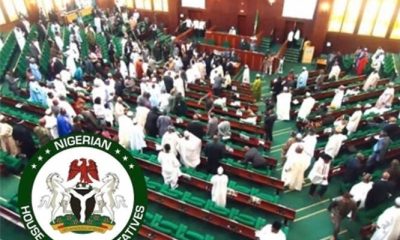
In the current Senate, out of 109 senators, only four – Ireti kingibe, Natasha Akpoti-Uduaghan, Ipalibo Banigo and Idiat Oluranti Adebule are women, leaving the Red Chamber of the National Assembly to be dominated by men, while in the Green Chamber, only 17 women are currently serving out of the 360 total members, representing only 4.7 per cent of the legislative seats.
As issues relating to primaries are about to be concluded, the development has again raised the question about why the number of women participating in politics is shrinking despite the encouragement, enlightenment and examples in other climes, which should have served to encourage Nigerian women.
Analysts say development across the globe should have spurred more women in Nigeria to go into politics.
Currently, the president of Tanzania, Samia Suluhu Hassan and that of Namibia, Netumbo Nandi-Ndaitwah, are women.
Weekend Trust recalls how, in the past, the low number of women participating in politics became an issue of concern that deliberate efforts were made to encourage their participation through sensitisation and lowering the financial cost, with many political parties offering their nomination forms to women at no cost.
Concerned groups and individuals have attributed the dwindling number to factors that include cost of participation, cultural and religious restrictions, as well as the perception about women in politics
A coalition of women-led movements and civil society organisations recently raised concerns over the declining participation of women in Nigeria’s electoral process, warning that the 2027 general elections could produce even fewer female lawmakers than the 2023 polls, unless urgent reforms are implemented.
Presenting the findings of an audit conducted on the primaries, the Executive Director of Invictus Africa, Bukky Shonibare, revealed that women’s participation remained critically low across most political parties.
According to the audit, only three of the 22 political parties recorded female aspirant participation above 20 per cent, with the Peoples Democratic Party (PDP) recording 28.2 per cent female participation, followed by the Young Progressives Party (YPP) with 22.2 per cent and the Young Progressives Party (YP) with 20 per cent.
The National Rescue Movement (NRM) recorded 11.8 per cent female participation, while the All Progressives Congress (APC) had 10.4 per cent, and the New Nigeria People’s Party (NNPP) recorded no female aspirant.
The audit also found that only three women emerged as senatorial candidates across all parties, prompting fears that women could occupy just 2.7 per cent of Senate seats after the 2027 elections if current trends persist.
Shonibare identified several barriers confronting female aspirants, including forced withdrawals, opaque consensus arrangements and last-minute candidate substitutions.
A co-founder and Executive Director of the Voice of Women Empowerment Foundation, Toun Okewale Sonaiya, on her part, warned that unless corrective measures were taken, women’s political representation in 2027 could be worse than what was recorded in the 2023 elections.
Another woman, Aisha Abdullahi Hudu, the chief executive officer and founder of United Women for Peace Initiative, said point blank that the men were not carrying the women along.
She said: “They don’t want women to occupy one seat to the other.”
Reserved Seat bill for women
Currently, there is a Reserved Seat bill contained in the constitutional amendment legislation seeking to create additional elective seats exclusively for women in the Senate, House of Representatives and State Houses of Assembly.
It seeks to create special legislative seats strictly for women. In the Senate, each state and the Federal Capital Territory (FCT) would have one extra seat reserved exclusively for women.
Also, the House of Representatives will have one extra seat for each state and the FCT. At the state level, each House of Assembly would add three women-only seats.
But the bill is yet to become law. If passed, Nigeria’s legislature would expand to 146 senators, 397 members of the House and 1,098 state legislators.
It is expected that if passed, the Reserved Seats legislation would offer equal status, powers and privileges as the existing seats, and women occupying them would not be barred from contesting regular seats. But the life of the special seats is only for 16 years
Women lament current situation
The United Nations (UN) Women Focal Person to the Governor of Yobe State, Fatima Muhammad Paga, has urged members of the National Assembly to support and pass the Special Reserved Seats for Women bill, describing it as a crucial step towards deepening democracy and promoting inclusive governance in Nigeria.
“The passage of this bill will encourage more women to participate actively in politics and contribute meaningfully to nation-building. It will provide a platform for women to influence policies and decisions that affect the lives of Nigerians,” she said.
A current affairs commentator, Malam Ibraheem Abubakar, said few number of female aspirants in most northern states reflected the broader challenges confronting women in politics.
These, he said included cultural and religious perceptions, limited access to campaign financing, weak political networks and the dominance of male politicians within party structures.
Analysts said that until political parties, voters and institutions deliberately addressed issues of funding, violence and internal party democracy, the number of women who win elections in Nigeria was likely to remain low.
Our correspondents report the current situation concerning women in the next general elections in some states:
Kano: 1 female candidate for House of Assembly
In Kano State, most of the major political parties have given their tickets to men, with only one slot allocated to a woman contesting for a state assembly seat by the African Democratic Congress (ADC).
Parties in the state mostly identify with women in areas of political appointment with few elective positions at local government level.
In the APC for instance, all their candidates emerged through consensus and are men. Similarly, the NDC also gave almost all their tickets to men via consensus.
The only party among the major ones that gave a ticket to a woman is the ADC, which nominated Na’ima Yahaya for the state assembly seat in Ungogo constituency.
Yobe: APC, ADC, 2 female Reps candidates
Only two women have secured tickets to contest House of Representatives seats in Yobe State ahead of the 2027 general elections, while no woman emerged as a governorship or senatorial candidate across the major political parties.
The successful female candidates are Fatima Talba of the APC and Zainab Boni Haruna of the African Democratic Congress (ADC).
Talba, the incumbent member representing Nangere/Potiskum federal constituency secured the APC ticket through the party’s consensus arrangement and will seek a third consecutive term in the House of Representatives. She is the only female House of Representatives candidate produced by the APC in Yobe State.
Similarly, Zainab Boni Haruna, wife of a former governor of Adamawa State, emerged by consensus as the ADC candidate for Fika/Fune federal constituency after defecting from the Peoples Democratic Party (PDP) to the ADC in 2025. She is the only female House of Representatives candidate on the ADC platform in the state.
Checks by Weekend Trust show that neither the Peoples Democratic Party (PDP) nor the Young Progressives Party (YPP) produced any female candidate for the National Assembly in Yobe State. The two parties also have no female governorship or senatorial candidates.
Meanwhile, Khadija Bukar Abba Ibrahim, who has represented Damaturu/Gujba/Gulani/Tarmuwa federal constituency in the House of Representatives since 2007, did not secure the APC ticket after party stakeholders endorsed Nasiru Hassan Yusuf as the consensus candidate for the constituency.
Borno: How a female Reps candidate emerged unopposed
In Borno State, two female aspirants contested for the House of Representatives tickets of the All Progressive Congress (APC). The aspirants are the current House of Representative members – Zainab Gimba, who lost the ticket, and a new entrant, Hajiya Fati Kakenna, who clinched the ticket for Guzamala/Kukawa/Abadam/ Mobbar federal constituency unopposed.
Efforts to reach Honourable Zainab Gimba for comments proved abortive, as multiple phone calls placed to her official line and a follow-up text message remained unanswered as of the time of filing this report.
Adamawa: A strong female contender for guber seat
In Adamawa, the NDC is featuring Senator Aishatu Dahiru Ahmed Binani as its governorship candidate, while few women have clinched the nomination of their political parties to contest for various political positions in the forthcoming 2027 general elections.
The women that emerged victorious through party direct or indirect primaries include Golfa Mallim Chaugwarau contesting for the Shelleng/Guyuk federal constituency under the APC, Hyellagiziya Naiwa Fakuta contesting for member House of Representative to represent Michika/Madagali on the ADC platform.
Hajiya Ramatu Sali Bello, daughter of a former Head of Civil Service of the Federation, Mr Sali Bello, is contesting for the House of Representative for Mubi North, Mubi South and Maiha constituency under the APC banner, as well as Hajiya Atika Ibrahim Sajoh, contesting for the Adamawa State House of Assembly seat for Mubi North constituency under the NDC platform.
Nasarawa: Incumbent retained ticket
In Nasarawa, one of the most visible success stories is that of Hajara Ibrahim Danyaro. She is the current member representing Nasarawa Central constituency in the Nasarawa State House of Assembly. Danyaro has secured the All Progressives Congress ticket to contest for a second term. Her continued presence in the legislature makes her a key figure in the current female representation in the state.
Danyaro’s emergence is historically significant because she is the second woman to win a seat in the Nasarawa State House of Assembly. The first was Mary Enwogulu, who represented Nasarawa Eggon East constituency between 2007 and 2011. Enwogulu also served as Minority Leader during her tenure, making her the first and only woman to hold a principal office in the state assembly so far.
Beyond the state assembly, women have also sought tickets for federal positions. Farida Umar obtained the ticket of the PDP to contest for the Lafia/Obi federal constituency seat.
At the state level, Mbikyu Maidoki secured the Labour Party ticket to contest for Akwanga North constituency in the Nasarawa State House of Assembly.
However, not all women who sought tickets were successful. Mahasin Usman Attah contested for the APC ticket for Awe/Doma/Keana federal constituency but lost to Yakubu Araf.
Another example is Hauwa Bawa Mohammed, who secured the APC ticket for the Nasarawa State House of Assembly, Obi I constituency. She contested the 2023 general elections but was not successful. She also contested in the last APC primary election for the same seat but lost.
According to INEC records, only three women have won elections conducted by the commission in the state. This low number underscores the structural challenges that continue to hinder female representation
The first of those three women was Patricia Akwashiki. She won the House of Representatives seat for Akwanga/Nasarawa Eggon/Wamba federal constituency and served between 2003 and 2007. She later went on to win the Senate seat for Nasarawa North senatorial district, serving from 2007 to 2011. Her back-to-back victories at both federal legislative levels remain unmatched by any other woman in the state.
The second woman to win was Mary Enwogulu, who represented Nasarawa Eggon East in the State House of Assembly from 2007 to 2011. As noted earlier, she also served as Minority Leader, a milestone that has not been repeated by any other woman in the assembly.
The third is Hajara Ibrahim Danyaro, the current representative of Nasarawa Central.
Katsina: How a woman defeated others to clinch APC Reps ticket
In Katsina State, women’s participation in the 2026 party primaries in Katsina State has remained low.
Although few women declared interest in elective offices across different political parties, only one emerged victorious in the primaries, highlighting the challenges women continue to face in securing party nominations.
The only woman so far that has succeeded in getting a party ticket is Hajiya Jamila Abdu Mani of the APC. She won the party’s ticket for the Mani/Bindawa federal constituency House of Representatives seat.
She defeated her main rival, Ahmed Saleh, making her one of the few female National Assembly candidates produced by the APC nationwide for the 2027 general elections.
Hajiya Jamila’s emergence as a candidate from Katsina State is a significant milestone in not only Katsina State, where women have traditionally struggled to secure elective positions through party primaries, but also to the entire northern Nigeria.
However, in the Peoples Democratic Party (PDP), Hajiya Fatima Sani Danladi sought the party’s nomination for the House of Representatives but was unsuccessful after losing the primary election.
Similarly, Hajiya Amina Lawal Kurfi of the Social Democratic Party (SDP) publicly expressed interest in contesting for a seat in the Katsina State House of Assembly. However, she did not eventually emerge as the party’s candidate.
Another attempt is by Hajiya Amina Lawal Rafin-Dadi, who showed interest to aspire for the Katsina central senatorial district on the platform of the African Democratic Congress, but unfortunately, she didn’t get the ticket.
Also, efforts to contact the Katsina lone APC female candidate to speak on her experience in the male dominated political scenario failed as all calls made via her phone were not answered and no reply to a text message sent to her was received.
Bauchi: Women pick tickets in APM, PDP, PRP
Political parties in Bauchi State have nominated women as candidates for the House of Representatives and State House of Assembly election ahead of the 2027 general elections.
The Allied Progressive Movement (APM) has nominated two women for the House Representatives, including the immediate past Commissioner for Humanitarian Affairs and Disaster Management, Hajara Yakubu Wanka, to contest for Alkaleri/Kirfi federal constituency, and the immediate past executive chairman of Itas Gadau, Hajara Gidado, to contest for Jamaare/Itas federal constituency in Bauchi State
The Peoples Democratic Party has nominated a onetime member of the State House of Assembly, Maryam Bagel as the candidate for Bogoro/Dass/Tafawa Balewa federal constituency.
The Peoples Redemption Party (PRP) nominated a former Commissioner for Women Affairs, Hajiya Zainab Babantakko as its candidate for Bauchi Central state constituency.
Zainab earlier contested for the APC ticket but lost during the primaries and defected to the PRP, alongside its gubernatorial candidate, Senator Shehu Buba Umar, and eventually emerged as the candidate of the party for the Bauchi State Assembly election.
Badiatu Inuwa, popularly known as Siyama, contested the APC ticket for Bauchi federal constituency in the just concluded party primaries but loss out during the exercise.
Investigation revealed that in the past, only three females were elected into the Bauchi State House of Assembly, including Habiba Sabo Gabarin from 1999 to 2007, representing Darazo constituency, Rifkatu Samson Danna from 2007 to 2015, representing Borogo constituency, and Maryam Bagel, representing Dass constituency from 2015 to 2019.
A group, Women Coalition for Sustainable Peace and Viable Democratic Gains and the Baheejah Mahmood Support Association (BAMASA), is however, campaigning for Hajiya Baheejah Mahmood Abdullahi (Mai Dankwali) to emerge as the deputy governorship candidate of the Peoples Redemption Party in Bauchi State.
Zamfara: Case of female senatorial aspirant still in court
In Zamfara State, a woman, Lubna Baba Gusau, aspired for the Zamfara Central senatorial ticket of the APC . She is, however, battling in court, challenging the outcome of the APC primary election in the state which declared her male rival, Senator Ikra Bilbis as the candidate.
Edo: 15 aspired, 6 emerged candidates
In Edo State, the percentage of female aspirants ahead of the political parties’ primaries for the 2027 general elections has been low. No fewer than 15 women indicated interest in contesting seats in the Edo State House of Assembly, the House of Representatives and the Senate. However, at the end of the primary elections, only six women emerged as candidates of their respective political parties.
Among them are Maria Iseme Osaimoje of the National Democratic Congress and Herberta Inemezele Okonofua of the African Democratic Congress, who are contesting the Edo North and Edo Central senatorial districts respectively.
Others are Omosede Igbinedion of the APC, contesting the Ovia federal constituency seat in the House of Representatives, Natasha Osawaro of the National Democratic Congress contesting the Egor state constituency seat, among others.
Gombe: Lone female candidate battle for Reps seat
In Gombe State, there are six federal constituencies evenly spread across the three senatorial districts of the state.
Weekend Trust reports that currently, all the six members representing the state at the House of Representatives are male.
Our correspondent reports that for the forthcoming 2027 general elections, Fatima Binta Bello, a House of Representative candidate for the Kaltungo/Shongom federal constituency on the platform of the APC, is the only female contestant for any elective positions from the state.
Also, all the 24 candidates fielded by each of the three major political parties, the ADC, APC and the PDP for the state House of Assembly are male.
Since 1999, only two women have ever served in the State House of Assembly: Hajiya Zainab Alman, who represented Kaltungo East state constituency between 2003 and 2007, and Asmau Mohammed Iganus, who represented Shongom state constituency from 2019 to 2023.
It took 12 years after Alman’s exit for another woman, Iganus, to be elected. While Alman was denied a return ticket in 2007, Iganus lost her re-election bid in 2023 despite securing her party’s nomination.
Also, in the National Assembly, only two women had served: Binta Bello, who represented the Kaltungo/Shongom federal constituency between 2011 and 2019 under the Peoples Democratic Party, and Aishatu Jibril Dukku, who represented Dukku/Nafada federal constituency between 2015 and 2023 on the platform of the APC.
Binta Bello was the first female to be elected into the National Assembly from the state in 2011. She also served as Deputy Minority Whip of the House of Representatives from 2015 to 2019.
She contested for the Gombe South senatorial district seat in 2019 but lost during the general elections. She lost the Senate ticket under the PDP during the 2022 primary election.
She defected to the APC and was elected as the chairperson of Shongom Local Government. After her tenure, she contested and clinched the party’s ticket to re-contest for the Kaltungo/Shongom federal constituency, a seat she vacated in 2019.
Aishatu Jibril Dukku sought a third term at the National Assembly in 2023 but was defeated during the general elections by the incumbent, Abdullahi El-Rasheed of the PDP.
She again indicated interest to contest for the seat during the recent primary election, but the APC picked Jamilu Ahmed Shabewa, who was the party’s consensus candidate. He later won the ticket.
Also, in 2019 and 2023, a former commissioner for education in the state, Aishatu MB Ahmad, contested for the Akko federal constituency seat on the PDP platform but was defeated in both elections by Usman Bello Kumo of the APC, the current Chief Whip of the House of Representatives.
Reacting to the development, the Deputy Speaker of the Gombe State House of Assembly, Sadam Bello Saleh, said creating special seats for women, especially in legislative positions, would be a panacea to the misrepresentation of women in political space.
A political analyst, Ibrahim Ahmed Abdullahi, also said creating special seats for women would solve the problem of under-representation of women in the political space.
Ondo: Female aspirants face uphill task
Despite a growing advocacy for gender inclusion, women remain significantly underrepresented in elective positions in Ondo State, with only a handful of female politicians emerging from the APC, and none from other political parties ahead of the 2027 general elections.
One of the notable female contenders is Omowunmi Ohwovoriole, who emerged as the APC candidate for the Akure North/Akure South federal constituency for a House of Representatives seat. She secured victory in the party’s primary election, polling more than 9,200 votes to defeat other aspirants and clinch the ticket.
Political observers noted that Omowumi was the only female House of Representatives candidate produced by the APC in Ondo State following the party’s primaries, underscoring the limited presence of women in elective politics.
Similarly, Adeola Rosemary Fynch, a former secretary of Akure South Local Government, won the APC ticket for Akure South constituency I in the Ondo State House of Assembly primaries.
Throughout her campaign, Fynch consistently identified with the cause of increased female representation in governance. At a stakeholders’ meeting, members of her campaign team urged party faithful to support women seeking elective offices.
However, not all female aspirants were successful in their political ambitions.
A former Secretary to the State Government (SSG), Princess Oladunni Odu, who expressed interest in the Ondo South senatorial seat, eventually stepped down following her party’s decision to support another aspirant.
Likewise,a former Speaker of the Ondo State House of Assembly, Jumoke Akindele, contested the APC primary for the Ondo South senatorial by-election but lost to Dr Faduyile Francis, who eventually secured the party’s ticket.
Cross River
In Cross River State, there are three female candidates for the state House of Assembly, namely, Bridget Alina, Esther Bepeh and Majorie Asuquo. There are two for House of Reps, namely, Dr Stella Odey-Ekpo and Mrs Blessing Egbara, while there are four for the PDP.
Kwara: APC, PDP fielding 4 women
In Kwara State, the ruling APC will once again field four female lawmakers for the 2027 House of Assembly election, with all of them seeking re-election after serving in the current Assembly of 24 members.
They are Rukayat Shittu, who represents Owode Onire state constituency and the youngest female member of the Kwara State House of Assembly; daughter of a former governor, Arinola Fatimah Lawal, the lawmaker representing Ilorin East state constituency and chairperson of the House Committee on Education and Human Capital Development; Maryam Aladi, who represents Afon state constituency and chairs the House Committee on Business Innovation, Industry, Women Affairs and Social Development; and Medinat Folorunsho Salaudeen, representing Moro state constituency, who is also seeking another term.
The opposition PDP, on its part, has produced four female House of Assembly candidates to contest legislative seats. They are Ibrahim Mojirayo Sherifat for Omupo state constituency, Aliu Mariam for Ilorin Central state constituency, Agoro Suliat Omolola for Ilorin North West state constituency, and Adeniran Muslimat Oluwatoyin for Isin state constituency.
The emergence of the four women on the PDP ticket sets the stage for increased female participation in the race for seats in the Kwara State House of Assembly, with the party hoping to make inroads against the APC’s experienced female legislators.
Kogi: 3 female candidates may contest
In Kogi State, beside the incumbent Senator Natasha Akpoti-Uduaghan, representing the central district, there are two female lawmakers in the state House of Assembly that may emerge as candidates of their respective parties in the 2027 general elections.
Senator Natasha Akpoti-Uduaghan is contesting for the central district of Kogi State, having emerged as the PDP candidate.
No female candidates have been reported yet in that capacity for Kogi West or Kogi East senatorial seats in the searched results. Equally, no female candidates’ names have surfaced yet in the available reports for 2027 House of Reps and the state House of Assembly in the state.
In the last election, 2 women won assembly seats: Mrs Omotayo Adeleye-Ishaya (Ijumu constituency, APC) and Mrs Comfort Nwuchola (Ibaji constituency, APC).
By the ongoing internal arrangement in the APC in the state, the 2 sitting female lawmakers are expected to seek re-election.
However, that has not been confirmed by the state chapter of the party or the electoral commission.
Research shows women are hindered from participation
Our research indicates that part of the reasons women do not go far in Nigerian politics is because Nigeria’s political system is heavily dependent on financial resources and networks built over the years. The report also revealed that women seeking political offices can face expectations and scrutiny that their male counterparts often do not encounter. Their marital status, appearance, family responsibilities, age and personal lives can become subjects of political attacks.
Women in politics also face harassment and gender-based abuse, including attacks on the social media. Such hostility can discourage women from contesting elections and can make political office a particularly costly pursuit.
How to make more women participate
Speaking with Weekend Trust, the Ondo State Commissioner for Women Affairs and Social Development, Seun Bosede Osamaye, attributed the low participation of women in politics to societal stereotypes and entrenched gender biases.
“For a long time, the society has conditioned women to believe that their place is only in the kitchen. But women are changing that narrative. More women are becoming politically aware and actively participating in governance,” she said.
Osamaye added that she had used her office to encourage and mentor women to take greater interest in politics and leadership.
Also speaking with Weekend Trust, a gender inclusion advocate and founder of the I Believe in Me Resource Centre, Dame Olubukola Adesina, called for deliberate efforts to increase women’s participation in politics and governance.
To improve women’s representation in politics, Olubukola advocated stronger implementation of gender inclusion policies and greater support for female aspirants.
She also called for the implementation of the 35 per cent affirmative action policy.
Cynthia Mbamalu of Yiaga Africa called on the Independent National Electoral Commission to publish comprehensive gender-disaggregated audit reports to expose exclusionary practices and strengthen accountability.
The Executive Director of Gender Strategy Advancement International, Adaora Sydney Jack, argued that the exclusion of women from political participation was fundamentally structural and institutional.
“If countries with fewer economic resources can achieve significantly greater levels of inclusion, then Nigeria’s challenge cannot be explained by capacity, talent or a lack of qualified women. It is a structural and political problem,” she said.
The national president of the Women in Politics Forum, Ebere Ifendu, urged political parties to uphold their constitutions and ensure accountability for violence, intimidation and discrimination against women aspirants.
Speaking on the development, the ADC South-South zonal publicity secretary, Mabel Oboh, noted that women’s participation in Nigerian politics was not hindered by lack of interest or ability but by entrenched systemic barriers that have persisted for decades.
“Politics in Nigeria continues to be dominated by money, violence, intimidation and deeply rooted patriarchal attitudes—forces that discourage many capable women from stepping forward to contest elective offices,” she said.


By Felix Umande
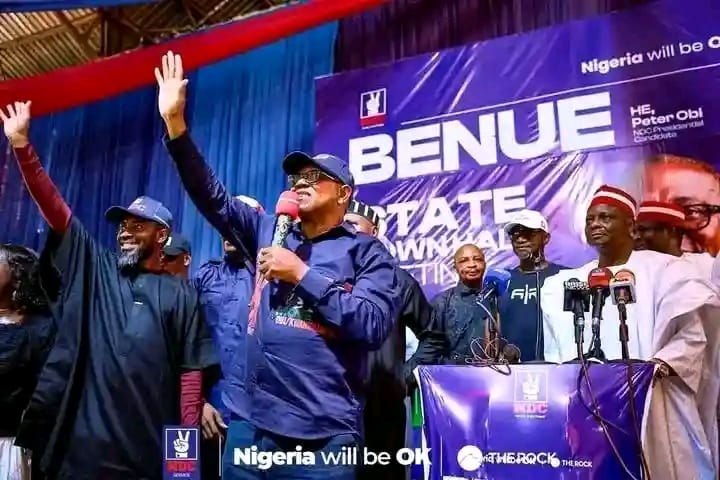
The NDC presidential candidate, Peter Obi, on Wednesday took his campaign for a new Nigeria to Benue State, combining humanitarian visits with a major town hall engagement in Makurdi.
Supporters described the gathering as an opportunity to engage directly with political leaders they believe can bring about a new Nigeria.
At the town hall, Obi unveiled his five-point agenda, promising jobs for young people, security for farmers, and an end to a system where employment depends on connections.
“We are going to ensure that young people have access to opportunities that will enable them to start their own businesses. We will also ensure that those who want to farm can return to their farms securely.
“We will ensure that when we create jobs, employment will no longer depend on knowing somebody. We must create a society where a child of nobody can become somebody without knowing anybody.”
On security, Obi said securing Nigeria would not be difficult, citing the position of the United Nations that the world should not be a means of defence.
He then listed his priorities in order:
“I repeat, we will ensure that we unite Nigeria. Nigeria will be one. We will unite Nigeria. Number two, we will secure Nigeria. Number three, we will fight corruption and stop the stealing of public funds so that public money can be used for the public good. Number four, we will invest in health to ensure proper healthcare. And number five, we will invest in education.”
He closed with his signature pledge: “A new Nigeria is possible! A new Nigeria is possible! We will move Nigeria from consumption to production.”
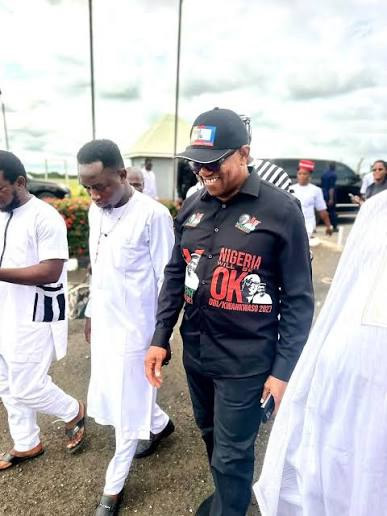
Before the town hall, Obi visited the palace of the paramount traditional ruler of the Tiv people, the Tor Tiv, Prof. James Ayatse, in Gboko.
The royal father thanked him for the visit, prayed for his protection and for a successful engagement in the state, and called for more prayers for Benue and Nigeria.
Obi told the monarch he was in the state for combined humanitarian and political engagements, and that it was important to visit the palace for blessing and important discussions.
He was accompanied by Bishop William Avenya of Gboko Catholic Diocese, Reverend Tor Ujah, other clergies and party supporters.
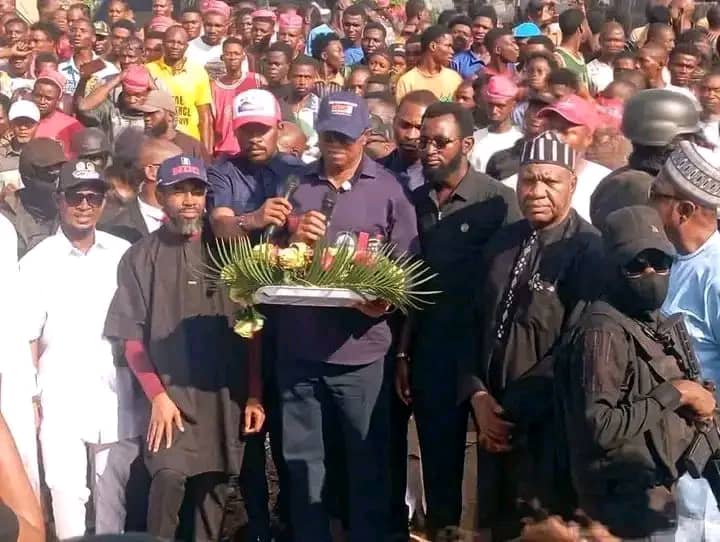
From Gboko, Obi proceeded to Yelwata community in Guma Local Government Area, where 271 people were massacred in June last year by armed invaders.
There, he laid a wreath in honour of the slain victims, in a solemn moment that underscored the humanitarian leg of his visit to the state.
–Promised water, basic edu for orphans
By Felix Umande
Presidential hopeful Peter Obi on Wednesday visited Yelwata community to commiserate with residents affected by recent attacks, pledging borehole water, N10 million for the education of orphaned children, and sustained support for the community.
Obi said he came to feel the pain of the people and to listen to their cries, not to apportion blame over what happened.
“First, I came here to most sincerely commiserate with the people of Yelwata. I came to feel your pain. I came to feel your cries.
“I have listened to Dr. Andrew. Let me assure you that we feel your pain. We understand all that you are going through, and I assure you that, while we are working hard in Nigeria, we must stop mothers from crying for their children and stop children from crying for their parents.”
Obi said his vision was for a secure country where no Nigerian fears living in his or her community and no Nigerian becomes a refugee.
“As long as Yelwata is suffering, Nigeria is suffering. As long as Yelwata is going through pain, Nigeria is going through pain. That is what we want to stop,” he said.
“We are not here in any way to say that we know what happened or who was responsible. We are here to say that what happened in Yelwata should not happen in a Nigeria where we are ready to fight back.”
He called on all men of goodwill to ensure that such an incident does not happen again, and prayed for comfort for mothers who lost their husbands and children who lost their parents.
Responding to issues raised by community leader Dr. Andrew, Obi identified water as the most urgent need and promised to support the provision of a borehole for the community.
“The most important issue Andrew raised today was the need for water. Andrew, I assure you that we will support you. I will support you to ensure that a borehole is provided here,” he said.
He also announced an initial sum of N10 million to support the education of children who became orphans and may no longer be able to go to school, noting his belief in supporting education, especially at the basic level.
Obi added that he would engage other agencies to explore ways of providing healthcare support for the community.
“Today, my purpose is to listen to what has happened. I have listened to your experiences, and I assure you that we will do whatever it takes to support this community and help you overcome these difficulties,” he assured.
“We cannot continue to have a Nigeria like this. We must deal with this situation. We want to unite Nigeria, secure it and lift people out of poverty. I want people to return to their farms.”
Obi assured the community that within two years, Nigerians would have access to primary healthcare, with a plan to build 10,000 primary healthcare centres covering at least one in each of the 8,809 wards in the country.
He said communities were currently without primary healthcare facilities, with schools not functioning and residents not secure.
“We will ensure that we decisively address these security challenges so that Nigerians can go to bed with their eyes closed and return to their farms to earn a living. I assure you that we will do this,” he said.
Obi disclosed that it was his third attempt to visit Yelwata and expressed happiness that he finally made it without any incident. He said he spoke with the Governor the previous day and that Governor Alia welcomed his visit.
“This will not be my last visit. I will come back to Yelwata. I am part of your pain,” he said.
Politics
In Defiance to Shettima’s Call: Benue APC forms ‘Strategic Alliance’ With other Political Parties

By Felix Umande
The Benue APC has formed the Strategic Alliance for Tinubu/Shettima 2027 with other political parties to garner votes for the president and his vice.
With loud silence about the party’s governorship candidate, the situation triggers suspicion of an arrangement to vote for a governorship candidate of their choice, outside the APC.
The constituted comprehensive Joint Campaign Council is to coordinate and oversee its campaign activities across Benue State in support of the 2027 re-election bid of President Bola Ahmed Tinubu and Vice President Kashim Shettima.
The constitution of the Council is the Alliance’s efforts to establish a coordinated and inclusive campaign structure that brings together its various political parties, stakeholders, political leaders and support groups across the state.
The Alliance has also announced Friday, November 20, 2026, as the date for the official commissioning of its Campaign Secretariat in Makurdi. The date for the formal inauguration of the Joint Campaign Council will be announced in due course.
According to a statement signed by the Publicity Secretary, Dan-Morgan Ihomun, on November 9, 2026, these events will formally mark the commencement of the Alliance’s structured campaign operations across Benue State ahead of the 2027 general elections.
The comprehensive list of members of the Joint Campaign Council is presented below:
1 Sen. Dr. George Akume (CON), Chairman
2 Chief, Dr. Samuel Ortom, Deputy Chairman
3 Prof. Sen. Amb. Ioywuese Hagher, Vice Chairman Zone-A
4 Chief, Laha Dzever Vice Chairman Zone-B
5 Chief Sylvester Ameh (MON), Vice Chairman Zone-C
6 Engr. Prof. Joseph Utsev, Member
7 Chief, Simon Shango (MFR), Chairman APC Elders Council/Member
8 Chief, Sen. Ameh Ebute, Member
9 Senator Jack Tilley Gyado (CON), Member
10 Dr. Austin Agada (APC State Chairman), Member
11 Chief. Ezekiel Adaji (PDP State Chairman), Member
12 Hon. Timothy Terzungwe Malu (PRP State Chairman), Member
13 Comrade Simon Ogbe (Zenith Labour Party State Chairman), Member
14 Comrade Ogli Joseph (All Progressive Grand Alliance State Chairman), Member
15 Hon. Aba Oche Innocent (NNPP State Chairman), Member
16 Comrade Emmanuel Terver Nyianshima (BOOT State Chairman), Member
17 Comrade Tor Aondofa Paul (NRM State Chairman), Member
18 Comrade Abaya Mike Kahan (YPP State Chairman), Member
19 Hon. Elias Abu Adikwu (ADC Legacy State Chairman), Member
20 Hon. Ogaia Ominyi (ADP State Chairman), Member
21 Hon. Ochigbo Matthew (NDP State Chairman), Member
22 Hon. Samuel Salifu (APP State Chairman), Member
23 Bishop Benson Ijachi (Accord Party Chairman), Member
24 Hon. Ochonu William Okofie (Labour Party State Chairman), Member
25 Chief, Akange Audu, Director General
26 Hon. Joshua Saleh, Deputy Director General
27 Sen. Abba Moro, Member
28 Sen. Memga Emmanuel Udende, Member
29 Sen. Titus Zam, Member
30 H.E. Hon. Chief, Mrs, Regina Akume (Jp), Member
31 Rt. Hon. Dickson Tarkighir , Member
32 Hon. Arch. Asema Achado, Member
33 Hon. Sekav Iortyom, Member
34 Hon. Terseer Ugbor, Member
35 Hon. Sesoor Ikpagher, Member
36 Hon. David Agada Ogewu, Member
37 H.E, Engr. Benson Abounu, Member
38 Chief, Samuel Adaa Maagbe, Member
39 Dr. Anthony Inalegwu Ekedegwa, Member
40 Prof. Barr. Agbo Madaki , Member
41 Hon. Lady Lilian Ogbole, Member
42 Engr. Dr. Mrs Roseline Ada Chenge, Member
43 Chief, Mike Aondoakaa (SAN), Member
44 Dr. Mathias T. Byuan, Member
45 Barr. Ukeyima Pius Akutah, Member
46 Arch. Sunny Echono, Member
47 Barr. Cosmos Akighir, Member
48 Chief, Mike Mku, Member
49 Hon. Jeffery Kuraun, Member
50 Hon. Terwase Orbunde, Member
51 Prof. Francis Aba Uba, Member
52 Dr. Dajoh Ashinya Tyover, Member
53 Dr. James Anbua, Member
54 Dr. Vincent Isegbe, Member
55 Chief, Mrs. Helen Bendega, Member
56 Barr. Mrs Patricia Kupchi, Member
57 Hon. Mrs Rosemary Aule, Member
58 Chief, Agbo Ogah, Member
59 Rt. Hon. Barr. Emmanuel Jime, Member
60 Chief, Elisha Amali, Member
61 Chief, Barr. John Ochoga, Member
62 Hon. Agbo Ameh, Member
63 Amb. Paul Adikwu, Member
64 Hon. Donald Gbuho Amokaha, Secretary
65 Amb. Dr. Philip Eche, Deputy Secretary
The Benue Strategic Alliance for Tinubu/Shettima 2027 may be another version of FCT Minister, Nyesom Wike’s, Rainbow Coalition, a body Vice President Kashim Shettima recently condemned while on campaigns in Lafia.
At the event, the Vice President had called on APC members to vote, from down to the top, all those contesting elections on the party’s platform.


Kwankwaso’s Daughter Files Divorce Suit from Kano Gov in Abuja
Spread the love–Suit ignites arrests By Michael Lim, Jos Zainab, daughter of the Nigeria Democratic Congress (NDC) Vice Presidential candidate,...

Tinubu In Jos: We are Taking Decisive Action Against Plateau Attackers
Spread the loveBy Michael Lim, Jos President Bola Tinubu at the weekend declared his government’s stern security measures against violence...

Prof Lar’s Appointment as First Female Unijos VC Triggers Hope, High Expectations
Spread the loveBy Michael Lim, Jos Professor Patricia Lar has been appointed vice chancellor of the .University of Jos (UNIJOS)...


The Disappearing Faces of Women in Nigeria’s Politics
Spread the loveThe number of women as candidates in the last primary elections of all the political parties in Nigeria,...
PERSPECTIVE: The Nigeria We Want To See is in Our Actions
Spread the loveBy Donald Aorkwagh Akule Yesterday, I met a Bolt driver named Aminu from Zamfara State. He told me...

ITF Jos Quits National Grid For Solar Power: the Way to Cleaner, Cheaper Power
Spread the loveBy Nick Ibe, Abuja The Industrial Training Fund, ITF, has started the process to permanently abandon the national...
PERSPECTIVE: The North, politics of power without development: Towards creating a paradigm shift
Spread the loveBy Umar Ardo There is a paradox Northern Nigeria can no longer avoid. After six decades of producing...

Abducted Abuja Farmer Dies in Captivity After Paying N56m Ransom
Spread the loveBy Nick Ibe, Abuja A farmer, Ibrahim Kadafa, popularly known as Ibro has been killed after kidnappers collected...

How Resilience and Necessity Forced IDPs to Build Abuja’s Largest Beans Market
Spread the loveBy Vincent Yusuf Ibrahim Philemon was compelled to abandon everything he had built in his youth and flee...


Youths Boo Tinubu at Abuja Mosque after Friday Prayers
Spread the loveYouths Boo Tinubu at Abuja Mosque after Friday Prayers By Isa Abdul, Abuja.Angry youths booed President Bola Ahmed...