
General News
N70,000 Divides Nigeria’s Labour As NLC Tells TUC: ‘Negotiate your terms,’


By Son Tertsea, Abuja
Joe Ajaero, President of the Nigeria Labour Congress, NLC, has advised the Trade Union Congress, TUC, to negotiate its terms with the Federal Government, as it cannot reject the N70,000 transport allowance NLC agreed with government for public sector workers.
TUC rejected the proposed N70,000 monthly transport allowance for federal workers, which NLC agreed upon after a meeting.
According to TUC, the federal government has the resources to pay N300,000.
TUC in a statement signed by Festus Osifo and Nuhu Toro, President-General and Secretary, respectively, said in view of the prevailing economic hardship facing workers and the wider population, as well as the proposed measures to address it, what was needed was a salary increase and the implementation of the Joint Health Sector Union, JOHESU, agreement.
However, while participating in an interactive programme on Channels TV, Thursday, Ajaero, NLC President, said officials of the TUC did not negotiate with the federal government on the subject.
He said TUC’s position on the allowance was improper.
He noted that the leadership of the TUC does not have the power to reject the agreement terms of a sister-agency.
In the NLC president’s words:
“I would have preferred a situation whereby if NLC was asking for one Naira, TUC will be asking for 10 Naira.
“TUC never asked for intervention as a result of the rising cost of transportation. On the issue of asking for wage increase, does the government gift wage increase? There must be a process put in place.
“I’m worried for some time now why you will say you reject something that was not given to you. That is not proper.
“You don’t have the power to reject what a sister agency negotiates. You have the power to ask for your own.”




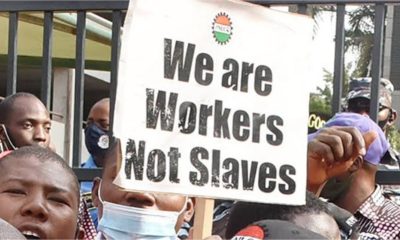




By Michael Lim
The deadly bandit attack on Binnari community in Karim Lamido Local Government Area of Taraba State, with the death toll reportedly reaching 60, the House of Representatives has decried the situation, calling for urgent security and humanitarian intervention.
To stem the tide of attacks and prevent further loss id lives, the lawmakers stressed the need for stronger security cooperation among Taraba, Plateau and Bauchi states.
The appeal followed a motion on the attack, which reportedly occurred on October 23, 2026, leaving dozens dead and residents displaced.
The House called for immediate relief for affected residents and urged the relevant authorities to expedite the completion of the Wase–Karim Lamido road to improve access and security in the area.
The Minority Leader, Fredrick Agbedi, in his contribution, criticised the over reliance on resolutions and minutes of silence in response to recurring security crises, insisting that practical measures to protect lives should be employed.
He called for a technology-driven security response, stressing the need for improved intelligence gathering, surveillance and coordinated operations to confront the attackers.
In his response, the Deputy Speaker cited government efforts to address insecurity, including the neutralisation of terrorists, surrenders by insurgents, a reduction in the number of local government areas under insurgent control and increased spending on security.
The House members’ disagreement underscores the growing wave of humanitarian consequences of repeated attacks in parts of the country and the need for more concrete and coordinated action by federal and state authorities.
The lawmakers further called the relevant agencies to act urgently to restore security, provide relief to victims and prevent further attacks on vulnerable communities.

By Michael Lim
Husband of a nursing mother, Malam Anas, was on Thursday dragged before a Shari’a Court in Kaduna, by his wife, Firdausi Ahmad, who is seeking divorce and the grant of a N10,000 monthly “breastfeeding” allowance.
Malam Sani Sunusi, counsel to the complainant, told the court that his client had been married to Anas for three years and she was nursing an eight-month old daughter.
He further told the court that his client’s husband, asked her to go back to her parents house until he gives her approval to return to their matrimonial home. He continued that:
“Since my client went to her parents, the defendant never checked on her or their eight months old baby.
“My client prays the court to dissolve the marriage through Khul’i and is willing to return his dowry of N100,000.
“He should also pay N10,000 monthly for the baby’s needs and for the eight months that she’ll be breastfeeding her baby.”
The defendant was not in court.
The Judge, Malam Yakubu Abdullahi, adjourned the case until Nov. 11 for the complainant to present her witness or evidence.
Abdullahi directed the registrar of the court to send a letter of invitation to the defendant and ensure that he attends the hearing.

By Seyi Balogun, Lagos
Nigerian fuel consumers would have access to more fuel as more modular refineries are expected to commence operations supplying the public with a combined volume of 83,000 barrels per day, according to Argus Media’s George Maher-Bonnett.
Disclosing this in Lagos on Wednesday during a presentation at the OTL Africa Downstream conference, Maher-Bonnett highlighted the changing dynamics of Nigeria’s petroleum products market amid rising local refining capacity and declining fuel demand.
In his presentation, titled ‘African Energy Outlook’, Maher-Bonnett said four modular refineries operated in Nigeria in September, with a combined capacity of 32,000 barrels per day. In his words, according to the Punch:
“Four modular refineries operating in September, total 32,000 b/d capacity …
“Seven new modular refineries to start next year“ with a total of 83,000 barrels per day”
The projected contribution of smaller refineries jerk up Nigeria’s domestic petroleum products supply.
However, the presentation did not identify the seven proposed refineries, their owners or locations, or provide individual capacity figures and commissioning schedules.
Maher-Bonnett also highlighted the growing role of the Dangote Petroleum Refinery in improving Nigeria’s self-sufficiency in petroleum products, despite a decline in fuel demand during the year.
“Nigerian fuels demand is down this year,” the presentation stated, attributing the development to “higher flat prices.”
He added self-sufficiency is improving with Dangote ramp-up, projecting that modular refineries would play a growing role.
The presentation linked the decline in demand to higher prices and noted that the only government intervention during the period covered was an NNPC price reduction.
“No government interventions, besides NNPC price cut this month,” it stated.
The expected expansion of modular refining capacity comes as Nigeria’s petroleum products market adjusts to increased domestic production and changing international trade flows.
Maher-Bonnett said the Dangote refinery is operating at a high rate, with steady petrol output, reducing the attractiveness of importing some petroleum products from Europe into West Africa.
“Dangote’s 700,000 bpd Lekki refinery is running hard, gasoline output is steady,” the presentation stated.
It also highlighted Ghana’s growing refining capacity, noting that the 45,000-barrel-per-day Tema refinery is ramping up production and improving the country’s self-sufficiency.
According to the presentation, the economics of shipping petroleum products from Europe to West Africa and from Europe to the United States has weakened, with freight costs further affecting the competitiveness of the routes.



N70,000 Divides Nigeria’s Labour As NLC Tells TUC: ‘Negotiate your terms,’
Spread the loveBy Son Tertsea, Abuja Joe Ajaero, President of the Nigeria Labour Congress, NLC, has advised the Trade Union...


As Death Toll of Taraba Massacre Reaches 60: Reps Decry Security Situation
Spread the loveBy Michael Lim The deadly bandit attack on Binnari community in Karim Lamido Local Government Area of Taraba...


Kaduna Nursing Mother Drags Husband to Court Over N10,000 ‘breastfeeding allowance’
Spread the loveBy Michael Lim Husband of a nursing mother, Malam Anas, was on Thursday dragged before a Shari’a Court...

NAFDAC Gets Five-year Jail term for Fake Goya oil Producer
Spread the love–Convicted Aba businessman given ₦5m fine option By Nick Ibe The National Agency for Food and Drug Administration...


Seven Modular Refineries Supply Nigerians 83,000 Barrels of Fuel Daily in 2027
Spread the loveBy Seyi Balogun, Lagos Nigerian fuel consumers would have access to more fuel as more modular refineries are...


For Riding 2.9-Metres-High Bicycle: Young Nigerian Cyclist Enters Guinness Book of Records
Spread the loveBy Michael Lim The Kebbi State Government has commended the display of ingenuity by a young man from...


England: “This is how to take over a nation by soft jihad.”
Spread the loveThe Mayor of London is a Muslim.The mayor of Birmingham is a Muslim.The Mayor of Leeds is Muslim.Mayor...


Africa must be built on African knowledge, by African ingenuity and sustained by African Enterprise
Spread the loveBy Goodluck Ebere Jonathan Today, I joined fellow African leaders and other stakeholders at the closing panel of...
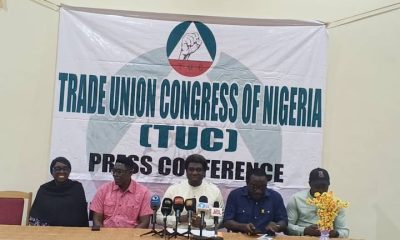

TUC Rejects N70,000 Transport Allowance, Tells FG: We Prefer Salary Increase
Spread the loveBy Nick Ibe, Abuja The Federal Government’s proposed N70,000 transport allowance for six months has been rejected by...


Alleged Assault of Wife: NSCDC Officer Arrested for Shooting at Kubwa Market
Spread the loveBy Isa Abdul, Abuja For alleged sporadic shooting at a market in Kubwa, Abuja, a Deputy Superintendent of...