
General News
Nigerians Lose Savings to Another Ponzi Scheme: PXES


By Our Reporter
Nigerians who invested millions of naira in an online investment platform known as PXES are are in sorrow after the scheme abruptly stopped paying returns and became inaccessible.
The PUNCH reports that the platform stopped paying participants in early September, with investors who committed sums ranging from tens of thousands of Naira to millions left in deep pain, unable to reach the operators.
The collapse has triggered outrage among investors, some of whom stormed and looted PXES offices across the country, particularly in Adamawa and Kogi states, in a desperate bid to recover part of their money.
The platform attracted investors with unusually high daily returns.
According to reports, the platform promised investment returns at between 25 per cent and 50 per cent, with some packages offering as high as 120 per cent.
In Adamawa and Kogi states, aggrieved investors allegedly descended on PXES offices after being unable to withdraw their funds.
Videos circulating online showed people removing chairs, tables and other items from the premises in Yola, while similar scenes were witnessed at the company’s office in Kabba.
In one of the videos, a man who reportedly invested about N209,000 was heard crying and lamenting his inability to recover his money.
The Kabba manager of the platform was said to have earlier sent a message to investors after payments stopped, assuring them that the management would compensate them for their patience.
However, three days after the message was circulated, the company allegedly shut its office, leaving investors with little information about the whereabouts of the operators or the fate of their funds.
How we were scammed – victims
A victim, Bunmi Awodipe, said the decision to invest in PXES was based on the experience of friends who appeared to be making money from the platform.
Awodipe said that three of her friends had shown evidence of receiving returns from PXES, convincing her to put N200,000 into the scheme.
“They told me they invested money in PXES and were receiving their payments. They showed me evidence, so I decided to invest N200,000 and was receiving N7,000 every week. They only paid me for three weeks.
“When I went to their office last week, I didn’t see anyone. The place was locked and there was nothing in the office. Everything was removed,” Awodipe said.
Another investor, Deji Mulero, said he joined the platform after it was introduced to him by a customer.
“It’s one of my customers who introduced this thing to me on September 4. I registered with N65,000 and it crashed the same Friday. That was how I lost my money,” he said.
Another participant, who introduced himself simply as Wale, said he registered with N207,000 and had accumulated almost N600,000 in his account before the platform stopped operating.
A victim Wale said, “Been there for some months. Registered with 207k, now on first stage supervisor. Got close to 600k already on that account. My friend in Abuja introduced the scheme to me.”
For 68-year-old Jumoke Talabi, the investment was intended to provide money for her granddaughter’s school expenses and household needs.
Talabi said she invested N64,800 after seeing other participants receive payments.
She said she had earlier received N70,000 from the platform and subsequently decided to increase her investment.
According to her, she had expected another payment when the platform’s withdrawal period arrived.
“I was meant to collect N18,000 before school resumes, and I thought that I would finish collecting all my profit. But so far, I have not collected any money.
“When they said we should withdraw on Friday, I was dancing. I told my brother that the money did not enter my account, but I was told it would hit my account in the evening. I was looking forward to it. They didn’t even pay me my N64,000. One of my friends doesn’t know what to do or where to go. She has been crying,” she recalled.
Explaining why she took the risk, the grandmother said, “It’s poverty that made me do it. If not poverty, I would not, because the money is meant for school fees. I thought that maybe, I would see some to buy rice and eat.”
Shola Adeshina, whose wife also lost money to the scheme, said that some investors were attracted by claims that relatively small amounts could generate substantial daily returns.
He said his wife initially ignored his concerns about the platform because of the stories of people making money from it.
“Stories of participants using proceeds from the platform to buy cars and build houses further increased its appeal.
“The situation became alarming when a couple who invested millions of naira visited a branch after payments stopped, only to discover that the office had been abandoned,” he said.
How PXES worked
Interviews with participants and promotional materials indicate that PXES operated through a tiered membership structure in which participants paid specified amounts to join and were then given access to an online dashboard.
One participant, Funmi Deinde, said that she withdrew her money before the collapse and explained that the platform had different levels, including Star 1, Star 2 and Star 3.
According to her, members were given access to a dashboard through which they completed daily tasks described as orders.
“If you’re on Level Star 1, so to say, it is about N21,600. Then Star 2 is N54,800. Star 3 is N207,000.
“When you join with this money, you have an account, a dashboard that you’ll be taking orders from every day,” she said.
Deinde explained that products, including household items, were displayed on the dashboard for participants to interact with.
She compared the process with ordering products on e-commerce platforms such as Temu and Jumia, although participants did not physically receive the goods.
“When you click ‘Order’, they will highlight some of the things that you should be clicking. Household properties will be highlighted there.
“The money that you used to register has secured you a place as a member. So, you now have access to take orders every day,” Deinde said.
According to Deinde, the platform initially allowed members to withdraw their earnings daily, with withdrawals later changed to weekly as the number of participants increased.
“Initially, every day, you can withdraw whatever you want to withdraw. The least withdrawal was N1,500, N5,000, N20,000, N100,000 and so on,” she added.
Deinde noted that withdrawal days were subsequently assigned according to the different membership levels.
Another investor, Emmanuel Ajayi, said a N64,000 package generated about N2,160 from the daily tasks, while a N21,600 package generated about N720.
The materials claimed that N21,600 could generate up to N259,200 over 360 days, while N64,800 could generate up to N777,600 within the same period.
The claims represented returns many times the original amounts invested.
Participants also said members could introduce new people to the platform and build networks.
A security guard (name withheld) who invested N64,000 said he was initially reluctant to join after his sister introduced the scheme to him.
He eventually invested after repeated persuasion and said he withdrew about N20,000 twice before losing the balance when the platform stopped paying.
He said his sister, who had built a larger network on the platform, lost more than N1m.
Investment or digital marketing?
The description of PXES by its representatives raises questions about the nature of the business and the source of the money used to pay participants.
At a recent event in Kabba, PXES representatives described the organisation not as an investment platform but as a digital marketing and advertising company.
A company representative, Olubowale Ayodele, told participants that PXES provided digital marketing opportunities to unemployed people and graduates.
“It’s a job that once you are doing it, we promote others; we promote brands from clients that have been giving to our company,” he said.
Ayodele urged unemployed people and graduates to use their smartphones to participate in what he described as digital marketing work.
“If you know you are a graduate, if you know that you are unemployed, or if you know that you just have your smartphone, use it to do this digital marketing work because it works,” he stated.
He also claimed that one member of his team was receiving N700,000 weekly.
“By God’s grace, I have got somebody even out of my team that is receiving 700,000 weekly as salary,” Ayodele said.
Another PXES official, identified as the company’s training director, Eniola Oluwatobi, described the company as an advertising firm.
“This is an advertising company. They partner with eBay and Amazon; those people give them, and PXES give us to advertise for them,” he said.
According to him, products were distributed to members through the PXES application for advertising.
“So, the PXES distributes those products to us to advertise for them through their app. So, by doing that, people are seeing the products,” Oluwatobi added.
At the same Kabba event, the Obadofin of Oweland, Olusegun Are, described PXES as an income opportunity.
“PXES is a very laudable programme that will help all of us in Nigeria to have another stream of income,” he said.
The traditional ruler also claimed that PXES had provided food items to more than 300 elderly people in Kabba.
Questions over authorisation
The collapse has also raised questions about whether the platform was authorised to solicit investment funds from members of the public.
A financial analyst, George Samuel, said prospective investors should establish whether an organisation was authorised to collect deposits or solicit investment funds before putting money into it.
He said registration with the Corporate Affairs Commission did not by itself authorise a company to accept investment funds from members of the public.
“While a Corporate Affairs Commission number may be necessary, it does not serve as a licence to accept deposits or investment funds,” Samuel said.
“Avoid depositing or investing with any unlicensed firms. They are required to display their licence in their office, so ask or look for that SEC licence and do basic due diligence,” he added.
Samuel said institutions taking deposits and those offering investments were subject to regulatory requirements and urged Nigerians to verify the relevant licence before investing.
A banker, Kemi Junaid, also identified promises of unusually high returns and guaranteed profits as major warning signs.
“Financial desperation and poor financial literacy often made people vulnerable to schemes promising quick and substantial returns.
“Prospective investors should question how an organisation intends to generate the returns it promises rather than relying on testimonials from other participants,” she said.
Report investment scams — EFCC
Meanwhile, the Economic and Financial Crimes Commission said it would investigate reported cases of financial crimes and investment scams brought before it.
The EFCC spokesperson, Dele Oyewale, said that the commission would act where complaints were formally reported.
“Any issue of financial crime, Ponzi scheme, investment scam that is duly reported to the EFCC, the commission will look into it. But it must be duly reported,” Oyewale said.
He recalled that the commission had repeatedly warned Nigerians against investment scams.
“As a form of reminder, the commission has issued several advisories against investment scams and Ponzi schemes. And we will continue to advise members of the public on doing due diligence before going into investment,” Oyewale said.
He added that the commission remained committed to preventing financial crimes and protecting members of the public from avoidable losses.
“But as an anti-corruption agency, we are unrelenting in our operational and preventive modalities to ensure that members of the public are shielded from all of these avoidable losses,” Oyewale said.
The EFCC spokesperson, however, did not confirm that the commission had opened an investigation specifically into PXES.
A recurring cycle
The PXES crisis is coming less than two years after a series of investment schemes left Nigerians counting losses after promising unusually high returns.
In April 2025, the collapse of Crypto Bridge Exchange, popularly known as CBEX, triggered one of the biggest recent Ponzi-related crises in Nigeria.
No fewer than 600,000 Nigerians reportedly invested in CBEX, with losses put at about N1.3tn.
The platform had promised investors 100 per cent returns after 30 days through purported artificial intelligence-powered trading.
The Securities and Exchange Commission subsequently said CBEX and its affiliates had never been registered to operate as a digital asset exchange or solicit investments from the Nigerian public.
The commission said its preliminary investigation showed that the platform created a false perception of legitimacy and promised “implausibly high guaranteed returns” within a short period.
The collapse also prompted the EFCC to investigate the scheme.
By July 2025, the commission said some promoters had been arrested and that recovery and forfeiture proceedings were underway.
Barely six months later, another platform, EMAAR, reportedly collapsed after attracting more than 4,000 investors with promises of returns from supposed real estate investments.
PUNCH investigation published in December 2025 found that the platform had operated largely online, with its promoters using Telegram groups to recruit and communicate with investors.
The platform crashed on October 27, 2025, with victims unable to withdraw their funds. Subsequent reports put the suspected losses at nearly N3bn.
In May 2026, another investment platform, XM Future Music Group, reportedly crashed after investors were unable to withdraw their funds.
Victims subsequently stormed its office in Badagry, Lagos State, and reportedly carted away generators, chairs, fans, televisions and other office equipment.
The platform had reportedly promised participants returns for listening to music and completing online tasks, with entry packages ranging from N21,600 to several million naira.
The repeated pattern of aggressive recruitment, early payments, promises of exceptional returns, referral incentives, withdrawal problems and eventual collapse has become familiar to Nigerians.
An attempt to access the platform’s known website, https://www.pxesng.com/, was unsuccessful.
It was also gathered from some investors that the platform’s WhatsApp channel had been blocked.
Checks on its Facebook page, PXES NG, showed that its last post was made on June 21.
A review of the page showed that it was largely used to publicise training sessions and meetings for participants, including offline sessions organised to train them on team building and how to maximise their earnings.
The page also served as an interface between the platform and participants, with posts highlighting PXES’ activities and its claimed expansion across Nigeria and other parts of Africa.
In some of its posts, the platform claimed to have impacted more than one million members through financial stability and welfare support.

The Mayor of London is a Muslim.
The mayor of Birmingham is a Muslim.
The Mayor of Leeds is Muslim.
Mayor of Blackburn – Muslim.
The mayor of Sheffield is a Muslim.
The mayor of Oxford is a Muslim.
The mayor of Luton is a Muslim.
The mayor of Oldham is Muslim.
The mayor of Rochdale is Muslim.
All this was achieved by only 4 million Muslims out of 66 million people in England:
Today, there are over 1800 mosques in England.
There are over 80 sharia courts.
There are more than 50 Sharia Councils.
78 percent of Muslim women do not work, receive state support + free accommodation.
A large percentage of Muslims do not work and receive state support + free housing.
State-supported Muslim families with an average of 3 to 8 children receive free accommodation.
Now, every school in the UK is required to teach lessons about Islam.”
- Johann P @JohannPbooks
By Nick Ibe, Abuja
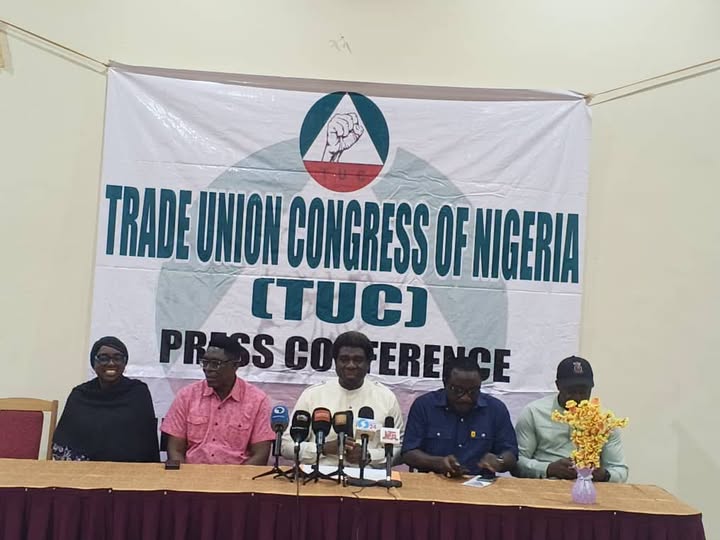
The Federal Government’s proposed N70,000 transport allowance for six months has been rejected by the Trade Union Congress of Nigeria, TUC, with the union demanding an immediate salary increase for workers and the implementation of outstanding agreements with health workers under the Joint Health Sector Unions.
The congress insisted that temporary wage awards were inadequate to address the worsening economic hardship confronting Nigerian workers, arguing that the government should increase salaries rather than introduce relief measures that might not be implemented consistently.
The TUC further accused the Federal Government of failing to fulfil its 2023 wage award obligations to some workers and neglecting a seven-month-old agreement on the adjustment of the Consolidated Health Salary Structure for health workers under JOHESU.
The congress made its position known in a statement issued on Wednesday by its President, Festus Osifo, and Secretary-General, N.A. Toro, following a National Administrative Council meeting held in Abuja on October 8, 2026.
According to the statement, the congress had written to the Federal Government through the Office of the Secretary to the Government of the Federation, demanding an immediate salary review in response to rising living costs.
The TUC argued that the government did not need to wait for negotiations on the national minimum wage before increasing workers’ salaries, noting that there was no legal ceiling on how much employers could pay their workers.
It said, “The Federal Government should review increasing workers’ salaries. This was hinged on the fact that the government does not require the minimum wage to be negotiated before increasing workers’ pay, as there is no maximum wage law in the country.”
The Congress proposed that the Federal Government could raise the salary of the lowest-paid worker to N300,000 from the current N70,000 and apply the appropriate consequential adjustments to other salary levels.
It maintained that while negotiations on the national minimum wage remained important, they should not be used as a reason to delay urgent salary increases for workers struggling with rising food, transportation, healthcare and other essential expenses.
The TUC said its leadership had held consultative meetings with government officials, including the Secretary to the Government of the Federation, during which it rejected the proposed wage award.
Explaining its opposition, the congress said the previous wage award negotiated in October 2023 had not been fully implemented, raising concerns about the credibility of another temporary arrangement.
“The wage award agreed between FGN and organised labour on the 2nd of October 2023 was to be implemented until a minimum wage was agreed in 2024 but was never implemented holistically,” the statement said.
It added that some workers were still being owed one or two months’ payments, while others had not received the allowance at all.
The Congress also alleged that workers who received the award did not always get their payments monthly, with some experiencing intervals of one or two months and having to make repeated demands before receiving their entitlements.
It further claimed that more than 80 per cent of states and workers in the informal sector had not benefited from any form of wage award.
“How do we go back to the same wage award that never benefited all workers? How can workers be expected to trust fresh promises when previous obligations remain outstanding?” the TUC asked.
The congress insisted that a permanent salary increase would provide more dependable relief than temporary allowances, which it said had failed to reach workers uniformly.
It stated, “Negotiations of a new national minimum wage must not become an excuse for postponing urgent pay increment.”
Beyond salary increases, the TUC called on federal, state and local governments to introduce measurable interventions to reduce the cost of essential goods and services.
It urged the authorities to ensure timely payment of salaries and pensions, protect existing jobs, curb exploitative labour practices and revitalise the productive sector to create decent employment.
The congress said economic hardship was not limited to federal workers but also affected state and local government employees, pensioners, private-sector workers and people in the informal economy.
It called for adequately funded interventions with clear implementation timelines, arguing that government announcements must translate into tangible improvements in the living conditions of Nigerians.
JOHESU agreement remains unimplemented
The TUC also accused the Federal Government of failing to honour an agreement reached with the Joint Health Sector Unions after months of industrial action.
According to the congress, its President, Osifo, led a delegation of organised labour, including JOHESU leaders and a representative of another labour congress, in negotiations aimed at resolving the dispute.
The negotiations culminated in a conciliation meeting at the Federal Ministry of Labour and Employment, where both parties agreed to a communiqué.
The Federal Government delegation was led by the Minister of Labour and Employment, Dr Muhammad Maigari Dingyadi, alongside the Coordinating Minister of Health and Social Welfare, Prof Muhammad Ali Pate, and the then Minister of Finance and Coordinating Minister of the Economy, Wale Edun.
The TUC said JOHESU suspended its industrial action in good faith after the agreement was signed, but accused the government of failing to fulfil its own obligations.
It said the agreement provided for the resolution of outstanding issues relating to the adjustment of the Consolidated Health Salary Structure, known as CONHESS.
However, the congress alleged that seven months after the agreement, the adjustment remained unimplemented.
“While the workers have kept their side of the bargain, the government hasn’t kept its side of the agreement,” the statement said.
The TUC described the delay as a breach of the principle of good faith, warning that failure to honour agreements could undermine confidence in collective bargaining between the government and organised labour.
It demanded the immediate implementation of the CONHESS adjustment, publication of a clear implementation timetable, provision of the necessary budgetary allocations and resolution of all outstanding issues in consultation with the relevant unions.
The congress said health workers should not be expected to continue delivering essential services while commitments made to them remained unfulfilled.
“The TUC demands tangible action, not further assurances,” it said, pledging to stand with affected unions and pursue lawful measures to compel the government to comply with the agreement.
The congress reiterated that workers were not seeking favours but demanding improved living conditions and respect for their rights.
“Workers’ welfare is not a privilege. Agreements must be honoured. Workers’ rights must be respected. Government must comply,” the statement added.
The TUC said it was awaiting the outcome of its scheduled meeting with the Federal Government before deciding on its next line of action.
The dispute comes against the backdrop of Nigeria’s prolonged cost-of-living crisis, which has intensified pressure on organised labour to secure higher wages and measures to protect workers’ purchasing power.
In July 2024, President Bola Tinubu signed the new national minimum wage law, raising the statutory minimum monthly wage from N30,000 to N70,000 following negotiations between the Federal Government and organised labour.
The agreement followed months of disagreements over the amount workers should earn amid the effects of the removal of petrol subsidy and other economic reforms on transportation, food and household expenses.
Organised labour had initially demanded a substantially higher minimum wage, while the government and employers raised concerns about the ability of employers, particularly state governments and businesses, to meet the proposed increases.
The resulting N70,000 minimum wage established a new statutory floor for eligible workers, but it did not automatically resolve demands for adjustments to salaries across different grades or address the broader rise in the cost of living.
The 2023 wage award was introduced as an interim relief measure during negotiations over the new minimum wage. The TUC’s latest statement renews concerns about the implementation of that arrangement and argues that future relief should be structured around permanent salary increases.
The JOHESU dispute represents a separate but related challenge involving remuneration and the implementation of agreements in the health sector. The union’s demands over CONHESS have been a source of industrial tension, with the latest TUC statement accusing the government of failing to implement the adjustment covered by the settlement.
The congress did not announce an immediate nationwide strike in its statement but said it would determine its next steps after receiving the outcome of its scheduled meeting with the Federal Government.

By Isa Abdul, Abuja
For alleged sporadic shooting at a market in Kubwa, Abuja, a Deputy Superintendent of Corps with the Nigeria Security and Civil Defence Corps (NSCDC) has been arrested by the Federal Capital Territory (FCT) Police Command.
The police said a pistol and 17 rounds of live 9mm ammunition were recovered from the suspect, identified as Onoja Samuel.
The command’s spokesperson, SP Josephine Adeh, said the incident occurred at about 1:50 p.m. on October 25, 2026, following a distress call reporting that a man armed with a pistol was firing into the air at the market.
Adeh said operatives attached to the Kubwa Police Division were promptly deployed to the scene and, after concerted efforts, disarmed and arrested the suspect.
“Preliminary investigations identified the suspect as one Onoja Samuel, a Deputy Superintendent of Corps with the Nigeria Security and Civil Defence Corps (NSCDC),” she said.
According to the police, preliminary findings indicated that the suspect went to the market armed with a pistol following reports that some traders had assaulted his wife.
“During an ensuing argument with the traders, he fired several shots into the air,” Adeh said.
She added that the suspect remained in police custody and would be charged to court after the conclusion of investigations.
The Commissioner of Police in the FCT, CP Ahmed Muhammed Sanusi, urged personnel of sister security agencies to exercise restraint and notify the police divisions responsible for areas where they intend to conduct authorised operations within the territory.
The command said the measure was necessary to improve operational coordirnation and prevent avoidable clashes.
Residents can contact the FCT Police Command on 08032003913 or 08061581938 for emergencies.



England: “This is how to take over a nation by soft jihad.”
Spread the loveThe Mayor of London is a Muslim.The mayor of Birmingham is a Muslim.The Mayor of Leeds is Muslim.Mayor...


Africa must be built on African knowledge, by African ingenuity and sustained by African Enterprise
Spread the loveBy Goodluck Ebere Jonathan Today, I joined fellow African leaders and other stakeholders at the closing panel of...

TUC Rejects N70,000 Transport Allowance, Tells FG: We Prefer Salary Increase
Spread the loveBy Nick Ibe, Abuja The Federal Government’s proposed N70,000 transport allowance for six months has been rejected by...


Alleged Assault of Wife: NSCDC Officer Arrested for Shooting at Kubwa Market
Spread the loveBy Isa Abdul, Abuja For alleged sporadic shooting at a market in Kubwa, Abuja, a Deputy Superintendent of...


Court Jails FCDA Official 25 Years for Land Racketeering
Spread the loveBy Nick Ibe, Abuja A staff of the Federal Capital Development Authority, FCDA, Kinsley Eselebor, has been convicted and...


FG Gives Workers N70,000 Monthly Transport Support for Six Months
Spread the loveBy Nick Ibe, Abuja To cushion the harsh impact of rising living costs, the Federal Government has approved...


Trump and the 95-year Mother: Government That Cares for All Citizens
Spread the love“Trump… Please bring my son back to me. I am begging you for mercy.” And what Trump did...


Probe Panel Says Heat, Dehydration Killed 33 Detained Niger Miners
Spread the love–Calls for NSCDC reforms, compensation for victims By Son Tertsea, Abuja Dehydration was cause of the death of...


Tinubu Seeks Law To Bring Back Nigerians Jailed Abroad
Spread the loveBy Felix Umande President Bola Ahmed Tinubu has transmitted a bill to the Senate seeking to empower the...

Senate Says: Travel Agencies, Short-let Apartments Need Closer Scrutiny in Human Trafficking Probe
Spread the loveBy Isa Abdul, Abuja As part of efforts to dismantle trafficking networks and protect Nigerians from exploitation abroad,...