
Article
I Stand With the Catholic Bishops’ Conference of Nigeria (CBCN) on their Pastoral Visit to the President of the Federal Republic of Nigeria


By Timothy Dokpesi AdidiDear Church Fathers,
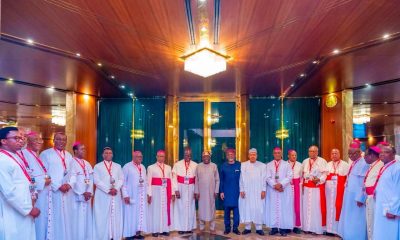
You have once again rekindled the hope of the Church. I am writing this open letter to you as a member of the Catholic community in Nigeria and a product of the Church. I am writing this letter not out of sentiment (although it will be interpreted as such) but out of a burning desire to put in perspective what the Catholic Church stands for. Your visit to President Bola Ahmed Tinubu of the Federal Republic of Nigeria was not necessarily political, as understood and misinterpreted. The joy of this visit lay in the collegial dimension it took on. It really brought out the beauty of the Catholic Church as known in the era of the Church Fathers through the ages. Your voice represented the old long saying, ‘Roma locuta est, causa finita est’ (Rome has spoken and the case is finished). A saying that comes from an early fifth-century sermon by Saint Augustine of Hippo, who stated, “The two councils sent their decrees to the Apostolic See, and the decrees quickly came back. The cause is finished.”
Your Excellencies, the visit was indeed timely and necessary. It reflects the unity and oneness of the Catholic Church. This was quite different from the usual ‘one-man squad,’ which sometimes confuses the true nature and identity of the Catholic Church. The visit you had definitely puts an end to the difference between when one speaks from the church and for the church. Your voice has changed the narrative in the nation’s political landscape, and these changes have given the Church a ray of hope in the current economic realities that confront the poor. Your Excellencies, you have also brought to the limelight the Catholic Social Teachings (CSTs). It has become very obvious that the CSTs are not theoretical; they are alive and impactful.
More so, in this regard, you have also reiterated and unraveled the concept of the Church as the Family of God, which was famously highlighted and formally adopted as the guiding pastoral image for the Church in Africa during the “Special Assembly for Africa of the Synod of Bishops” in 1994 and subsequently promulgated by Pope John Paul II in his post-synodal apostolic exhortation, “Ecclesia in Africa” (1995). As the President of the CBCN, Most Rev. Dr. Matthew Man-Oso Ndagoso was reading the mind of the Church; I truly see what the Catholic Church represents.
The Church is known to be non-partisan. This nonpartisan dimension of the Church is indifferent to the realities that characterize the membership of political parties that reside in the Catholic community.
The Catholic Church represents the true Body of Christ but does not belong to any political party. Hence, it underscores the fact that it is this nature of the Catholic Church that gives it the prerogative to speak truth to power. Your Excellencies, you indeed spoke truth to power. It reminds me of the draconian days of Sani Abacha when the likes of Bishop Matthew Hassan Kukah (then Fr. Kukah) and Fr. George Ehusani spoke truth to power as they constantly used the Catholic Secretariat to engage the military government.
Your Excellencies, you have done what you ought to do, and the world has seen your significant effort in calling a spade a spade. Your message defied any form of diplomacy and corporate negotiation. It was firm and without fear of intimidation. The gleaming red buttons and the red colors on your cassock reflect your acceptance of the consequences of your position you were ready to take. You were ready to die for the sake of the truth. You were ready to become martyrs for the sake of the members of the Catholic community and all of Christendom, knowing full well that the blood of martyrs is the seed of Christianity. You took the risk to surrender your lives like the Good Shepherd who laid down His life. This you have done for Nigeria and Nigerians. It is also important to know that you have done this not for the Catholic community alone; you have added your voice to liberate Nigerians and Africa by extension. You have set the path for economic recovery.
It is indeed worthwhile to know that the Prophetic mission of the faith is very much alive. Again, you have re-echoed the true understanding of prophecy in Ancient Israel. Your prophetic voice stands out against the misunderstanding of Biblical prophecy. A prophet is not a soothsayer, nor is he a prognosticator, neither is he person who forecast the future. A prophet is a mouth piece of God; he is one who addresses the socio-economic and political condition of his time and addresses the ill; thereby warning the leaders to do what is right or else face the wrath of God. You have issued a warning to the leaders of our time. May they take heed and let no one lead them astray.
On this note, I commit myself to the fidelity of the faith as seen in the Catholic Social Teachings and as deposited in the authority of your mission as Fathers of the Faith. In so doing, I renew my baptismal promises to align with the Faith that was handed over to you through the apostles. May your faith in the teachings that were handed down to you through the Apostles be constantly renewed and reinvigorated.
By Timothy Dokpesi Adidi, PhD






By Harira Najeem
Democracy is not a loyalty test. Supporting President Tinubu does not mean surrendering the right to reject the APC governorship candidate or any other party candidate in Nasarawa State.
Therefore, Governor Abdullahi Sule’s declaration during the inauguration of the Presidential and Nasarawa State Campaign Council Advisory Committee at the Government House, Lafia, that anyone who truly loves President Bola Tinubu should also vote for Senator Ahmed Aliyu Wadada and all APC candidates in 2027 raises a fundamental question about democratic freedom: must support for one politician, automatically, translate into support for everyone wearing the same party’s colours?
Speaking during the inauguration of the Presidential and Nasarawa State Campaign Council Advisory Committee in Lafia, Sule urged APC supporters to vote for Tinubu, Wadada and all party candidates. He argued that electing an APC governor alongside APC lawmakers would make it easier to implement government programmes.
But political convenience is not a democratic commandment, and party loyalty must never take precedence over the people’s right to choose.
Tinubu is not Wadada, and Wadada is not Tinubu. They are different candidates seeking different offices, with distinct responsibilities and agenda. Voters may support Tinubu’s policies at the federal level while preferring another candidate to govern Nasarawa. They may equally support Wadada while disagreeing with Tinubu’s performance. Both choices are legitimate.
Under Nigeria’s presidential system, candidates contest distinct offices and are expected to present their own programmes, records and policy positions. This differs from the parliamentary system, where government formation and survival are more directly tied to legislative majorities and party confidence.
Even under a presidential system, cooperation between the executive and legislature matters. However, cooperation does not require every elected official to belong to the same party, nor does it justify pressuring voters to cast uniform ballots.
The argument that an APC governor needs APC lawmakers to perform effectively is, at best, incomplete. Good governance depends on competence, accountability, negotiation and a shared commitment to public welfare—not simply party membership. Expectedly, legislators must represent their constituents, scrutinise government spending and challenge policies that harm the people, regardless of party affiliation.
Indeed, a legislature that merely rubber-stamps the governor’s decisions could weaken accountability rather than strengthen governance.
Nasarawa voters have pressing concerns: insecurity, unemployment, inadequate healthcare, struggling schools, poor infrastructure and the rising cost of living. They deserve candidates who can explain how they intend to address these problems, not political leaders who reduce voting to a test of loyalty to Tinubu or the APC.
Calling on citizens to vote for candidates from one party is legitimate political campaigning. But presenting such conformity as proof of genuine love for a leader becomes troubling when it delegitimises independent choices or encourages political intimidation. Democracy thrives on persuasion, not coercion; competition, not compulsory allegiance.
The ballot belongs to the people, not the party.
If Tinubu deserves another term, his supporters should convince Nigerians through his record and promises. If Wadada deserves to govern Nasarawa, he must earn the confidence of Nasarawa voters on his own merits.
Voters must be free to support Tinubu, Wadada, both or neither. The real test of political leadership is not whether citizens vote in one party’s colour, but whether their choices deliver security, jobs, better public services and a dignified life.
In 2027, the people of Nasarawa must vote with their eyes open, their conscience clear and their future in mind—not under the pressure of political loyalty tests.

By Bulama Bukarti
On May 5, 2026, the High Court of Borno State sitting in Maiduguri convicted Mrs Lami Samuel Dawa, a primary school teacher, and sentenced her to 14 years’ imprisonment.
On Saturday, October 31, the Christian Association of Nigeria, through its President, Archbishop Daniel Okoh, said the case raised questions about religious freedom and constitutional rights. CAN said it was particularly concerned by reports that the case arose from the conversion of an adult woman to Christianity.
Online, the story has hardened further: headlines now say a Christian woman was jailed for sharing her faith, or for converting a Muslim woman in Gwoza.
I understand why that narrative travels. Nigeria has a long, painful history of religious grievance and tension, and it seeps into almost every public issue. I also want to credit Archbishop Okoh for something many who are sharing his statement have skipped: he said plainly that the precise facts and legal basis of the conviction were still being verified. That was the right instinct. I have done that verification. I have read the full judgment and the certified record of proceedings in The State v. Lami Samuel Dawa & 5 Ors (BOHC/MG/CR/154/2025). With respect, the record tells a different story.
This is a case about a child, not a creed.
The premise of CAN’s concern is that an adult chose a new faith and was punished for it, or someone was punished for helping her. Every adult in Nigeria has that right and I would defend it without hesitation. But that is not this case.
The person at the centre of this trial is a girl. She told the court she was born in 2009, that she was 13 when she was first abducted, converted and taken to Jos, and 16 when she testified in December 2025. Her mother gave the same ages. The defence did not establish otherwise. The events happened in Maiduguri, not Gwoza. She was a minor at every stage that matters, which is why the charges were brought under the Borno State Child Protection Law.
Once that single fact is restored, the whole picture changes. The question is no longer whether an adult may change her religion. It is whether an unrelated adult may secretly take someone else’s child away from her parents. No legal system in the world, religious or secular, answers yes.
I will not name the girl. She is a child, and the online campaign has already exposed her far more than any child deserves. But her story, as the court heard it, deserves to be told plainly.
After her first disappearance and return, her mother asked a trusted neighbour, Mrs Dawa, to help re-enrol her in school. By the girl’s sworn account in court, Mrs Dawa then told her that her own parents were plotting to kill her. She asked the girl to hand over the N20,000 her mother had given her for WAEC registration. She gave her a phone and a SIM card. On the appointed day, she met the girl on Baga Road, had her change out of her school uniform in a chemist into clothes belonging to Mrs Dawa’s own daughter and put her in a car bound for Jos.
Midway, the girl testified, Mrs Dawa called her to say the search for her was intense and that she should get off at Bauchi, where a man would collect her. She stayed with him for three days until, in Mrs Dawa’s words as recounted, things had calmed down. Mrs Dawa later visited her in Jos with gifts and N15,000. Nine sets of clothes she gave the girl were tendered in court.
All the while, the girl’s mother was searching for her daughter. She told the court she sold her belongings to pay for spiritual help, and that Mrs Dawa was among those who bought them. When the mother asked about her daughter, Mrs Dawa said nothing of where the girl was. She simply told her to be patient, assuring her that the girl would return.
This was not merely the girl’s word. Mrs Dawa’s own statement to investigators, Exhibit B, admitted in evidence without objection from her counsel, acknowledged giving the SIM card, visiting the girl in Jos and not telling the family where she was. In the witness box, the court found, her defence dwelt on her good relationship with the family rather than answering the specific allegations.
If this were a religious witch-hunt, it was a remarkably poor one. Six people were charged. Three of the five who stood trial, all Christians, walked free.
The court acquitted Binta Mamman Sasuwa and Esther Simon, who received the girl in 2022, because nothing showed they knew she had been taken from her parents. It acquitted Mrs Dawa’s own husband, Amos Suleiman. It threw out the conspiracy count against everyone.
A court bent on punishing Christianity does not carefully separate the guilty from the innocent along the lines of proof. This one did.
Mrs Dawa was convicted under the Borno State Penal Code Law 2023 and the Borno State Child Protection Law 2021. Both apply to every resident of the state, whatever their faith. The sentences attach to three counts: enticing a child away from her parents, removing her from lawful custody, and depriving her of schooling. None of them punishes anyone for being a Christian, for worshipping or for sharing their faith.
The court’s reasoning on religion turned on a principle found in the federal Child’s Rights Act and mirrored in Borno’s own law: a child has freedom of thought, conscience and religion, exercised with the guidance of her parents or guardians. That principle protects Christian children in Muslim neighbourhoods exactly as it protects Muslim children in Christian ones. What it forbids is an unrelated adult secretly overriding a family and spiriting a minor hundreds of kilometres away.
One more fact has been lost in the noise. The girl’s mother was born a Christian, and her grandmother and other relatives remain Christians to this day. This is not the story of a Muslim family persecuting a Christian daughter. It is the story of a mother who, for more than a year, did not know whether her child was alive.
Swap the labels and the answer is obvious. Had a Muslim teacher spirited her Christian neighbour’s 15-year-old to an Islamiyya in Kano behind her parents’ backs, CAN would rightly condemn it, and I would stand with them. What is a crime against a Christian child is a crime against a Muslim child.
Much of the outrage centres on the 14-year term, so the arithmetic matters. Mrs Dawa was convicted on three counts and sentenced to 14, 14 and 10 years respectively. The court had the discretion to order those terms to run consecutively, one after the other. Had it done so, she would be facing 38 years in prison.
It did not. After she pleaded for leniency in her allocutus, the court ordered all three sentences to run concurrently. She will serve 14 years in total, no more than the longest single term. Of the options open to it, the court chose the lighter one.
That is why I am troubled by the abuse now being directed at the trial judge, Hon. Justice A. B. Kumalia, much of it from people who have not read a line of the judgment. Judges cannot step into the arena to defend themselves; convention rightly keeps them silent. It therefore falls to the rest of us to set the record straight. On this record, His Lordship weighed the evidence carefully, acquitted wherever the proof fell short and tempered the sentence with restraint. That deserves commendation, not insult.
None of this means the judgment is beyond criticism. Lawyers may reasonably debate aspects of the court’s reasoning. An appeal has now been filed and the Christian Lawyers Fellowship of Nigeria, which defended Mrs Dawa at the trial, will rightly press every point it can. That is how it should be. I welcome CAN’s commitment to letting the judicial process run its course, and I would defend Mrs Dawa’s right of appeal as firmly as I defend the basis of her conviction.
What is not legitimate is to recast a carefully argued criminal judgment, one that acquitted most of the Christian defendants, as a sectarian assault. Doing so inflames a region that has paid in blood for exactly this kind of mistrust. It also teaches Nigerians that courts are to be trusted only when they rule for our side.
I appeal respectfully to the leadership of CAN, and to everyone sharing this story, to read the judgment before amplifying claims about it. Keep the girl’s identity out of it. Let the appellate process take its course. And let us hold one standard for every child in Nigeria, whatever their faith: no adult, however well-meaning they believe themselves to be, may secretly take a child from her parents.
That is not persecution. It is the law doing exactly what each of us would demand of it if the child were our own.
Dr Bukarti is a lawyer called to the bars of Nigeria and of England and Wales and a lecturer in International Law and Jurisprudence at Bayero University Kano
Article
Africa must be built on African knowledge, by African ingenuity and sustained by African Enterprise

By Goodluck Ebere Jonathan
Today, I joined fellow African leaders and other stakeholders at the closing panel of the 12th Tana High-Level Forum, in Bahir Dar, Ethiopia, where we exchanged perspectives on advancing the geopolitical and economic transformations needed to move our continent forward.
For Africa to achieve sustainable growth, economic sovereignty and robust industrialisation that create productive opportunities for our teeming youth, we must deliberately invest in research-intensive universities which serve as factories for producing knowledge. They are special educational institutions, centres of research, innovation and advanced skills where knowledge is transformed into productive enterprise.
The experiences of countries such as India, Singapore and South Korea, demonstrate the importance of building strong technological and scientific capabilities to drive industrial development, nurture innovation and create globally competitive economies.
Africa must therefore move beyond being primarily a consumer of technology developed elsewhere to becoming a creator, producer and exporter of technology, knowledge and innovation. This requires sustained investment in science, engineering, digital technologies, applied research and the close collaboration of our universities, industries and governments.
Our young people must be equipped not merely to participate in the global economy, but to shape it through their ingenuity, enterprise and capacity to develop homegrown solutions to Africa’s development challenges.
Africa’s transformation and economic sovereignty must be built on African knowledge, driven by African ingenuity and sustained by African enterprise.
-Jonathan is former Nigerian President



PERSPECTIVE: Tiv Leaders Must Hear This: While Akwa Ibom Asked For A Future, Tiv Leaders Fight Over A Man
Spread the loveBy Edward Tion I watched the presidential campaign in Akwa Ibom today with a bleeding heart. Not because...

Pursue Unity, Peace, Play Active Role in Nigerian Politics, Deputy Speaker, Kalu Urges Igbo Elites, Leaders
Spread the loveBy Saint Mugaga Deputy Speaker of the House of Representatives, Rt. Hon. Benjamin Kalu has called on Igbo...


2027: Amupitan Seeks Royal Support, Partnership to Discharge Mandate Peacefully, Effectively
Spread the loveBy Isa Abdul The National Chairman of the Independent National Electoral Commission (INEC), Professor Joash Amupitan, has said...


Place 7-Year Ban On Establishment Of New Tertiary Institutions– Edu Minister Begs NASS
Spread the loveBy Son Tertsea, Abuja The Federal government has appealed to the National Assembly to halt the passage of...

Gov Sule to Security Agencies: Fish Out Sponsors of VP Shettima’s Attackers in Lafia
Spread the loveSDP: attackers APC members against Wadada’s candidacy By Isa Abdul, Abuja Prominent personalities in the state planned and...


Wike’s Entry, Allocation of UniAbuja Land a Breach of Court Order– ASUU
Spread the loveBy Nick Ibe, Abuja The Federal Capital Territory Administration’s (FCTA) allocation of some hectares of land belonging to...


Alleged 4 Herbal Concoction Consumers Die in Benue
Spread the loveBy Vincent Tyosuugh After consuming a suspected poisonous herbal concoction allegedly sold to residents of Oju Local Government...


BENUE APC Split Deepens As SGF, Stakeholders Shun Alia Campaign Flag-off, Disown Campaign List
Spread the loveBy Felix Umande The crisis rocking the Benue State chapter of the All Progressives Congress (APC) deepened on...


Defence Minister Invites Cybersecurity, Drone, DefenceTech Experts for Collaboration with DICN
Spread the loveBy Nick Ibe, Abuja Minister of Defence, General Christopher Musa (rtd) has called on Nigerians with expertise in...


Wike’s Rainbow Coalition Faces Storm Over Alleged Split Voting: VP Shettima, SDP, Ondo APC Reject Coalition
Spread the loveBy Son Tertsea, Abuja Nyesom Wike’s Rainbow Coalition has been identified as a split voting device according to...