
Judiciary
Court Fines Plaintiff N1m Over Suit to Bar Jonathon from 2027 Election

Friday in Abuja, Justice Peter Lifu of the Federal High Court frowned at the attitude of Johnmary Jideobi, the plaintiff, and his lawyer, Ndubuisi Ukpai, for their lack of diligence in pursuing a suit filed to bar former President Goodluck Jonathan from contesting the 2027 presidential election.
The judge described the delay tactics of both the plaintiff and his lawyer, which have been instrumental in delaying proceedings in the case as “unacceptable.” Consequently, he imposed a fine of one million Naira against the plaintiff, to be paid to former president Jonathan.
“I have carefully and painstakingly considered all the submissions and prayers of the learned counsel in this matter. As this court has earlier ruled and ordered, this case has a character of politics. I have taken judicial notice of the timetable of the Independent National Electoral Commission (INEC).
“The duty of this court is to ensure that political cases are given accelerated hearing and disposed of expeditiously. In that wise, and as earlier stated, this court reiterates the provisions of the National Judicial Policy in case management”, the court held.
Justice Lifu queried why the plaintiff filed the suit since October 6, 2025, but had not deemed it fit to serve ordering it “is hereby granted grace of two hours from now, that is 10:30 am, to serve all the processes on INEC and the Attorney General of the Federation (AGF), who are 2nd and 3rd defendants in the suit.
“The 2nd and 3rd defendants are hereby ordered to file and serve their responses, if any, before 11am on Monday, 18th of May, 2026.
“By consent of counsel, this suit is adjourned to May 18th, 2026, by 12 noon for definite hearing of the originating summons and all pending applications,” Justice Lifu held.
He gave account of how counsel for the former president (1st defendant), Chief Chris Uche, SAN, told the court on May 8, when the case came up that they got the information about the suit in the media and decided to file and serve their processes.
The judge expressed disappointment also that on May 11, neither Jideobi, who is also a lawyer, nor Ukpai was in court despite fixing the hearing time at 2 pm at the instance of the plaintiff’s lawyer on May 5.
He further noted that though Uche asked for a N5 million cost, the request was not granted in the interest of fair hearing.
“On May 11 , this court refused to grant the 1st defendant’s application for a cost of N5 million. Today, it is crystal clear that the plaintiff did not serve the originating summons on the 2nd and 3rd defendants since October 6, 2025.
“This case is for hearing today and the hearing has been frustrated or aborted due to the tardiness of the plaintiff who is a lawyer by training and calling. Hearing cannot go on now. Consequently, I hold that punishment should lie where the fault is.
“I hereby award the cost of N1 million against the plaintiff but in favour of the 1st defendant only. I so rule” Justice Lifu held.
Earlier, when the case was called on Friday, 15th May 2026, neither Jideobi nor Ukpai was in court again, but counsel to the former president, Uche, and AGF’s counsel, J. D. Esho, were in court.
Justice Lifu then confirmed from the registrar if the plaintiff and INEC were served with hearing notices.
The former president’s lawyer, therefore, applied that the case be dismissed with substantial cost due to the plaintiff’s continued absence in court.
Uche said the plaintiff and his lawyer did not see the reason to either write to the court or the defendants on why they would not be in court.
The senior lawyer said Jideobi and Ukpai, in their manner, had portrayed absolute disdain and disrespect to the court and expressed surprise that the plaintiff, who initiated the suit, dragged a former Commander-In-Chief of the Armed Forces of the country to court for nothing and abandoned the case.
“The plaintiff thinks he can hold the court and other parties to ransom, and stay back in the comfort of his house and drag all of us to court,” he said and added, there must be consequence for every action.
“They think the courts are toothless bulldog and the dignity of the court must be protected my lord,” he said and urged the court to invoke its disciplinary power on the plaintiff and dismiss the case as being an abuse of court process.
AGF’s lawyer, Esho, told the court that her office was served with the ex-president’s response to the suit on May 11, saying they were yet to be served with the originating summons of the plaintiff.
The registrar also confirmed that, though INEC was served with hearing notice of the day’s sitting, the commission had not also been served with the plaintiff’s processes.
Midway into the case, Ukpai entered the court and apologised for his lateness.
After taking submissions of all the lawyers, the judge adjourned the matter till May 18 for definite hearing of all pending applications and the substantive suit at 12 noon.


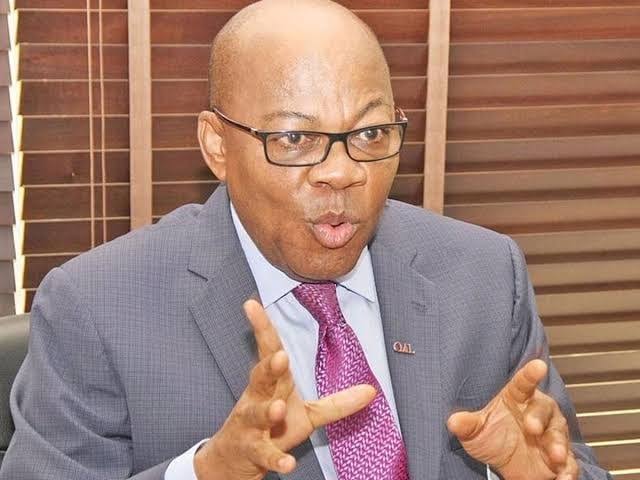
In this interview, former Nigerian Bar Association, NBA, President, Dr Olisa Agbakoba, SAN, examines the state of Nigeria’s judiciary, 66 years after independence. He discusses public confidence in the courts, conflicting judgments, judicial appointments, funding, executive influence and the reforms needed to strengthen justice delivery. He also calls for greater autonomy for the NBA and a constitutional approach to the relationship between religion and the state.
Disgraceful conflicting judgements that taint courts reputation
66 years after independence, how would you assess the Nigerian judiciary, today, particularly when compared with the past?
Generally speaking, I am not giving my personal view. I am giving the view of what I see the public saying. It seems to me that the perception of the public is that there is low performance on the part of the judiciary. They judge that from what they see as too much interference and uncertainty in the decisions of the courts, particularly in election petition cases.
The public perception is that it is not the place of the judiciary to determine political office holders, such as the President, governors and senators. It is the duty of the people who elect them. But it seems now that the judiciary has taken over that function, and everybody turns to the judiciary to ask, “Who will they elect?” That is not their function.
The judiciary should resist the invitation to be lured into becoming an electoral umpire. That is not its function. There are cases I have seen where a judge would take a case and you would ordinarily wonder: “Why is this case here? I am sitting in Jigawa, and this matter concerns a party dispute in Onitsha. Why is it here?”
Those are the issues. I think there is a lot that needs to be done to restore public confidence in the judiciary because there are so many fine judges on the bench. There are so many brilliant and distinguished judges serving today. But whether we like it or not, there is a very strong perception by the public that something is wrong.
What, in your view, are the major factors responsible for this perception, particularly the conflicting judgments that have become a concern?
There are two reasons for that. One is the public perception that judges are no longer following their oath and are influenced by considerations other than judicial considerations. Whether that is so or not, I don’t know.
But I have seen evidence of cases that look alike and should be decided alike, yet they receive different decisions.
The second problem has to do with competence. To be a judge is not an easy thing. You have to demonstrate competence. In the old days, when my father was around, there were competent people who did not apply for the job.
In fact, I know that the first Northern lawyer, Alhaji AbdulRazaq, the father of the current governor of Kwara State, declined to become a judge in 1969. They asked him and he said, “I just can’t afford to be a judge. How much are you going to pay?”
That was the quality of the time. It wasn’t a matter of being forced into it. People who wanted to be judges had already made successful careers as lawyers. They didn’t have the temptation to go there to make money. I don’t know if you can speak of that criterion today.
Appointment of judges
In the appointment of judges, it is very important that we talk about competence. If you do not have criteria for competence, then anybody can become a judge.
I have appeared before judges whom I am shocked by how they became judges. If a judge doesn’t understand the rudimentary rules of the law of evidence, how to decide cases or the substantive issues involved, then he will give poor-quality decisions. All these factors have brought into the public mind a very low perception of judges, and that needs to be turned around.
How, then, should judges and justices be appointed to ensure competence and integrity?
The appointment process should be transparent. I sat on the National Judicial Council, NJC, and we set up criteria for appointment. Unfortunately, those criteria are not being followed. I don’t know whether you are familiar with the objection process in churches when a couple wants to get married.
That is the way we should appoint judges. Put it in the newspaper: “The following 10 people have applied to be judges in the Anambra State High Court. Anyone who has any complaint or anything against them, please say so.” Put them through public scrutiny so that anything we have against them will be put on the table. I think that is a very important filter.
If the NJC criteria for the appointment of High Court judges, Court of Appeal justices and Supreme Court justices are followed, I think it will go a long way towards dealing with the problem we have. But they are not being followed. That is the problem.
Beyond the appointment process, what role should the NJC play in addressing conflicting judgments and other problems affecting the judiciary?
The problem with the NJC goes back a long way. The composition of the NJC makes the Chief Justice of Nigeria the almighty power. When I sat on the NJC, nobody could challenge the CJN. Nobody. Because he appoints virtually everybody.
The only CJN I can say tried to deal with the structural issues of the NJC was the late Dahiru Musdapher. When he became CJN, he constituted a high-powered 29-man panel to look at all these issues. The main thing we said was that if the NJC structure continued to be what it was, then we cannot have a great judicial policy.
Unfortunately, the late Dahiru Musdapher was only six months in office. He was the shortest-serving CJN in Nigerian history. Immediately he retired, all the reforms died. He appointed me to create model rules for the speedy administration of justice, but till today, not one person has remembered what the late Justice Musdapher put in place.
The NJC continues to be a body that doesn’t have any staff. It is unbelievable. We are all ex-officio members. The law says there are five NBA members and judges from the six geopolitical zones, and they are all appointed by the CJN. But what about the quality of people who work in the NJC?
There is nobody. So, they don’t deal with high judicial policy. There is no thinking about the concept of how to speed up justice. The only CJN I recall who was worried about that was Justice Dahiru Musdapher.
Is the lack of a clear response to conflicting judgments also responsible for the public’s concerns about the judiciary?
The only issue where speed of justice has relevance is politics. If it is the National Assembly where politicians have an interest, they have created a very fast timeline. Six months and it must be finished.
What about commercial cases? What about people on trial for murder who sit on death row for 30 years? When I was a political prisoner in Enugu under Abacha, I met two or three people on death row. One was an 80-year-old man who had been on death row for about 45 years.
Nobody cares. The only interest we see in speed is political cases because politicians have an interest. But the NJC ought to have an interest in saying: “If cases don’t go fast, nobody will be interested in going to the courts.”
All these rule-of-law things you see are just hype. We need to see a very active NJC. You mentioned conflicting decisions. Has the NJC ever made a statement on it? Has it ever said to judges, “why do you keep giving conflicting decisions?”
Nobody can tell what exactly constitutes a pre-election matter. Even me, at 50 years at the Bar, I am not sure that if a client comes to me and asks, “what exactly is a pre-election matter,” that I know.
There are too many conflicting decisions. In what cases can the courts determine to remove the chairman of a political party? I don’t know.These very basic issues heat up the polity.
You have mentioned the need for speedy justice. What specific changes would you like to see in the way courts operate?
The NJC and the constitutionally mandated organ to deal with judicial policy ought to do more about the speed of justice. You have to look at the rules of court and how the courts work.
Why are judges still handwriting and taking things down in longhand in today’s technological, digital age?
If Mr Justice Jones, who sat in the High Court of Lagos in 1830, were to come back to life today, he would recognise the system and say there has been no change. The entire architecture that underlies the way the legal profession works needs a complete overhaul.
Another issue is the relationship between Sharia law and Nigeria’s general legal system. What are the constitutional implications of the continued operation of Sharia alongside the general legal system?
The problem is the failure to observe Section 10 of the Constitution. When Sharia law first started in Zamfara, I led a strong team. We lost the case. We argued that the state could not declare that Zamfara was a Sharia state because it conflicted with the doctrine of separation of religion from the state.
Nigeria is a secular state. Nigeria is not a secular state for nothing. It does not mean Nigeria ceases to be a religious country. It means that religion is a private matter. It is in the Constitution.
But the Constitution is not obeyed. That is the problem. If the Constitution were obeyed, a lot of these conflicts around religion would have been dealt with. That is why I raised the issue that government should not sponsor pilgrimages to Mecca or Jerusalem. There should be nothing like Christian pilgrimage.
People criticised me for saying that, but that is what the Constitution says. The problem is that the Constitution is not being obeyed. There is no compliance with the Constitution.
How can the judiciary be insulated from executive influence, particularly through funding and infrastructure?
It goes back to the NJC. I sat on the NJC and raised this point: the Constitution confers on the NJC a funding structure. But the problem is that the funding structure set out in the Constitution is not being obeyed, and the NJC has not really pushed to have it obeyed.
I went to court. I went to three courts and I won all three cases. I raised the issue in the NJC that it has the power to determine its budget. Why doesn’t it take that power? At that time, it was Justice Aloma, the first female CJN.
I thought, since nobody would do it, I would do it. I won the cases establishing that the judiciary does not depend on the executive to be funded. Unfortunately, the effort I made and the decisions of the courts have not been implemented.
The NJC itself has not helped matters. Neither has the Supreme Court helped matters. There was a case before the Supreme Court on the funding mechanism of the Parliament, the executive and the judiciary. By Section 162(9) of the Constitution, the makers of the Constitution set out parameters for funding. The justices of the Supreme Court said that provision was unconstitutional.
That was shocking to me. Judges said that the way they should get money was unconstitutional. My predecessor, Alegeh, after he had been NBA president, went back to the Supreme Court and we again raised the issue that the Supreme Court does not have the power to declare the Constitution unconstitutional. It cannot, unless the National Assembly amends it.
The NJC sends an estimate to all branches of the judiciary across Nigeria. They gather together what is called an estimate and it is sent to the National Assembly for appropriation, not to the executive.
But what is going on now is that the NJC sends it to the executive, and somebody in the Ministry of Finance may then decide that the judiciary’s budget will be, for example, N100 billion. That is not their job. It is the job of the NJC to determine its budgetary allocation. That is the problem. And that is why Wike is building houses for them and they are gratefully accepting them. Is that his job?
It is the job of the judiciary to create a budget where it takes care of itself—its salaries, housing and courts. If a judge has collected a house from the executive, the public perception becomes: “Can this man really do justice in my case?”
You have raised concerns about judicial autonomy. What reforms would you prioritise to address these problems?
I would focus on the competence of a judge being properly weighed and subjected to public scrutiny. That is the area I would focus on, so that the person who becomes a judge is entitled, not only in law but by public confidence, to be called a judge.
Once the quality of a judge goes up, the judge is not interested in who you are. He does his job without fear or favour, then we are good. But if the judge is influenced by what he is going to get or fear of executive condemnation, then we don’t have a judiciary.
That is the most important thing: the quality of the individual judge sitting on the bench. You know what it was to be a judge in the old days? A judge was seen as a god. My father was Chief Justice, and you couldn’t just come to our house. Who were you to approach our house?
Even the Commissioner of Police in Enugu at that time couldn’t just come and see my father. He would come to the gate and sign the visitors’ book, saying, “My Lord, I am here to ensure that your safety and security are secured,” and he would go away.
My father never went to any social function. There was total seclusion. Today, it is strange. So, we need to go back to the period when a judge was found worthy in character and learning to occupy the bench.That would be my priority.
Apart from the quality of judges, what other reforms would you like Nigerians to see?
Funding. Judges must be free from executive control of their funding. They must be totally free. The constitutional provision that provides the framework for funding the judiciary should be a top priority. I should not need Wike to build me a house, nor should I need the executive to assign a budget for me to build courts. Once the judiciary controls its budget, that is the second important thing.
With quality judges and proper funding, I think you will see that judges will not be afraid. The words “without fear or favour” are very heavy words. The reason judges of old could dispense justice without fear or favour was because they were protected. They didn’t have anything to lose, either in terms of their emoluments or whatever.
There was a judge in a case in Benin who gave a decision adverse to the interest of the government. He was transferred from Benin to Maiduguri as punishment. Other judges would see what happened to him and become afraid. So, judges must be able to do their work without fear or favour. The Constitution needs to guarantee their tenure of office.
Look at how Justice Onnoghen, the CJN of Nigeria, was removed and nothing happened. Yet, the Constitution gives him protection. I was the one who defended him at the NJC trial against the way he was removed.
Finally, as a former NBA President, you have also called for greater autonomy for the legal profession. What changes would you like to see in the NBA?
I don’t even sit on the body that disciplines lawyers, yet I am their president. It is ridiculous. So, please don’t assume that the NBA is what you think it is. It has a powerful voice, but I think two things should happen.
Either the system should free the NBA and allow it to operate like ICAN. ICAN controls its own examination. There is no law school for ICAN; it has its own examination process and nobody controls it.
For us, everybody goes to law school. The NBA is too constrained by government bureaucracy and, as a result, it is not anywhere near as influential as people think. That is why, for me, the NBA cannot do much unless to play an advocacy role. But I want the NBA to have the sort of power that its equivalent in London has.
If a lawyer misbehaves in the United Kingdom, you complain to the professional body. If it finds that your complaint is justified, it can impose the relevant punishment, including striking the lawyer’s name off the roll.
But in Nigeria, by the time you go through the hierarchy and get to the Legal Practitioners Disciplinary Committee and all of that, the whole process is muddled in statutory bureaucracy.
We should regulate ourselves. Everything about the law profession should be done by us, not the government.We should determine the curriculum that lawyers require. We should determine the discipline that is required. We should determine the excellence that we will bestow on those found worthy of it. That is when you will have a strong NBA.
When there is misconduct, the decision should be taken at the local bar. If a lawyer in Lagos misbehaves, the Nigerian Bar Association, Lagos Branch, should be able to deal with it.
Source:Vanguard
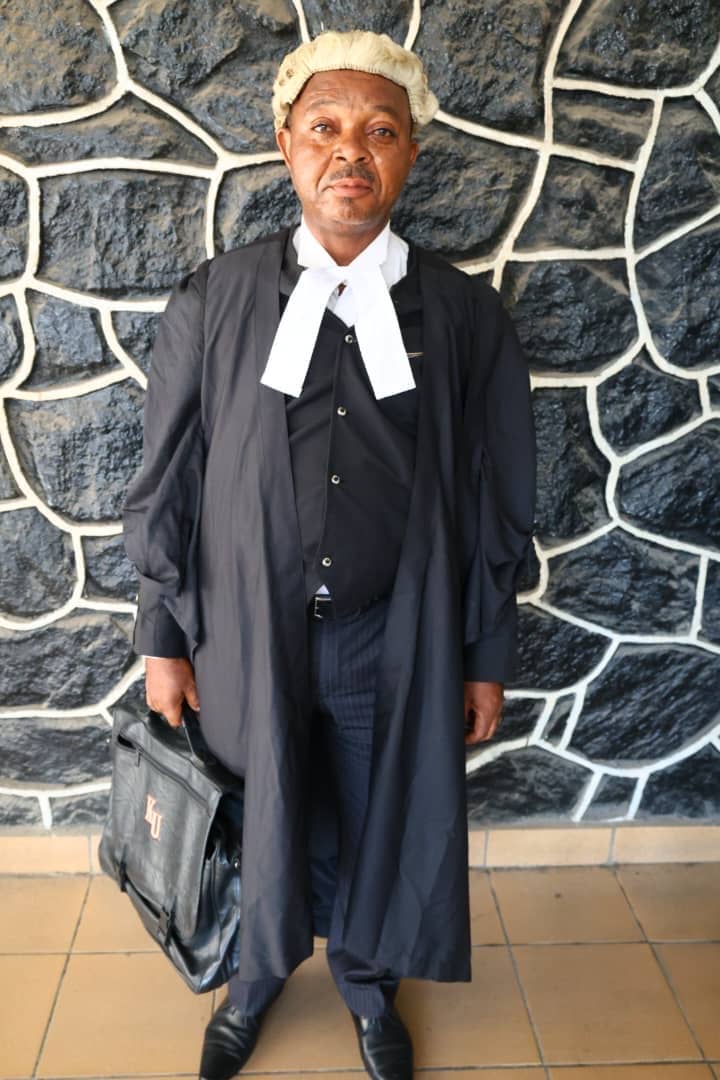
–Does legal and educational consultancy in Ikorodu, Lagos
By Seyi Balogun, Lagos
A fake lawyer, John Nwawuto Anoruo, has been convicted and sentenced for impersonation and possession of a forged seal of the Nigerian Bar Association, NBA by
Justice A.M. Lawal of the Lagos State High Court sitting in Ikeja, Lagos, on Tuesday, August 4, 2026.
Anoruo, who runs legal and educational consultancy office in the Ikorodu area of Lagos, was arrested by operatives of the EFCC on Monday, April 20, 2026.
His case began after he submitted a petition dated September 22, 2025, to the EFCC on behalf of his clients against the management of Global West Vessel Specialist Nigeria Limited.
Investigations, however, revealed that both the petition and a subsequent Letter of Withdrawal dated March 5, 2026, bore a forged NBA seal, which Anoruo admittedly obtained from an undisclosed business centre in Lagos.
In the course of investigations, the 55-year-old claimed that although he obtained a law degree in 2018 from the University of Nigeria, Nsukka, through evening classes, he did not attend the Nigerian Law School.
Upon the conclusion of the investigation, Anoruo was arraigned on Tuesday, August 4, 2026, by the Lagos Zonal Directorate 2 of the EFCC on a two-count charge bordering on the use of a counterfeit NBA seal and impersonation.
One of the counts reads:
“That you, JOHN NWAWUTO ANORUO, sometime between 2025 and 2026, within the jurisdiction of this Honourable Court, fraudulently used a counterfeited seal titled ‘Nigerian Bar Association’ with Supreme Court Number SCN037400, with intent that same be acted upon as genuine and thereby committed an offence contrary to Section 366(1) and punishable under Section 365(1)(x) of the Criminal Laws of Lagos State, 2015.”
The second count stated that the defendant, on September 4, 2025, falsely represented himself to the Economic and Financial Crimes Commission as a legal practitioner duly certified to practice law in Nigeria and as the holder of a Nigerian Bar Association seal bearing Supreme Court Number SCN037400, which lawfully belonged to another legal practitioner, thereby committing an offence contrary to Section 382 of the Criminal Law of Lagos State, 2015.
He pleaded “guilty” to the charges preferred against him.
Following his plea, prosecution counsel, Saadatu Mahmud Yabo, called Umar Faruk Ahmad, an investigating officer with the EFCC, to review the facts of the case.
In his testimony, Ahmad told the court that the Commission, on April 15, 2026, received a petition dated April 14, 2026, from a legal practitioner, Adeyinka Olumide-Fusika.
According to the witness, the petitioner alleged that Anoruo had filed a petition against him and his law firm while falsely presenting himself as a legal practitioner.
Ahmad stated that investigations revealed that the Supreme Court enrolment number on the NBA seal used by the defendant belonged to another legal practitioner.
He further informed the court that the defendant admitted obtaining the counterfeit NBA seal from a business centre in Lagos and confirmed that he was not called to the Nigerian Bar.
The witness also disclosed that the defendant earned N7,500,000.00 (Seven Million, Five Hundred Thousand Naira) from the legal brief in question, out of which he paid N1,500,000.00 (One Million, Five Hundred Thousand Naira) to a qualified legal practitioner to handle the matter on his behalf.
Ahmad further testified that when the defendant honoured the EFCC’s invitation, he came to the Commission’s office with a legal practitioner’s attire, adding that a subsequent search of his residence led to the recovery of the counterfeit NBA seal bearing the Supreme Court enrolment number of another lawyer.
Through the investigating officer, the prosecution tendered in evidence the petition written by Olumide-Fusika; the defendant’s extra-judicial statement made under caution; investigation letters sent by the EFCC to the Body of Benchers and the Supreme Court of Nigeria, together with their responses; the legal practitioner’s attire recovered from the defendant; the counterfeit NBA seal; and evidence of a N300,000.00 (Three Hundred Thousand Naira) bank draft paid by the defendant into the EFCC’s recovery account.
The witness also identified the legal practitioner’s attire produced before the court as the same one the defendant brought to the EFCC’s office during interrogation.
The defence counsel, G.E. Demkemefa, raised no objection to the admissibility of the exhibits, following which Justice Lawal admitted and marked them as Exhibits 1 to 9.
During his allocutus, the defendant informed the court that he paid N2,500,000.00 (Two Million, Five Hundred Thousand Naira) to the individual who introduced the legal brief to him and N1,500,000.00 (One Million, Five Hundred Thousand Naira) to the lawyer he engaged to handle the matter.
Yabo thereafter urged the court to convict and sentence the defendant in accordance with his guilty plea.
She also prayed the court to order the forfeiture of all the exhibits to the Federal Government of Nigeria.
Delivering his judgment, Justice Lawal held that “In view of the plea of the defendant, the defendant is hereby convicted on the two counts.”
The defence counsel, thereafter, pleaded with the court to temper justice with mercy, describing the defendant as a first-time offender who did not waste the time of either the EFCC or the court.
He added that the defendant “is the breadwinner of his family, comprising his wife and five children,” and urged the court to impose the option of a fine rather than a custodial sentence.
Justice Lawal subsequently sentenced the defendant to a fine of N120,000.00 (One Hundred and Twenty Thousand Naira) on count one and N150,000.00 (One Hundred and Fifty Thousand Naira) on count two, bringing the total fine to N270,000.00 (Two Hundred and Seventy Thousand Naira), payable to the Lagos State Judiciary.
The court also ordered that the legal practitioner’s attire and the forged NBA seal recovered from the defendant be forfeited to the Federal Government of Nigeria through the EFCC.
By Felix Umande, Makurdi
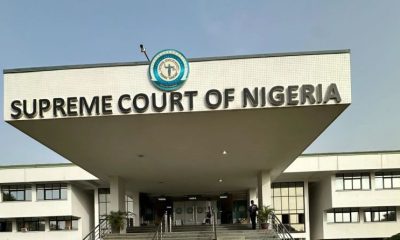
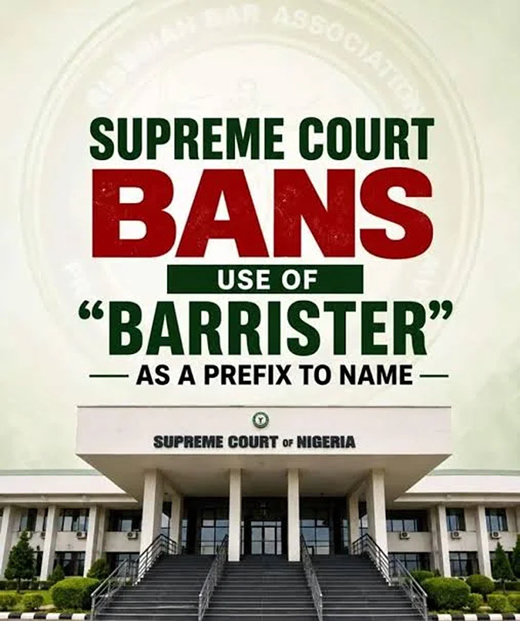
The Chief Justice of Nigeria, Justice Kudirat Kekere-Ekun, has directed all lawyers and court officials to immediately stop using the title “Barrister” as a prefix to their names in official dealings at the Supreme Court.
The directive was contained in a memorandum dated July 13, 2026, signed by the Chief Registrar of the Supreme Court, Kabir Akanbi.
Addressed to litigation staff, legal practitioners, court registrars and lawyers, the circular said the measure was part of efforts to uphold professional standards within the apex court.
“I am directed by the Honourable Chief Justice of Nigeria to notify all Litigation Staff, Legal Practitioners, Court Registrars, and Lawyers that the use of the title ‘Barrister’ as a prefix to names is inappropriate and inconsistent with the standards of professionalism expected within the Supreme Court of Nigeria,” the memo read.
The memorandum directed all affected officers to discontinue the use of “Barrister” before their names in official correspondence, court records, documents, identity materials, and any other official engagement “with immediate effect.”
“Heads of Departments and Unit Heads are requested to ensure strict compliance with this directive by all officers under their supervision. Please be guided accordingly,” it added.
The Supreme Court’s order comes weeks after the Council of Legal Education warned prospective lawyers against wearing wigs and gowns or presenting themselves as qualified legal practitioners before they are formally called to the Nigerian Bar.
The council said such conduct undermined the dignity of the legal profession and warned that violators could face disciplinary measures. It also reminded candidates that the use of legal regalia is governed by the Rules of Professional Conduct and is reserved for duly qualified legal practitioners.
Legal analysts say the CJN’s directive reinforces the distinction between qualification and title, and seeks to align courtroom decorum at the Supreme Court with global best practice, where “Barrister” is not used as a formal prefix.
The Supreme Court did not indicate any sanctions for non-compliance, but heads of departments have been tasked with enforcing the new rule.


100 Days To 2027 Polls: INEC Vows Neutrality, Says BVAS, Ballots Ready
Spread the loveBy Felix Umande The Independent National Electoral Commission, INEC, has assured Nigerians and the international community of its...


THE LAST TANGO: Tears, Tributes and A Final Goal As Messi Bows Out After 21 Years
Spread the loveBy Felix Umande Emotions ran high at the Estadio Monumental on Tuesday night as Lionel Messi signed off...

Church’s Duty to Empower Individuals, Create Opportunities and Improve Family’s Economic Well-being
Spread the loveBy Seyi Balogun, Lagos The need for the Church’s commitment to empowering its members through employment opportunities, entrepreneurship...
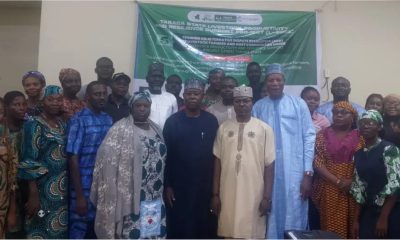

Taraba Explores ADR for Sustainable Peace Between Crop, Livestock Farmers
Spread the loveBy Michael Lim Conflict prevention between livestock farmers and host communities in Taraba State through the promotion of...
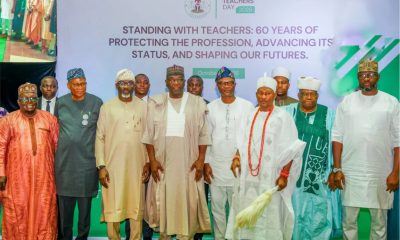

Financial Inclusion: Kwara Buys Dangote Refinery Shares For Female Teachers
Spread the loveBy Michael Lim Kwara State Government has announced plans to buy shares in the Dangote Refinery Initial Public...

Benue Govt Gives 2-Week Ultimatum To Owners Of Illegal Billboards, Threatens Mass Removal
Spread the loveBy Felix Umande The Benue State Government has decried the arbitrary erection of billboards across the state by...


INEC Tracking Illegal Campaign Spending
Spread the love–Tells Editors: “remain primary filter against information disorder.” By Son Tertsea, Abuja The Independent National Electoral Commission (INEC)...


Importers, Petroleum Marketers Kick Against Dangote’s Restriction of Petrol Sales
Spread the loveBy Seyi Balogun Major marketers have kicked against Dangote Petroleum Refinery’s non sale of Premium Motor Spirit (petrol)...

Jim Ovia Counsels: Nigeria must not Sacrifice Quality for Quantity in Tertiary Education
Spread the loveBy Seyi Balogun, Lagos Nigeria must not allow the size and the number of universities to come at...


Unidentified, Mutilated Corpse of Man Found Behind Pankshin Market in Plateau
Spread the loveBy Michael Lim, Jos On Tuesday morning, the corpse of an unidentified man was found behind the Monday...